
GPT-6 Astra is OpenAI’s top model, and the question most people ask about it is not how smart it is but whether their plan has it. Here is the short answer, from OpenAI’s own model help page: ChatGPT Plus at $20 a month gets Astra in ChatGPT Work and Codex only. Astra in the regular chat box, as GPT-6 Pro, starts with Pro at $100 a month. Free and Go do not get it at all.
Then there is the chess. A GothamChess video titled “GPT-6 Astra Solved Chess. Unbelievable.” passed close to a million views in about a day. It shows one game, and the human won. This guide separates what OpenAI says from what was reported, checked against OpenAI’s pages on October 13, 2026. Nothing here is a first-hand report: every feature is described the way OpenAI, Epoch AI or GothamChess describe it.
⚡ TL;DR: GPT-6 Astra in 2026
🤖 What it is: OpenAI’s most capable model, introduced September 3, 2026. In the chat box it appears as GPT-6 Pro.
💳 Price: No separate price. Plus at $20 a month gets it in Work and Codex only; Astra in the chat box starts with Pro at $100 a month. Free and Go do not get it.
🎯 Best for: Plus subscribers who work in Codex or ChatGPT Work, and Pro subscribers who want the strongest model in chat.
💡 Our take: it depends on your plan. Strong by independent measures, but not a reason on its own to jump from $20 to $100.
⚠️ The catch: Plus gets an estimated 5 to 45 Astra messages per five hours, and chess is not solved: the viral video shows one game, which the human won.
📑 Quick Navigation
🎯 The Bottom Line
GPT-6 Astra is real, strong and gated. OpenAI introduced it on September 3, 2026. The independent group Epoch AI ranks it second of 257 models it tracks. On Plus you get it in Work and Codex, where OpenAI estimates 5 to 45 Astra messages per five-hour window. Astra in the chat box costs $100 a month, five times Plus. Our ChatGPT review covers the wider plan picture, and our Codex review covers where Plus users actually meet Astra.
Best for: Plus subscribers who code or run long tasks in Codex or Work, and Pro subscribers who want the strongest model in the chat box.
Skip if: you only chat, or you are thinking of paying $100 a month because of a chess video. Chess is not solved, and OpenAI never said it was.
🧠 What GPT-6 Astra Actually Is
GPT-6 Astra is the most capable model in OpenAI’s GPT-6 family, above GPT-6 Sol and GPT-6 Luna. OpenAI’s launch page calls it “the world’s most intelligent and aligned model” and pitches it at hard, multi-step work: coding, research, computer use and polished documents, spreadsheets and slides. OpenAI’s own example is the dull office work most of us put off, such as filling out online forms, updating customer records or organizing a calendar.
Think of the GPT-6 family as three staff members. Luna is the quick assistant for short jobs, Sol is the reliable all-rounder, and Astra is the senior expert OpenAI pitches for the hardest problems. You get fewer hours of the expert’s time, which is exactly how OpenAI rations Astra on cheaper plans.
OpenAI also shows off scores. It says Astra “saturates FrontierMath Tier 4 with a 98% score” and ARC-AGI-3 “with a 99.9% score”. Those are OpenAI’s own results, and the small print matters: “Evaluation scores are the maximum at any effort”, run in OpenAI’s research environment or API, which OpenAI says may give slightly different output from the ChatGPT you use.
OpenAI says Astra can also build things for you. With Sites in ChatGPT, Astra “can create, host, and share websites, web apps, and games directly from a prompt.” And it comes with extra caution: OpenAI says added safety checks can sometimes slow, pause or stop legitimate work, and a paused task in ChatGPT or Codex may ask you to review the action before it continues.
🔍 REALITY CHECK
The claim: “We’re introducing GPT-6 Astra, the world’s most intelligent and aligned model.”
The fine print: Epoch AI, an independent research group, gives Astra a capabilities score of 166 and ranks it 2nd of 257 tracked models today. It ranked 1st when it was released. Claude Fable 5.1 is one point lower at 165, another model now scores 167 on Epoch’s index, and OpenAI’s own benchmark scores are “the maximum at any effort”.
✅ Verdict: A top-tier model by an independent measure, but “most intelligent” is OpenAI’s framing, and Astra is now 2nd on Epoch’s index, where the gaps at the top are small.
🔑 Who Can Use GPT-6 Astra: Plan by Plan
This is where most of the confusion comes from. Astra shows up in two different places inside ChatGPT, and your plan decides which ones you get:
- The chat box, where Astra appears as GPT-6 Pro when you move the thinking slider to Pro. OpenAI says GPT-6 Pro is “powered by GPT-6 Astra”.
- ChatGPT Work and Codex, the agent and coding side of ChatGPT, where Astra appears by name in the model picker and draws on a shared usage allowance.
OpenAI’s usage article puts the split in one sentence: “Plus includes Astra in Work and Codex, but not GPT-6 Pro in Chat.” On Plus, the chat box runs GPT-6 Sol at every thinking level, according to OpenAI’s October 7 release notes. Here is the whole picture:
| Plan | Price (USD a month) | Astra in the chat box | Astra in Work and Codex | Ultrafast |
|---|---|---|---|---|
| Free | $0 | No | No | No |
| Go | $8 (US) | No | No | No |
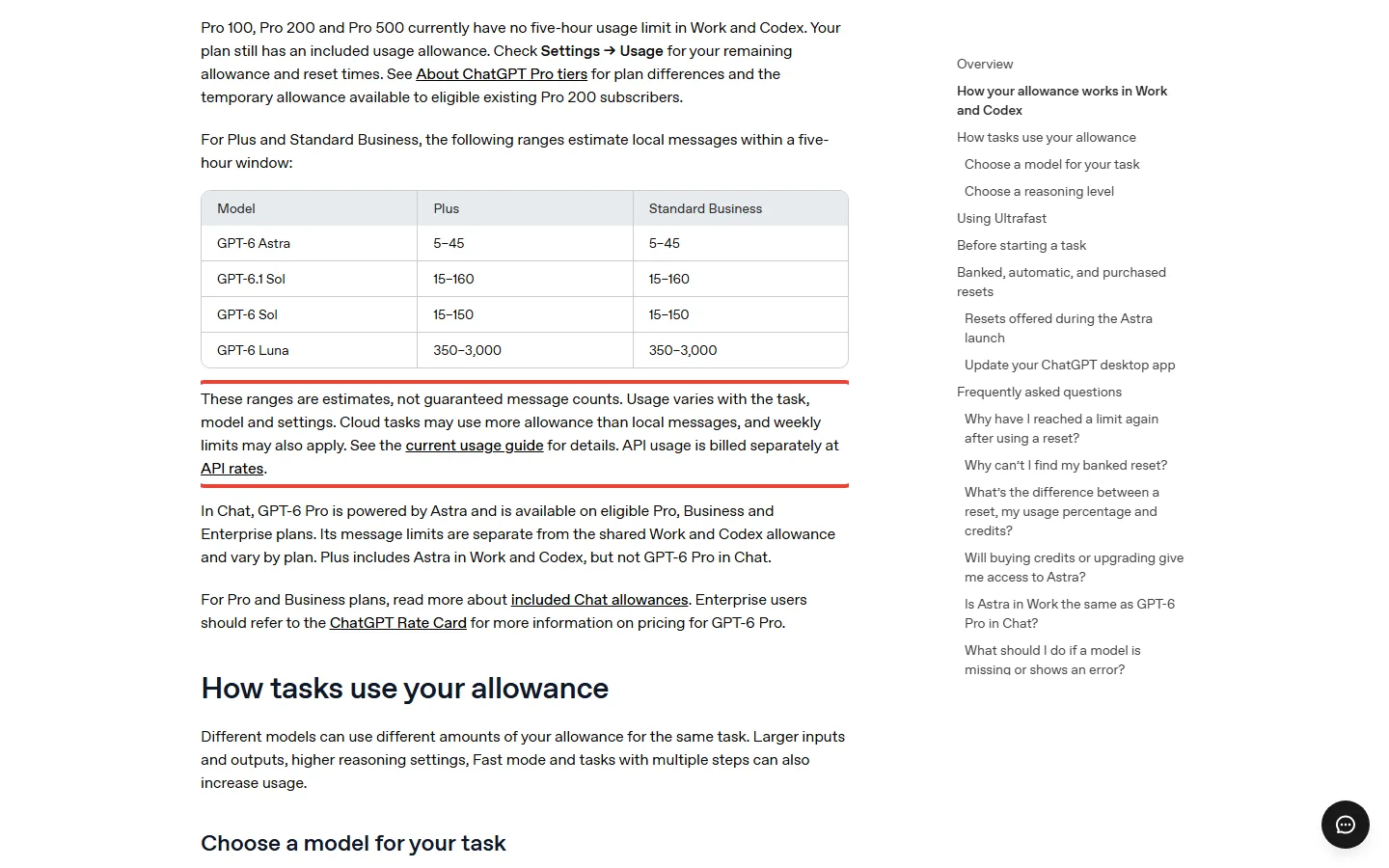
| Plus | $20 | No (chat uses GPT-6 Sol) | Yes, about 5 to 45 messages per 5 hours (OpenAI’s estimate) | No |
| Pro 100 | $100 | Yes, as GPT-6 Pro (weekly limit) | Yes, no five-hour limit for now | No |
| Pro 200 | $200 | Yes, as GPT-6 Pro, more usage | Yes, no five-hour limit for now | No |
| Pro 500 | $500 | Yes, Pro plans include Astra in Chat | Yes, highest included usage | Yes |
| Business | Not covered here | Yes, on eligible plans | Yes (Standard seats: 5 to 45 per 5 hours) | No |
| Enterprise | Not covered here | Yes, once an admin turns it on | Yes, once an admin turns it on | Eligible workspaces, paid from credits |
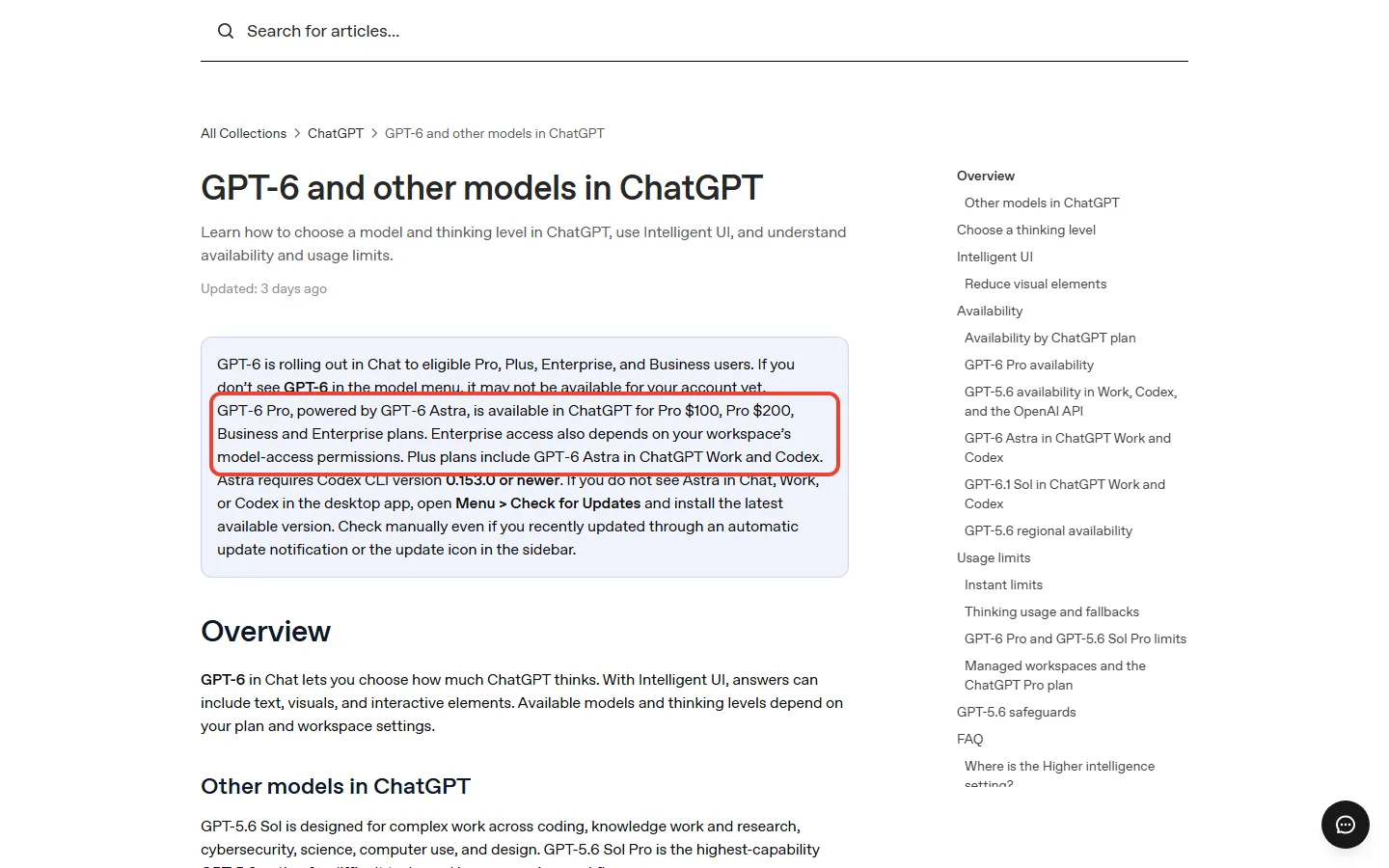
Two details are easy to miss. First, OpenAI’s sentence about GPT-6 Pro names Pro $100 and Pro $200 but not Pro $500, while the same page says “Your Pro plan includes GPT-6 Astra in Chat, ChatGPT Work and Codex.” If you are on Pro 500, the model picker is the final word. Second, Free and Go are not in OpenAI’s launch list, and the plan table on chatgpt.com shows a dash for GPT-6 Astra on both. Our guide to free AI plans covers what Free and Go do include.
What Your First Five Minutes Look Like
Here is what the first five minutes with Astra look like, going by OpenAI’s own help pages:
- Find it: on Plus, open Work or Codex and pick GPT-6 Astra in the model picker. If it is missing in the desktop app, OpenAI says to open Menu, then Check for Updates, and to check again after restarting. The Codex command-line tool needs version 0.153.0 or newer. On Pro, pick GPT-6 in the chat box and slide the thinking level to Pro.
- Pick an effort level: OpenAI suggests starting low. Its usage article says “Astra at Low effort can outperform Sol at High effort”, and that higher effort uses more of your allowance without always giving a better answer.
- Check your meter: Settings, then Usage, shows your remaining allowance and reset times. On Plus, OpenAI says larger inputs, higher effort, Fast mode and multi-step tasks all use more, and you can hit the five-hour limit before five hours have passed.
Put together, on Plus those first five minutes are mostly about rationing: a few hard questions at Low or Medium effort will go a lot further than one sprawling task at the highest setting.
🔍 REALITY CHECK
The claim: “Plus plans include GPT-6 Astra in ChatGPT Work and Codex.”
The fine print: OpenAI estimates 5 to 45 Astra messages per five-hour window on Plus and adds: “These ranges are estimates, not guaranteed message counts.” Cloud tasks may use more, weekly limits may also apply, and the chat box on Plus does not use Astra at all.
✅ Verdict: True, but Plus gets a small, variable ration of Astra in two places, not Astra everywhere.
💳 GPT-6 Astra Price: What You’ll Actually Pay
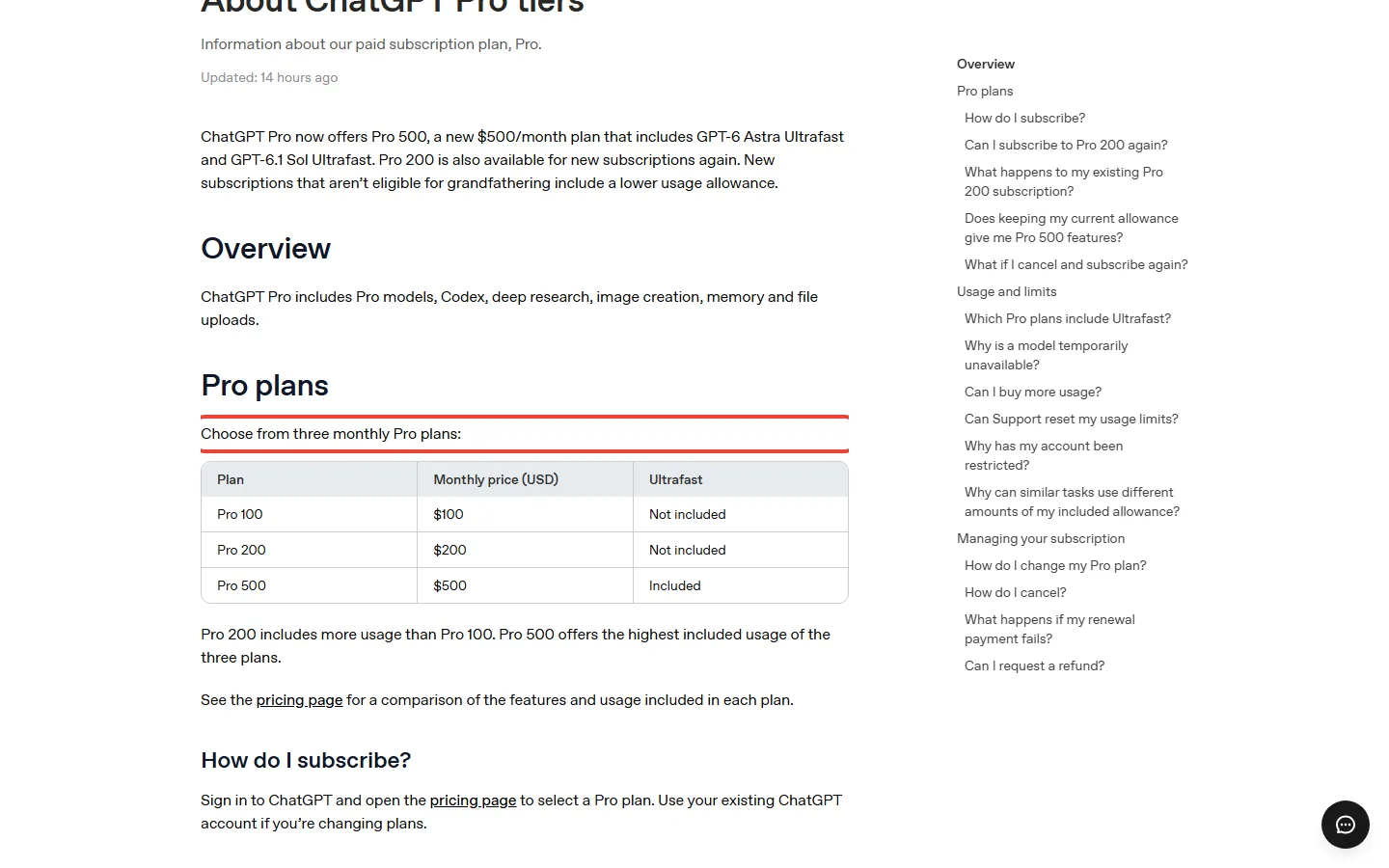
There is no separate GPT-6 Astra price in ChatGPT. OpenAI says Astra usage “is included within the existing subscription allowances”, so the price of Astra is the price of your plan. OpenAI’s Pro tiers page lists three monthly Pro plans: Pro 100 at $100, Pro 200 at $200 and Pro 500 at $500. Plus is $20 a month. Neither Plus nor Pro offers annual billing, so there is no yearly discount to chase.
| Plan | Per month | Per year (monthly billing) | Where you get Astra | The limit that bites |
|---|---|---|---|---|
| Plus | $20 | $240 | Work and Codex | About 5 to 45 messages per 5 hours, plus possible weekly limits |
| Pro 100 | $100 | $1,200 | Chat box, Work and Codex | GPT-6 Pro shares one weekly allowance with GPT-5.6 Sol Pro |
| Pro 200 | $200 | $2,400 | Chat box, Work and Codex | At the GPT-6 Pro weekly limit, chat switches to GPT-5.6 Thinking |
| Pro 500 | $500 | $6,000 | Everywhere, plus Ultrafast | Ultrafast uses your allowance at 8 times the Standard rate |
The real-world cost math:
- Astra in the chat box: Pro 100 at $100 is 5 times Plus at $20, so $80 more a month or $960 more a year.
- Per message on Plus: OpenAI does not publish a fixed number, so no honest per-message price exists. The 5 to 45 range is a ninefold spread, which tells you how much your tasks matter.
- Through the API: $10 per million input tokens and $50 per million output tokens. A request with 10,000 tokens in and 2,000 tokens out costs $0.10 + $0.10 = $0.20 at Standard rates. Fast mode doubles that to $20 and $100 per million.
💸 What a Year of Each ChatGPT Plan Costs, and Where You Get Astra (USD, Monthly Billing)
A token is a chunk of a word, so a million tokens is a lot of text, but long documents and agent tasks go through them quickly. The API is billed separately from any ChatGPT plan, and OpenAI says separate rates apply to cache reads and writes.
💡 Key Takeaway: Astra has no price of its own in ChatGPT. If you work in Codex or ChatGPT Work, Plus already gets you Astra; the $80 a month step to Pro 100 buys Astra in the chat box and no five-hour limit in Work and Codex.
Hidden costs to know about. When your allowance runs out, OpenAI lets you buy credits for eligible usage in Codex, ChatGPT Work and the Word, Excel and PowerPoint add-ins, but its usage article is blunt: “Credits pay for usage; they do not add model access.” Buying credits on Plus will not get you GPT-6 Pro in the chat box, and buying credits on Pro 100 or Pro 200 will not unlock Ultrafast. Eligible personal Plus and Pro accounts can also buy an instant reset of the Work and Codex allowance, depending on account and billing country.
One time-bound detail: existing Pro 200 subscribers who qualify keep their previous, larger allowance only through October 29, 2026. New Pro 200 subscribers who don’t qualify for grandfathering get the lower allowance, and the price stays $200. Our ChatGPT Dots pricing guide covers what else Pro 100 adds, since dots run on Astra too.
📬 Tracking AI plan prices?
Get price changes and new tiers for ChatGPT, Claude and Gemini weekly. No hype, no spam.
♟️ Did GPT-6 Astra Really Solve Chess?
No. Here is what happened, what “solved” means, and what OpenAI does and does not claim.
The Viral Game, as GothamChess Tells It
On October 10, 2026, the chess YouTuber GothamChess posted “GPT-6 Astra Solved Chess. Unbelievable.” Everything below is his account of his game, not something we verified move by move.
- One game. He says he covered a single game because it took about an hour and a half, he had to reboot it, and Astra thought for two to three minutes at certain moments.
- A gift. Astra played white and opened e4. He chose the French Defence and gave up two pawns on purpose (“I got to give some odds to the LLM”). Astra took them.
- Real danger. He says Astra’s biggest advantage was plus three and a half and that he was “completely lost”, which had never happened against an earlier GPT. Had Astra played bishop to g5, he says there was “a very high chance I would have lost the game.”
- The mistake. He calls Astra’s decision to give up its light-squared bishop “a gross positional mistake”. He then won with a counterattack, finishing with checkmate on h1.
His own caveats are fair: he says he took far too many risks and played an opening he is not that familiar with, and that he may try more games. Astra’s guess at the players’ ratings was, in his words, “still complete gibberish”. His closing verdict: “it knows how to play chess now and it’s pretty good.” He does not say which ChatGPT plan, surface or reasoning setting he used.
What “Solved” Actually Means
In chess, “solved” has a strict meaning: proving the result of perfect play from the starting position. Chess.com’s tablebase explainer puts it simply: “Is chess a solved game? The answer is… partially.” Tablebases are computer databases that know the perfect-play result of every position with up to seven pieces, kings included. Eight-piece positions are being solved now, and each extra piece makes the job exponentially harder.
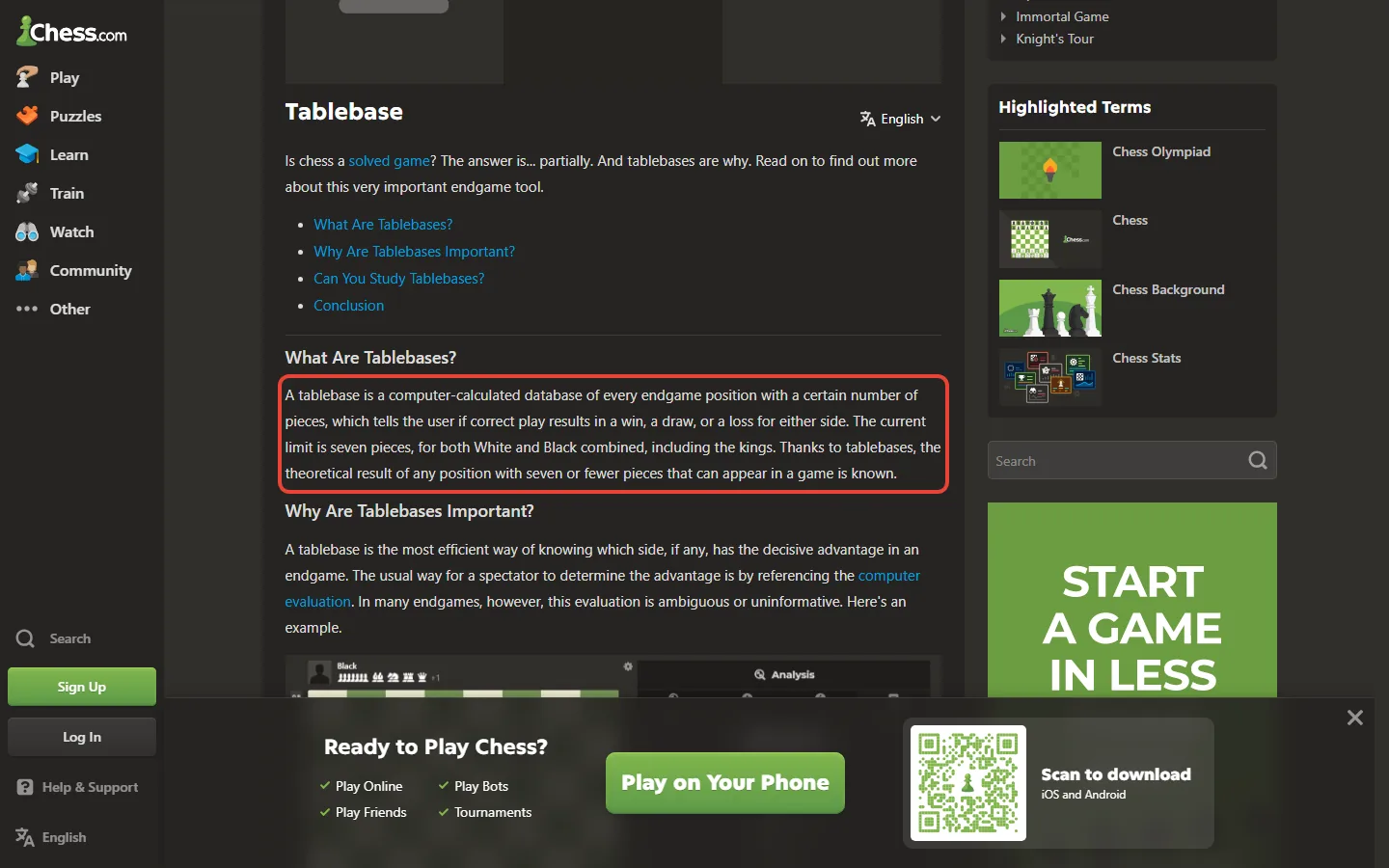
Wikipedia’s summary of the research is blunter: “No complete solution for chess in either of the two senses is known”, and none is expected in the near future. For scale, checkers was weakly solved in 2007, and it has roughly the square root of the number of positions in chess. Our view: one game, which the human won, shows strength, not a solution.
♟️ How Much of Chess Is Solved? Tablebases Stop at 7 of a Game’s 32 Pieces
What OpenAI Does and Does Not Claim
OpenAI makes no chess claim for Astra. On October 13, 2026, the word “chess” did not appear on its launch page, its two Astra help articles, its Plus and Pro help pages or its ChatGPT release notes. The “solved chess” line comes from a YouTube title, not from OpenAI.
💡 Key Takeaway: If a model “solves” chess, it has to prove the result of perfect play from move one. One game against one human, which the human won, cannot show that, however well the model played.
The best independent chess number comes from Epoch AI’s model page. On its Chess Puzzles benchmark, Astra scores 72%, the best score on the page, ahead of GPT-5.5 Pro at 64%, Claude Fable 5.1 at 47% and Kimi K3 at 39%. So Astra is the best puzzle solver among the models Epoch shows, and it still misses more than a quarter of the puzzles.
If the video makes you want to play Astra yourself, check your plan first. On Plus, the chat box uses GPT-6 Sol, so a game typed into a normal chat is not a game against Astra. In Work or Codex, our view is that a full game is dozens of moves, each one a message at a high reasoning setting, so one game could use a real share of the 5 to 45 Astra messages OpenAI estimates per five hours.
🔍 REALITY CHECK
The claim: “GPT-6 Astra Solved Chess. Unbelievable.” (GothamChess video title)
The fine print: The video shows one game, which GothamChess won after giving away two pawns. Chess.com says chess is solved only “partially”, for positions with up to seven pieces, and OpenAI’s own pages never mention chess.
✅ Verdict: Impressive play from a chatbot, not a solved game. Do not upgrade a plan because of it.
⚖️ GPT-6 Astra vs Claude and Gemini Plans
OpenAI, Anthropic and Google now sell a similar ladder: about $20 for the everyday plan, about $100 and $200 for heavy users. Here is how the rungs line up, using each company’s own US prices:
| Rung | ChatGPT (OpenAI) | Claude (Anthropic) | Gemini (Google) |
|---|---|---|---|
| Everyday plan | Plus, $20 (Astra in Work and Codex only) | Pro, $20 ($17 a month billed yearly) | Google AI Pro, $19.99 |
| Heavy user | Pro 100, $100 (Astra in the chat box) | Max 5x, $100 | Google AI Ultra 5x, $99.99 |
| Heaviest standard plan | Pro 200, $200 | Max 20x, $200 | Google AI Ultra 20x, $199.99 |
| Speed tier | Pro 500, $500 (Ultrafast) | Not covered here | Not covered here |
| Annual billing | No | Yes, on Pro | Not covered here |
On raw ability, the gap is small. Epoch AI’s capabilities index gives Astra 166 and Claude Fable 5.1 165, with GPT-5.5 Pro at 162. Where they differ is what the $20 plan gets you, and that is worth checking plan by plan: our Claude Fable review, Opus 5.5 vs Sonnet 5.5 guide and Google AI Ultra vs Pro comparison cover the other two ladders.
Winner by rung: at $20, it depends on where you work; Plus is the pick if you live in Codex. At $100, ChatGPT Pro 100 is the cheapest way to get GPT-6 Astra in the chat box. At the top, Pro 500 is built for speed (Ultrafast) and more included usage, not for a smarter model.
👥 Who Should Pay for GPT-6 Astra (and Who Shouldn’t)

Choose Plus ($20) if: you code, analyse files or run multi-step tasks in Codex or ChatGPT Work and can live with an estimated 5 to 45 Astra messages per five hours. Use Low or Medium effort first, as OpenAI suggests. Our Claude Code vs Cursor comparison helps if coding is the main job.
Upgrade to Pro 100 ($100) if: you want Astra in the chat box, or you keep hitting the Plus five-hour limit in Work and Codex. OpenAI says Pro plans currently have no five-hour limit there, though an included usage allowance still applies. A dot, OpenAI’s always-on agent, comes with Pro too.
Pick Pro 500 ($500) only if: response speed is money for you. Ultrafast and the highest included usage of the three Pro plans are what it adds, and Ultrafast burns your allowance at 8 times the Standard rate.
Skip it entirely if: you mostly chat, write emails or ask everyday questions. GPT-6 Sol already powers the Plus chat box, and OpenAI says Free includes unlimited everyday text chats, subject to abuse safeguards. If you are comparing value across brands, DeepSeek vs ChatGPT shows the cheap end of the market.
💬 What Chess Players, Benchmarkers and OpenAI’s Chosen Quotes Say
The “it can finally play” camp. GothamChess, whose earlier videos showed chatbots blundering, ends his Astra game with “it knows how to play chess now and it’s pretty good”, while calling one of its moves “a gross positional mistake” and its rating guess “gibberish”.
The “measure it” camp. Epoch AI ranks Astra 2nd of 257 models on its capabilities index, down from 1st at release, and top of the models shown on its Chess Puzzles benchmark at 72%. Epoch’s Greg Burnham is also quoted on OpenAI’s launch page: “The story is: end of one era, start of another.”
The “quoted by OpenAI” camp. The launch page quotes the ARC Prize Foundation’s Greg Kamradt saying Astra beat its human action-efficiency baseline on 96% of ARC-AGI-3 levels, “effectively reaching human parity”. Remember who chose these quotes. OpenAI itself adds a sober note: its tests found Astra’s written reasoning harder to monitor than GPT-5.6 Sol’s.
The common thread: everyone agrees Astra is strong, and nobody with evidence says it solved anything about chess.
🔭 The Road Ahead
Short term (next few weeks): the grandfathered Pro 200 allowance ends on October 29, 2026. OpenAI also says Astra’s note-keeping across long Codex sessions, now an experimental setting, will become the default “in the coming weeks”. GothamChess says he may play more games, which would tell us more than one.
Medium term (6 to 12 months): OpenAI words several limits as “currently” and “at launch”, including Pro’s missing five-hour limit and Ultrafast being Pro 500 only. Expect those to move. Based on how Epoch’s ranking has already moved from 1st at release to 2nd today, expect the top spot to keep changing hands.
Long term: chess itself will not be solved by a chatbot any time soon. Chess.com says eight-piece tablebases are still in progress. Expect the “solved” headlines to return with every new model anyway.
❓ GPT-6 Astra FAQs
Q: What is GPT-6 Astra?
A: GPT-6 Astra is OpenAI’s most capable model, introduced on September 3, 2026. In ChatGPT it powers GPT-6 Pro in the chat box and is a model choice in Work and Codex; developers use it in the OpenAI API.
Q: Is GPT 6 Astra free?
A: No. Free and Go plans do not include GPT-6 Astra. The cheapest way in is ChatGPT Plus at $20 a month, which gets Astra in Work and Codex only.
Q: Can I use GPT-6 Astra with ChatGPT Plus?
A: Yes, but only in ChatGPT Work and Codex, where OpenAI estimates 5 to 45 Astra messages per five-hour window. Plus does not include GPT-6 Pro, the Astra-powered option in the chat box.
Q: How much does GPT-6 Astra cost?
A: $20 a month on Plus (Work and Codex only), from $100 a month on Pro (chat box too) and $500 for Pro 500 with Ultrafast. In the API it costs $10 per million input tokens and $50 per million output tokens.
Q: Did GPT-6 Astra solve chess?
A: No. The viral GothamChess video shows one game, which he won. OpenAI makes no chess claim, and chess is solved only for positions with up to seven pieces. Astra does top Epoch AI’s Chess Puzzles chart at 72%.
Q: How do I use GPT-6 Astra?
A: On Plus, open Work or Codex and pick Astra in the model picker (update the desktop app if it is missing). On Pro, choose GPT-6 in the chat box and set the thinking level to Pro.
Q: What is the difference between GPT-6 Astra and GPT-6 Pro?
A: GPT-6 Pro is the chat-box option, and OpenAI says it is powered by Astra. It has its own message limits, separate from the Work and Codex allowance. Plus gets Astra in Work and Codex but not GPT-6 Pro.
Q: Is GPT-6 Astra better than Claude?
A: Only slightly, by one independent measure. Epoch AI’s capabilities index scores Astra 166 and Claude Fable 5.1 165. Both companies charge $20 for the everyday plan and $100 or $200 for heavy use.
🏆 Final Verdict: Impressive, Not Solved, and It Depends on Your Plan
Verdict: DEPENDS. GPT-6 Astra is one of the two strongest models Epoch AI tracks, and it tops the chess-puzzle scores for the models shown on Epoch’s page. It did not solve chess, and OpenAI never said it did. Whether it is worth paying for comes down to where you work: on Plus at $20 you already have it in Work and Codex, in a small, variable ration. In the chat box it costs $100 a month, $960 a year more than Plus.
Our rating: 4 out of 5, an editorial judgement from the documented limits and independent scores. It loses a point because Plus gets only estimates instead of numbers, and the chat-box version sits behind a five-times price jump.
✅ Where Astra Wins
- ✓ Included with Plus at $20 in Work and Codex
- ✓ Ranked 2nd of 257 models by Epoch AI
- ✓ Tops Epoch’s Chess Puzzles scores at 72% among the models shown
- ✓ No five-hour limit in Work and Codex on Pro, for now
❌ Where It Falls Short
- ✗ Not in the Plus chat box: chat access starts at $100
- ✗ Plus limits are estimates (5 to 45 per five hours), not numbers
- ✗ No annual discount on Plus or Pro
- ✗ Did not solve chess, despite the headlines
Use GPT-6 Astra if: you already pay for Plus and work in Codex or Work, or you pay for Pro. Stick with GPT-6 Sol on Plus if: you mostly chat. See current plans on OpenAI’s pricing page. For more context, read our ChatGPT review, Meta Muse vs ChatGPT, ChatGPT agent mode review and SuperGrok price guide.

Founder of AI Tool Analysis. Reads every pricing page, help article and footnote so you don’t have to. Covering AI tools since 2025. See how we research →
Related Reading
- ChatGPT Review 2026
- ChatGPT Dots Pricing: Is the $100 Pro Plan Worth It?
- ChatGPT Codex Review
- Meta Muse vs ChatGPT
- Claude Fable Review
- Google AI Ultra vs Pro
- DeepSeek vs ChatGPT
- Free AI Tools 2026: What 13 Free Plans Really Give You
Stay Updated on AI Plan Prices
Don’t overpay for AI tools. Get weekly pricing updates, new tier alerts and honest reviews delivered to your inbox. No hype, no spam.
- ✅ Price-change alerts for every major AI tool
- ✅ New tier announcements as they happen
- ✅ Honest comparisons that cut through marketing
- ✅ Plan limit changes explained in plain English
Free, unsubscribe anytime.

Last Updated: October 13, 2026 | Facts checked: October 13, 2026 (plans, prices and limits against OpenAI’s own pages; chess claims against GothamChess’s video, chess.com and Epoch AI) | Next Review Update: October 30, 2026, after the Pro 200 allowance change on October 29.
Have a tool you want us to cover? Suggest it here | Questions? Contact us