
This DeepSeek vs ChatGPT comparison tests the May 2026 reality of the price-vs-quality battle between China’s cost-leader frontier model and OpenAI’s category-defining flagship. The headline question for buyers in 2026 isn’t “is DeepSeek cheaper than GPT” — it is, by 5-10x — but “is DeepSeek’s quality finally close enough that the savings justify the data-sovereignty trade-offs and ecosystem differences.” This review tests both in current-version state, walks through the May 2026 benchmark reality (DeepSeek V4 vs GPT-5.4/5.5), pricing math at typical workload tiers, and honest verdicts for the personas reaching for either model — cost-conscious API developers, Western enterprise buyers wrestling with data-sovereignty questions, casual consumer users, and anyone deciding which to pick as a default flagship.
⚡ TL;DR – The Bottom Line
What This Is: Honest May 2026 comparison of DeepSeek V4 vs ChatGPT GPT-5.4/5.5 — flagship LLMs split by price, ecosystem, and data-sovereignty story.
Best For: API developers choosing between cost-leader and ecosystem-leader flagships, enterprise buyers weighing data-sovereignty trade-offs, and consumer users picking a default chat tool.
Pricing: DeepSeek API ~$0.14-$1 per 1M input tokens (5-10x cheaper than GPT). ChatGPT Plus $20/mo, Pro $200/mo. Verify current pricing on both vendor sites — both adjust tiers periodically.
Our Take: DeepSeek wins on raw price-per-quality for API workloads and reasoning-heavy tasks. ChatGPT wins on ecosystem (Codex CLI, Agent Mode, Plus/Pro consumer experience), Western data sovereignty, and integration breadth. The honest read in May 2026: pick by use case, not by “category leader” claims.
⚠️ The Catch: DeepSeek’s data sovereignty story matters for Western enterprise buyers — your inputs sit on Chinese infrastructure. For personal/internal use, this is unlikely to matter; for regulated business data, it does.
📑 Quick Navigation
The Bottom Line
- You’re a cost-conscious API developer building production AI features: Use DeepSeek. The 5-10x price advantage compounds dramatically at scale; quality is close enough on most workloads that the savings outweigh the marginal differences. Reasoning-heavy tasks especially benefit — DeepSeek V4’s reasoning quality + DeepSeek’s pricing is hard to beat for backend AI infrastructure.
- You’re an enterprise buyer with Western data-sovereignty requirements: Use ChatGPT. DeepSeek’s Chinese data infrastructure is a real concern for regulated industries (finance, healthcare, defense, EU privacy contexts). The price savings don’t outweigh the compliance risk for sensitive business data.
- You’re a consumer using AI for personal productivity: Use ChatGPT Plus ($20/mo). The Plus tier covers most consumer use cases comfortably, the ecosystem (Plus apps, Codex CLI, Agent Mode) is more polished than DeepSeek’s consumer experience, and the data-sovereignty concern is lower stakes for personal use anyway. DeepSeek’s consumer chat is good but not category-leading.
- You’re building developer tools or coding agents: Try both. DeepSeek’s coding scores have been strong in 2026; ChatGPT’s Codex CLI and Plus tier integration makes ChatGPT easier to integrate into existing developer stacks. Test on your specific code language and complexity before committing.
- You want bleeding-edge reasoning capabilities: Both are credible options. DeepSeek V4’s reasoning approach is well-regarded; GPT-5.5 holds its own with the o-series reasoning models. Pick by ecosystem fit and pricing, not by “smartest reasoning” claims that don’t survive contact with the latest releases.
- You’re not sure: Start with ChatGPT Plus for consumer use ($20/mo, low risk, broad ecosystem). Test DeepSeek’s API for any backend AI infrastructure where the cost savings would compound. Most professional AI users in 2026 use both for different purposes.
What They Actually Do
DeepSeek is China’s frontier-model lab — built around the strategy that aggressive pricing combined with strong technical execution can challenge US category leaders. DeepSeek V4 (the May 2026 flagship) handles general-purpose chat, reasoning-heavy tasks, code generation, and multi-step agentic workflows. Available as a consumer chat app (deepseek.com), a developer API at meaningfully lower prices than US competitors, and as open-weight model variants for self-hosting.
ChatGPT is OpenAI’s consumer-facing product wrapping their flagship LLMs. The May 2026 lineup includes GPT-5.4 (Plus tier baseline) and GPT-5.5 (Pro tier and selective Plus rollout), with the o-series reasoning models for harder analytical tasks. Available as a consumer chat app (chatgpt.com), Plus subscription ($20/mo), Pro subscription ($200/mo), and the OpenAI API. Ecosystem extras include Codex CLI (the terminal coding agent), Agent Mode (the autonomous task agent), and deep integrations with Microsoft 365, GitHub Copilot, and the broader Microsoft ecosystem.
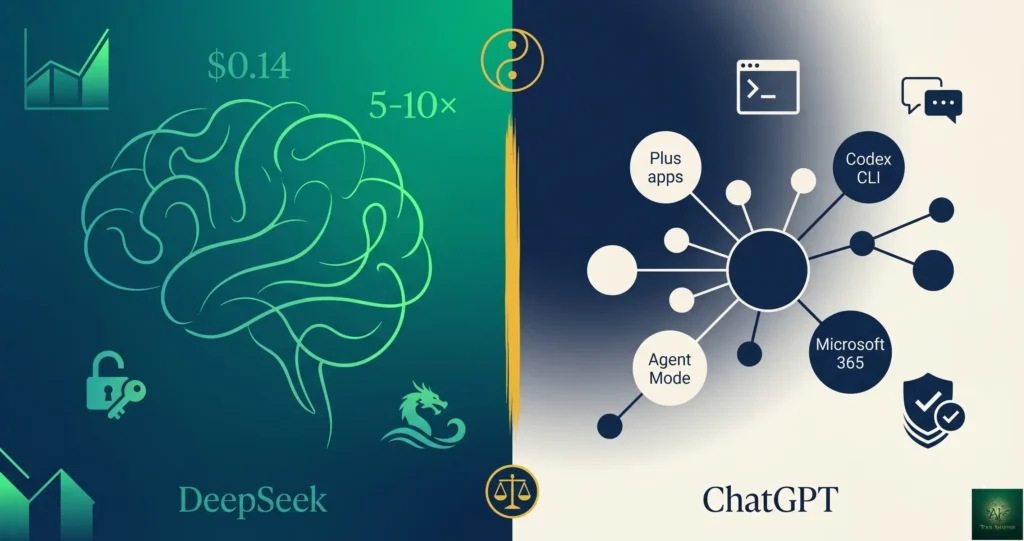
What Changed Since Late 2025
- DeepSeek V3.2 → V4. The version that defined late-2025 (“$0.14 model that just beat OpenAI”) gave way to V4 in early 2026. Stronger reasoning, slight pricing adjustments, retained the cost-leader positioning that’s the brand’s defensible moat.
- ChatGPT GPT-5 → GPT-5.4 → GPT-5.5. OpenAI rolled progressive updates through 2026. Plus tier baseline moved from GPT-5 to GPT-5.4; Pro tier got 5.5 and selective access to o-series reasoning models. Same $20/mo Plus, $200/mo Pro pricing structure held.
- Price gap narrowed slightly but remains 5-10x. DeepSeek raised some API tier amounts marginally; OpenAI didn’t lower prices materially. Net: DeepSeek still meaningfully cheaper for API workloads, the headline gap shrank but the value-per-dollar story holds.
- Codex CLI + Agent Mode matured on the ChatGPT side. OpenAI’s terminal coding agent and autonomous task mode moved from “interesting demos” to “production-grade tools” through 2026. Adds meaningful value to the ChatGPT ecosystem that DeepSeek doesn’t match.
- Open-weight DeepSeek variants gained traction. Self-hosted DeepSeek deployments became more common in regulated industries — addresses the data sovereignty concern by running on your infrastructure. Trade-off: hosting + ops complexity vs DeepSeek’s hosted API simplicity.
- Competitive context. Both face Claude (Anthropic) and Gemini (Google) in the broader flagship category. The pure DeepSeek-vs-ChatGPT framing is narrower than the full market reality — see our Claude vs Gemini comparison for the broader 4-flagship picture.
Getting Started: The “Thinking” Difference
The fastest way to feel the difference between DeepSeek and ChatGPT is to give both the same reasoning-heavy prompt and watch their thinking. DeepSeek surfaces its reasoning trace explicitly — you see the model working through the problem step-by-step before arriving at the final answer. ChatGPT (with the o-series reasoning models active in Plus/Pro) does similar but often hides more of the intermediate steps behind a “Thinking…” indicator. Both produce strong final answers; the visible-reasoning pattern is more pronounced on DeepSeek.

Practical onboarding pattern: pick one reasoning-heavy task you do regularly (debugging a stack trace, analyzing a document, planning a multi-step workflow), run it through both tools, compare the outputs side by side. The 30-minute test exposes you to both reasoning styles and gives you a sense of which fits your work better. For most users, neither model decisively wins reasoning quality — DeepSeek wins price-per-quality; ChatGPT wins ecosystem fit.
The $0.14 vs $15 Pricing Gap
| Tier | DeepSeek | ChatGPT | Notes |
|---|---|---|---|
| Free chat | Free (deepseek.com) | Free (chatgpt.com, basic) | Both have generous free tiers |
| API: input per 1M tokens | ~$0.14-$15-10× CHEAPER | ~$3-$15 | DeepSeek’s structural advantage |
| API: output per 1M tokens | ~$1-$3 | ~$15-$60 | Same gap, sometimes wider |
| Consumer subscription | Free / Limited paid | $20/mo PlusECO LEADER | ChatGPT’s ecosystem perks |
| Pro / heavy use | API at scale | $200/mo Pro | ChatGPT Pro = unlimited GPT-5.5 + o-series |
| Self-hosting | Open-weight variants available | Not available | DeepSeek option for sovereignty needs |
| Best value for… | API workloads at scale | Consumer + ecosystem use | Different optimization frontiers |

Pricing math at typical workload tiers: a moderate API workload (10M input + 2M output per month) runs ~$50-100/mo on DeepSeek vs ~$200-500/mo on GPT — meaningful at single-developer scale, transformative at production scale. A heavy production workload (200M input + 50M output per month) runs ~$500-1,000 on DeepSeek vs $3,000-7,000 on GPT — the kind of difference that genuinely affects engineering decisions.
📬 Find this DeepSeek vs ChatGPT comparison useful?
Get our weekly LLM reviews — DeepSeek releases, ChatGPT updates, Claude / Gemini benchmarks, and pricing changes.
Real Test: Coding & Debugging
Coding is where the price-vs-quality tradeoff gets concrete. Tested both on identical coding tasks — multi-file refactors, debugging stack traces, generating test suites, writing small Python utilities. May 2026 honest take: DeepSeek V4 produces working code reliably and handles routine tasks competently. ChatGPT (especially GPT-5.5 with Codex CLI integration) edges ahead on complex multi-file work, error recovery, and tasks where the agent has to maintain context across multiple steps.

Practical implication: for one-shot coding tasks (write a function, debug an error, generate boilerplate), both work well — DeepSeek’s price advantage tips the decision. For complex multi-step coding workflows (autonomous refactor across 10 files, long-running agent tasks, codebase-wide reasoning), ChatGPT’s Codex CLI ecosystem and Pro tier compute budget pull ahead. Use the right tool for the right job rather than committing to one.
Features That Matter
Visible reasoning trace (DeepSeek’s signature)
DeepSeek surfaces the model’s reasoning explicitly — you see step-by-step thinking before the final answer. Useful for debugging the model’s logic on complex tasks; sometimes overwhelming for simple queries. ChatGPT’s o-series models do similar but hide more of the intermediate steps. Pick based on whether you want to see the work or just the result.
Codex CLI + Agent Mode (ChatGPT’s signature)
OpenAI’s terminal coding agent (Codex CLI) and autonomous task mode (Agent Mode) both matured into production-grade tools through 2026. Codex CLI competes with Claude Code and Gemini CLI in the autonomous-coding tier. Agent Mode handles multi-step web tasks autonomously. DeepSeek doesn’t ship comparable consumer-facing agent tools — its strength is the underlying API at low cost.
Open-weight self-hosting (DeepSeek’s escape hatch)
DeepSeek releases open-weight model variants you can self-host on your own infrastructure — addresses the data sovereignty concern by removing dependency on Chinese cloud infrastructure. Trade-off: GPU costs, ops complexity, model weight management. Worth it for regulated industries; overkill for most use cases.
Ecosystem integration (ChatGPT’s moat)
ChatGPT integrates with Microsoft 365, GitHub Copilot (model choice), Slack, Notion, and dozens of third-party tools. Plus tier includes the GPT Store, custom GPTs, and a deep app ecosystem. DeepSeek’s ecosystem is meaningfully thinner — strong API, weak consumer-product integrations. For ecosystem-driven workflows, ChatGPT wins.
🔍 REALITY CHECK — Data Sovereignty
Marketing Claims: DeepSeek’s marketing emphasizes performance + price. The data sovereignty story isn’t surfaced prominently in marketing — readers have to know to ask.
Actual Experience: DeepSeek is a Chinese AI company. Your inputs to DeepSeek’s hosted API and consumer chat sit on Chinese cloud infrastructure subject to Chinese law. For personal use, internal note-taking, and other non-sensitive tasks, this is unlikely to matter for most users. For business contexts — particularly anything regulated (finance, healthcare, defense, EU GDPR-sensitive data) — your compliance team needs to evaluate whether DeepSeek’s hosted offering is acceptable, or whether you need to self-host the open-weight variants instead. ChatGPT’s data sits on US/Microsoft Azure infrastructure subject to US law — a different (often easier) compliance story for Western enterprise buyers. Don’t let the price advantage override a compliance requirement.
Verdict: Cheap doesn’t mean compliant. Audit your data sovereignty requirements before adopting DeepSeek for business workloads. For personal use, the price advantage usually wins.
Data Sovereignty: The Decision That Actually Matters
For Western enterprise buyers, the data sovereignty question often determines the decision more than benchmark scores or pricing. DeepSeek’s hosted infrastructure sits in China, subject to Chinese law and data-handling requirements. ChatGPT’s hosted infrastructure sits on US/Microsoft Azure, subject to US law. Different compliance regimes, different risk profiles, different acceptability for regulated industries.
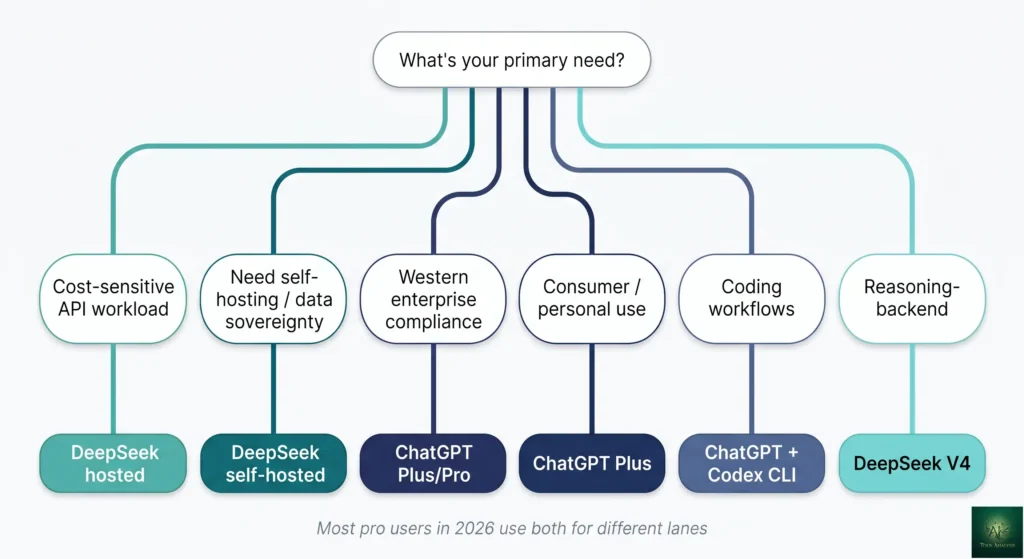
Practical decision tree: (1) For consumer/personal use, sovereignty is low-stakes — pick by price + features. (2) For internal business use with non-sensitive data, sovereignty is a soft preference — most teams default to ChatGPT but DeepSeek is acceptable. (3) For regulated industries, compliance-sensitive data, or any context where “where does this data live?” is a contract question, ChatGPT or self-hosted DeepSeek (open-weight variants) are the right answers — hosted DeepSeek is typically not.
Who Should Use Each
- Cost-conscious API developers (production AI features at scale): DeepSeek. The 5-10x price advantage compounds dramatically. Use DeepSeek’s hosted API or self-host open-weight variants based on data sovereignty requirements.
- Reasoning-heavy workloads (complex analytical tasks, research synthesis): Either works well. DeepSeek V4’s visible reasoning is useful for debugging the model’s logic; ChatGPT’s o-series gets you to similar answers with less verbosity. Pick by ecosystem fit.
- Consumer users (personal productivity, casual chat): ChatGPT Plus ($20/mo). Better ecosystem, more polished consumer experience, broader app integrations. DeepSeek’s free chat is competent but not category-leading on consumer UX.
- Western enterprise buyers (regulated industries, compliance-sensitive data): ChatGPT — or self-hosted DeepSeek open-weight variants if cost dominates. Hosted DeepSeek typically doesn’t pass compliance review for regulated sectors.
- Developer-tool builders (CLI agents, IDE integrations, autonomous coding): ChatGPT — Codex CLI + Agent Mode + Plus tier integration breadth wins this category. DeepSeek’s API powers backend AI features well but the developer-product layer is thinner.
- Anyone running AI on their own infrastructure (privacy-first, on-prem, edge): DeepSeek open-weight variants. ChatGPT doesn’t offer self-hosted options. The DeepSeek open-weight ecosystem is the strongest answer to “I need to run this myself” requirements.
- Mixed-use multi-tool stacks: Use both. Many teams in 2026 route cost-sensitive backend work through DeepSeek and consumer-facing / ecosystem-integrated work through ChatGPT. The operational complexity is small; the cost-or-quality wins compound.

💡 Key Takeaway: The DeepSeek-vs-ChatGPT decision in May 2026 is rarely “which is better” and almost always “which fits this specific use case.” DeepSeek wins API cost + self-hosting flexibility. ChatGPT wins consumer experience + ecosystem + Western compliance fit. Match the tool to the task; many sophisticated AI users run both.
FAQs
Is DeepSeek actually better than ChatGPT in 2026?
The DeepSeek vs ChatGPT answer depends on the dimension. DeepSeek wins on price-per-quality for API workloads and offers open-weight self-hosting that ChatGPT doesn’t. ChatGPT wins on ecosystem integrations, consumer experience, Codex CLI / Agent Mode tooling, and Western data sovereignty fit. For raw model quality on most reasoning tasks, both are credible — neither decisively wins.
How much cheaper is DeepSeek than ChatGPT?
Roughly 5-10x cheaper on per-token API pricing. A moderate API workload that costs ~$200-500/mo on ChatGPT runs ~$50-100/mo on DeepSeek. At production scale (200M+ input tokens monthly), the gap widens to thousands of dollars per month. Verify current pricing on both vendor sites — both adjust API tiers periodically.
Is DeepSeek safe to use for business data?
DeepSeek’s hosted infrastructure is in China, subject to Chinese law. For non-sensitive personal/internal use, this is unlikely to matter. For regulated business data (finance, healthcare, defense, EU privacy contexts), audit your compliance requirements before using hosted DeepSeek. The open-weight self-hosting option lets you run DeepSeek on your own infrastructure, which addresses the sovereignty concern.
Can I self-host DeepSeek?
Yes — DeepSeek releases open-weight model variants you can run on your own infrastructure (typically GPU servers). Trade-off: hardware costs, ops complexity, model weight management vs DeepSeek’s hosted API simplicity. Worth it for regulated industries and privacy-first deployments; overkill for most use cases.
Which is better for coding?
Both are competent. ChatGPT (especially with Codex CLI integration) edges ahead on complex multi-file coding work and autonomous agent tasks. DeepSeek handles routine coding tasks well and the price advantage tips the decision for one-shot work. For serious autonomous coding, see also Claude Code which leads SWE-bench Verified at 87.6%.
Does DeepSeek work for English content?
Yes — DeepSeek is fluent in English and major Western languages, despite being built primarily for Chinese-language workflows. English coding, analysis, and chat all work well. Technical writing in English is competent. Some idiomatic English nuance occasionally trails native-English-trained models, but the gap is small for most use cases.
Does ChatGPT have a free tier?
Yes — ChatGPT free tier at chatgpt.com gives access to a limited GPT-5 with daily message limits. Plus tier ($20/mo) removes the limits and adds GPT-5.4 baseline + Plus apps. Pro tier ($200/mo) adds GPT-5.5 + o-series reasoning + unlimited usage. Verify current tier features on openai.com before committing.
What’s the best alternative to both?
Beyond the DeepSeek vs ChatGPT debate, the major flagship LLMs in May 2026 are Google Gemini 3.1 Pro (best multimodal + price-leader vs Claude) and Anthropic Claude Opus 4.7 (best for coding + agentic workflows). Most professional AI users in 2026 use 2-3 of these models depending on the specific workload — the practical answer is rarely “pick one and stick with it.”
✅ Where Each Wins
- ✓ DeepSeek: 5-10x cheaper API for production workloads
- ✓ DeepSeek: Open-weight self-hosting option
- ✓ ChatGPT: Codex CLI + Agent Mode + ecosystem breadth
- ✓ ChatGPT: Western data sovereignty fit (US/Azure)
- ✓ ChatGPT: Consumer experience + Plus app store
❌ Where Each Falls Short
- ✗ DeepSeek: Chinese data sovereignty for hosted API
- ✗ DeepSeek: Thinner consumer + ecosystem layer
- ✗ ChatGPT: 5-10x more expensive at API scale
- ✗ ChatGPT: No open-weight self-hosting option
- ✗ Both: Headline benchmarks shift quarterly
The flagship LLM category is the healthiest it has ever been — DeepSeek and ChatGPT both ship credible frontier-quality output with structurally different value propositions (price-leader vs ecosystem-leader). Half a star off because vendor cherry-picking benchmarks remains rampant and the “absolute best model” framing keeps oversimplifying genuinely segmented use cases.
The Final Verdict
The DeepSeek vs ChatGPT decision in May 2026 isn’t “which is better” — both are credible flagship LLMs with different optimization frontiers. The honest read: DeepSeek wins on price-per-quality for API workloads and uniquely offers open-weight self-hosting that ChatGPT doesn’t. ChatGPT wins on consumer experience, ecosystem integrations (Codex CLI, Agent Mode, Plus apps), and Western data sovereignty fit. Pick by the specific use case in front of you, not by aggregate “category leader” claims that don’t survive contact with current pricing or current benchmarks.
If we had to name one DeepSeek vs ChatGPT default for a typical reader: ChatGPT Plus for consumer/personal use ($20/mo, low-risk, broad ecosystem), DeepSeek API for backend AI infrastructure where the cost savings compound. Most professional users running both models for different workloads is a feature of the 2026 LLM market, not a bug — the two products optimize for different points on the price-vs-ecosystem frontier and the smartest move is often using each where it actually wins.
Final verdict: use DeepSeek for cost-sensitive API workloads, reasoning-heavy production tasks, and any context where the open-weight self-hosting option matters (privacy, sovereignty, on-prem). Use ChatGPT for consumer use, ecosystem-integrated workflows, Western enterprise compliance contexts, and developer tooling that benefits from Codex CLI / Agent Mode integration. Most sophisticated AI users in 2026 use both — there’s no single winner, just specialists serving different lanes. And remember: Claude and Gemini are also in the conversation — see our Claude vs Gemini comparison for the broader 4-flagship picture.
Related Reading
- ChatGPT Review — full review of OpenAI’s flagship
- Google Gemini Review — Gemini 3.1 Pro flagship comparison context
- Claude vs Gemini Developer Tools — broader 4-flagship picture
- Best AI Developer Tools 2026 — for the broader dev-stack context
- GitHub Copilot Pro Review — for dev tooling that uses ChatGPT models
- AI Agent Frameworks 2026 — for building agents on top of these models
- The Complete AI Tools Guide — buyer’s guide for picking the right tool from 200+ tested
Founder of AI Tool Analysis. Reads every pricing page, help article and footnote so you don’t have to. Covering AI tools since 2025. See how we research →
Stay Updated on Flagship LLMs
The flagship LLM category shifts every quarter. Subscribe for honest reviews of new DeepSeek / ChatGPT / Claude / Gemini releases, benchmark updates, and pricing changes — delivered every Thursday at 9 AM EST.
- ✅ Honest Reviews: We actually test these models, not rewrite press releases
- ✅ Model Releases: DeepSeek / ChatGPT / Claude / Gemini launches covered within days
- ✅ Pricing Changes: Know when API tiers shift
- ✅ Benchmark Updates: Side-by-side scoring as the field evolves
- ✅ No Hype: Just the AI news that matters for your work
Free, unsubscribe anytime.

Last Updated: May 1, 2026
Models Tested: DeepSeek V4 (current Chinese frontier model) and ChatGPT GPT-5.4 / GPT-5.5 (current OpenAI flagship), with comparison context to Claude Opus 4.7 and Gemini 3.1 Pro. Verify current pricing + version numbers on deepseek.com and openai.com before publish — both vendors adjust tiers periodically.
Slug Note: Renamed from /deepseek-v3-2-vs-chatgpt-5/ to /deepseek-vs-chatgpt/ on May 1, 2026 for evergreen URL. 301 redirect in place. Original double-version-locked slug retired under the no-version-or-year-in-slugs standing policy.
Next Review Update: August 2026 (or sooner when either vendor ships major model releases)
Have a tool you want us to review? Suggest it here | Questions? Contact us