
GLM Coding Plan Review: The Bottom Line
If you remember nothing else from this GLM Coding Plan review: GLM is a near-frontier coding model from a Chinese lab that you can plug straight into the tools you already use, for roughly the price of one lunch a month. It speaks Anthropic’s API, so it drops into Claude Code with a two-line change and runs the same agentic loops at a fraction of the cost.
The catch is honesty around three things: the benchmarks at launch were self-reported by Z.ai, not independently checked. The model is slow compared to Claude or Grok. And every prompt you send to the cloud API travels through servers in China. None of that is a dealbreaker for most side projects. All of it matters if you are shipping client code or anything sensitive.
Best for: indie developers, students, and anyone who burns through their Claude limits and wants a deep quota pool for cheap. Skip if: you need the absolute best reasoning on hard problems, you code interactively and hate waiting, or your work touches data that cannot leave your control. If cost is the whole problem, also read our Claude Code Router guide on cutting your AI coding bill.
⚡ TL;DR – The Bottom Line
What It Is: A near-frontier Chinese coding model (GLM-5.2) you rent by the month and wire straight into Claude Code, Cline, Roo Code and other tools you already use.
Best For: Indie developers, students, and anyone who keeps burning through Claude or Codex limits and wants a deep quota pool for cheap.
Price: Coding Plan from $18/month; GLM-4.7-Flash and GLM-4.5-Flash are free to every registered user.
Our Take: The clearest value play in AI coding right now — best run as a second model paired with Claude, not as a full replacement.
⚠️ The Catch: It’s slow next to Claude or Grok, the launch benchmarks are self-reported by Z.ai, and the cloud API routes your code through servers in China.
📑 Quick Navigation
What the GLM Coding Plan Actually Does
Here is the thing most people get wrong. GLM is not an app you open. It is a brain you rent and wire into a body you already own.
GLM stands for General Language Model, built by Zhipu AI, a 2019 spinoff from Tsinghua University that now trades on the Hong Kong Stock Exchange under the name Z.ai. In January 2026 it became the first Chinese AI lab to go public. The GLM Coding Plan is its answer to Claude Code: a flat monthly subscription that gives your coding tools access to GLM’s models, instead of you paying Anthropic or OpenAI per token.
Think of it like swapping the engine in a car you like. You keep your steering wheel, your seats, your dashboard. Claude Code, Cline, OpenCode, Roo Code, Goose, and a dozen other tools are the car. GLM is a cheaper engine that bolts into the same mount because Z.ai built its endpoint to speak the exact same language Anthropic’s tools expect.
The Five-Minute Test
In five minutes with the GLM Coding Plan, here is what you can do: sign up at Z.ai, generate an API key, set two environment variables in your terminal, and open Claude Code. The banner shows your active model is now GLM-5.2. You type a normal request, like “add pagination to this product list and write the tests,” and the agent goes to work exactly as it would on Claude, reading your files, editing across them, and running your test suite.
The first time you watch it ship a working multi-file change, the price tag stops feeling believable. That is the whole pitch.
🔍 REALITY CHECK
Marketing Claims: “Code faster, debug smarter, with rock-solid reliability and 3x the usage at a fraction of the cost.”
Actual Experience: When you connect GLM to Claude Code, the interface often still shows a Claude model name while GLM does the work underneath. That confused a lot of people, and it is not an accident of branding. In December 2025, MIT researchers found GLM models identified themselves as Claude in roughly half of certain test prompts. GLM-5 even launched under a stealth name, “Pony Alpha,” before Z.ai confirmed it.
Verdict: The tool works as advertised, but treat the “is this really Claude” feeling as a known quirk, not proof of equal quality. It is GLM. Judge it as GLM.
Getting Started: Your First Hour
Setup is genuinely fast, with one rough edge. You sign up at Z.ai, switch to the overseas site if you want to pay in dollars, and create an API key. The billing portal defaults to Chinese until you flip it, which is the first small friction you will hit.
For Claude Code, you export two variables in your shell profile and you are done:
export ANTHROPIC_BASE_URL=https://api.z.ai/api/anthropic
export ANTHROPIC_API_KEY=your_zai_key_here
Open a project, run claude, and the startup banner confirms it is pointing at Z.ai. To use the new 1 million token window, set the model to glm-5.2[1m] and raise your timeout, because loading a huge context takes longer to return the first token than Claude’s default cutoff allows. Z.ai also ships a helper you can run with npx @z_ai/coding-helper that configures supported tools for you.
Time to first useful output: under ten minutes if you already have Claude Code installed. That is faster onboarding than most paid tools, and a big reason the GLM Coding Plan spread by word of mouth.

💡 Key Takeaway: If you already run Claude Code, switching is two environment variables and you’re live. But to actually use the 1 million token window, set your model to glm-5.2[1m] and raise your timeout first — otherwise large-context calls will hit Claude Code’s default cutoff before GLM returns its first token.
Features That Actually Matter
The 1 Million Token Context Window
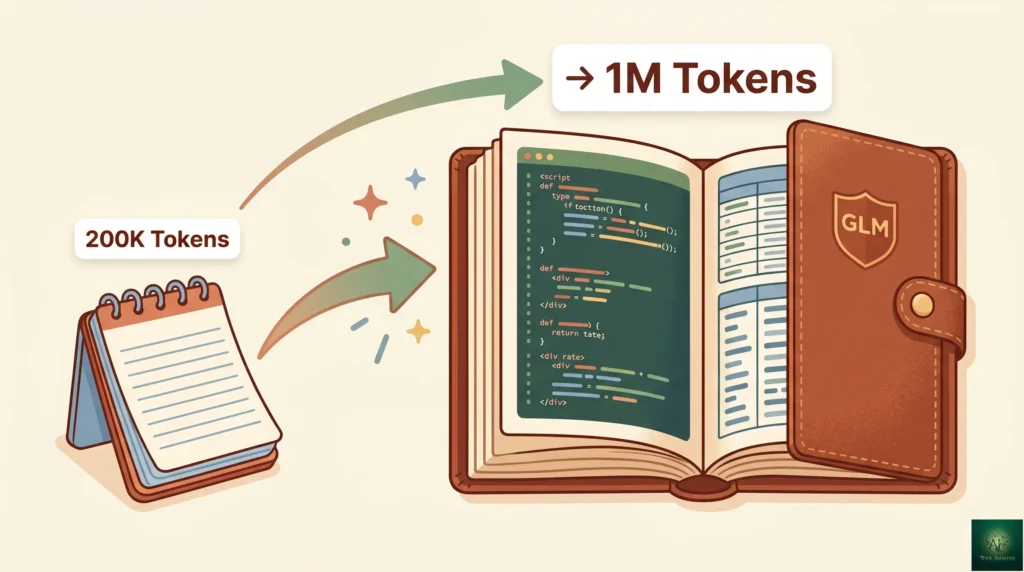
This is the GLM-5.2 headline, and it is the upgrade most likely to matter in real work. A context window is the model’s short-term memory, the notepad it can hold open while it works. GLM-5.1 capped at 200K tokens. GLM-5.2 stretches that to a usable one million.
In practice, that means you can load a 300K to 500K token directory into context and ask the model to trace a call path or plan a refactor that touches eight files at once, without it forgetting the start of the codebase by the time it reaches the end. For repo-scale agentic work, that is the difference between a toy and a tool. Rating: 4.5 out of 5 stars, with the half-star docked because the only way to know if it stays coherent across the full window is to test it on your own repo, not a demo.
📊 Context Window: The GLM-5.2 Jump
Drop-In Compatibility
Any tool that speaks Claude’s API can talk to GLM by swapping one URL. That includes Claude Code, Cline, OpenCode, Roo Code, Kilo Code, Goose, Crush, and OpenClaw. No SDK changes. No relearning your workflow. For a small lab releasing a model into a market Anthropic already shaped, building on the existing standard was the smartest move they made. Rating: 5 out of 5 stars. This is the feature that turns “another Chinese model” into “a model I can use today.” If you are weighing front-ends, our guide to AI agents for developers covers how these tools differ.
The Free Models Nobody Talks About
Before you pay anything, GLM-4.7-Flash and GLM-4.5-Flash are free to every registered user. GLM-4.7-Flash carries a 203K context window with no subscription, which makes it one of the strongest zero-cost models from any provider. It is perfect for code formatting, quick lookups, and basic completions. Reserve the paid plan for the heavy lifting. Rating: 4 out of 5 stars. Free is free, but the Flash models are noticeably less capable than the premium tier, so do not expect them to debug your gnarliest bug.
🔍 REALITY CHECK
Marketing Claims: Charts circulating after launch show GLM-5.2 beating GPT-5.5 and finishing in a near-tie with Claude Opus 4.8 on long-horizon coding benchmarks.
Actual Experience: Z.ai published no official benchmark numbers at launch — the much-shared figures (SWE-bench Pro 62.1, FrontierSWE 74.4 percent, MCP-Atlas 77.0) trace back to vendor-aligned or community sources, not an independent lab. The same pattern held with GLM-5.1, whose much-quoted “94.6 percent of Claude Opus” score was self-reported and never independently confirmed. Third-party benchmarks for GLM-5.2 were still pending in the days after launch.
Verdict: The model is clearly strong, but a vendor grading its own homework is not the same as a neutral result. Treat the benchmarks as a starting hypothesis, then test it on your own code.
GLM Coding Plan Pricing: What You’ll Actually Pay
This is where the GLM Coding Plan earns its reputation, and where you need to read the fine print. Pricing has shifted several times in 2026 and is frequently promotional, so always confirm the live number on Z.ai before you pay. As of mid-June 2026, Z.ai’s own documentation lists plans starting at 18 dollars a month, with the common monthly figures landing roughly like this:
| Tier | Approx. Monthly | Best For | Rough Quota |
|---|---|---|---|
| Lite | $10 to $18 | Trying it out, light daily coding | ~80 prompts / 5-hour cycle |
| Pro | ~$30 | Full-time developer, steady use | ~400 to 600 prompts / 5-hour cycle |
| Max | ~$80 | Heavy agentic, parallel projects | ~1,600 prompts / 5-hour cycle |
| Team | Seat-based | Organizations | Highest ceilings |
The detail that trips people up is that quotas are measured in prompts per cycle, not tokens. You get a set number of prompts every rolling five hours, plus a weekly cap. That is the limit heavy users actually hit, and it matters more than the headline price. GLM-5.2 and the Turbo model also burn quota faster, at a 3x multiplier during peak hours (14:00 to 18:00 Beijing time) and 2x off-peak, though Z.ai is running a limited-time 1x off-peak deal through the end of September.
💡 Key Takeaway: GLM meters prompts per rolling five-hour cycle, not tokens — and GLM-5.2 spends them at a 2x to 3x multiplier during Beijing peak hours. If you’re a heavy user, that prompt cap, not the sticker price, is the ceiling you’ll actually feel, so size your tier by how many requests you fire per session rather than by the dollar figure.
Two hidden costs to flag. First, there are no refunds, even on unused time, so start small. Second, the plan only works inside officially supported tools. Z.ai’s usage policy warns that SDK-based or unsupported access can trigger throttling, and three violations can mean a ban. The cost math still wins for most people, but go in with eyes open. For the broader value picture across budget coding models, our DeepSeek review covers the other major Chinese contender.
📬 Enjoying this review?
Get honest AI coding tool analysis delivered weekly. No hype, no spam.
GLM-5.2 vs Claude Code vs DeepSeek
Same job, three different tradeoffs. Here is how GLM stacks up against the tool it imitates and the rival Chinese open-weight model it is chasing.
| Criteria | GLM-5.2 (Coding Plan) | Claude Code (Opus 4.8) | DeepSeek |
|---|---|---|---|
| Entry price | ~$18/month | ~$20/month (Pro) | Free chat, cheap API |
| Context window | 1 million tokens | Large, model-dependent | Large |
| Open weights | Yes, MIT license | No, closed | Yes |
| Speed | Slow | Fast | Moderate |
| Data location | China (cloud API) | US | China |
| Hardest problems | Strong | Best | Strong on math |
| Native coding tool | No, uses Claude Code etc. | Yes, purpose-built | No |
Winner on cost: GLM, easily. Winner on raw quality and speed: Claude Code. Winner on flexibility: GLM again, because the MIT-licensed weights mean you can eventually self-host and cut the cord entirely. The smartest setup most developers land on is not “pick one.” It is to keep Claude Pro for the 5 percent of truly hard problems and route everything else to GLM, which our Claude Code Router review explains how to automate.
🍩 The Smart Stack: How Developers Split the Work
Who Should Use the GLM Coding Plan (And Who Shouldn’t)
Choose the GLM Coding Plan if you are an indie developer, student, or early-stage startup that keeps hitting Claude or Codex usage limits. For roughly the cost of a single Claude Pro seat, you get a far deeper quota pool and a model that handles everyday features, bug fixes, and tests with the gap to Claude effectively invisible.
Choose the GLM Coding Plan if you run long agentic refactors and care more about throughput than per-prompt polish. The 1 million token window and long-horizon focus are built for exactly that.
Stick with Claude Code if you code interactively and the model’s slow speed will drive you up the wall, or if you are tackling the kind of multi-system architecture problem where the last few points of reasoning quality decide whether it works. Our ChatGPT Codex review covers the other premium option.
Skip the cloud API entirely if your code or prompts touch anything sensitive. This is the most important line in the review.
🔍 REALITY CHECK: THE CHINA DATA QUESTION
Marketing Claims: Z.ai’s privacy policy describes commercially reasonable security measures and anonymization of personal data.
Actual Experience: When you use the cloud API, your code and prompts pass through servers Z.ai controls, and that data is subject to Chinese law, including the National Intelligence Law, regardless of where you sit. In May 2025, a Chinese state cybersecurity body flagged Zhipu’s consumer app for collecting more user data than authorized. In May 2026, US House lawmakers opened an inquiry into PRC-origin AI models in critical infrastructure, naming Zhipu among others.
Verdict: For hobby projects and open-source code, this is a non-issue. For client work, proprietary code, or regulated data, it is a real one. The escape hatch is the MIT-licensed weights: self-host GLM-5.2 and no data leaves your control. But full precision needs around 1.5 terabytes of GPU memory, roughly eight H200 cards, so it is realistic only for well-resourced teams.
What Developers Are Actually Saying
The community verdict has been consistent across forums and reviews: extraordinary value, with real rough edges.
The praise centers on price-to-performance. Developers repeatedly describe keeping Claude Pro for hard problems and adding a GLM plan for overflow, landing around 30 dollars a month total for what feels like the best of both worlds. The Anthropic compatibility gets called out again and again as the reason adoption was painless.
The complaints are just as consistent. Speed is the big one. GLM-5.1 was independently clocked among the slowest frontier coding models, noticeably slower than Claude or Grok, which stings during interactive work even if it matters less for autonomous loops. The second is reliability under load: after the GLM-5 launch, traffic spiked tenfold, the service was unstable for days, and Z.ai issued a public apology. New subscriptions were briefly capped because demand overwhelmed capacity. The third is polish, with reviewers noting GLM can be verbose, sometimes wrapping a one-line function in three paragraphs of explanation unless you tell it to lead with code.
FAQs: Your GLM Coding Plan Questions Answered
Q: Is there a free version of GLM?
A: Yes. GLM-4.7-Flash and GLM-4.5-Flash are free to every registered user, with no subscription. GLM-4.7-Flash even carries a 203K context window, which makes it one of the strongest zero-cost models around for light tasks. The premium GLM-5.2 model requires a paid Coding Plan.
Q: Can GLM really replace Claude Code?
A: For most everyday coding, yes. For the hardest reasoning tasks and fast interactive work, not quite. The honest answer from the community is that GLM replaces about 90 percent of your Claude usage, and you keep Claude for the rest.
Q: Is my data safe with GLM?
A: If you use the cloud API, your prompts travel through servers in China and fall under Chinese law. For non-sensitive work, that is a manageable tradeoff. For client code or regulated data, it is a real concern, and the only true fix is self-hosting the open-weight model on hardware you control.
Q: How does GLM compare to ChatGPT or Claude?
A: On Z.ai’s own benchmarks, GLM-5.2 edges out GPT-5.5 on several long-horizon coding tests and lands in a near-tie with Claude Opus 4.8. Those scores are not yet independently verified. In daily use, GLM is close enough on routine work that the savings usually win, while Claude keeps an edge on the toughest problems and on speed.
Q: What’s the learning curve?
A: Almost none if you already use Claude Code, Cline, or a similar tool. You change one or two settings and keep your existing workflow. The only new thing to learn is the prompt-based quota system, which limits how many requests you can send per five-hour window.
Q: What is the GLM-5.2 1 million token context actually good for?
A: Loading large portions of a codebase at once. You can drop a 300K to 500K token directory into context and ask GLM to trace a function call across many files or plan a refactor that spans the whole project, without it losing the thread. For single-file edits it is overkill, so route smaller tasks to a faster, cheaper model.
Q: Can I self-host GLM-5.2?
A: Yes. The weights are MIT-licensed and available on Hugging Face. The catch is hardware: full precision needs around 1.5 terabytes of GPU memory, roughly eight NVIDIA H200 cards. An FP8 version roughly halves that, but it is still enterprise-grade infrastructure. For most people the cloud plan is the practical choice.
Q: Why does GLM sometimes say it is Claude?
A: Two reasons. Inside Claude Code, the interface maps GLM onto Claude’s model slots, so you see a Claude name while GLM runs underneath. Separately, GLM models have a documented habit of identifying as Claude in certain prompts, a quirk researchers flagged in late 2025. It does not change what you are paying for, which is GLM.
The Final Verdict
The GLM Coding Plan is the clearest value play in AI coding right now, and GLM-5.2 only sharpens it. You get a near-frontier model with a one million token context window, drop-in compatibility with the tools you already use, and a price that undercuts everything else credible. For indie developers and anyone tired of rationing their Claude limits, it is close to a no-brainer as a second model in the toolbox.
It is not a clean Claude replacement, and the honest reasons are the slow speed, the self-reported benchmarks that still need independent confirmation, and the China data exposure on the cloud API. Respect those three limits and the math is hard to argue with.
Rating: 4.3 out of 5 stars. Use the GLM Coding Plan if you want frontier-class coding volume for the price of a sandwich, and you are pairing it with Claude rather than betting everything on it. Stick with Claude Code if speed, polish, and the hardest reasoning are non-negotiable, or if your data cannot leave your control. Try it today by grabbing a Lite plan and the free Flash models first at z.ai/subscribe.

✅ What We Liked
- ✓ Near-frontier coding quality for roughly the price of one lunch a month
- ✓ Drop-in compatible with Claude Code, Cline, Roo Code, Goose and more — a two-line switch
- ✓ Usable 1 million token context for repo-scale refactors
- ✓ MIT-licensed open weights — you can self-host and cut the cord entirely
- ✓ Genuinely useful free tier (GLM-4.7-Flash, 203K context)
❌ What Fell Short
- ✗ Among the slowest frontier coding models — painful for interactive work
- ✗ Launch benchmarks are self-reported, not independently verified
- ✗ Cloud API routes your code through servers in China
- ✗ Prompt-based quotas with peak-hour multipliers and no refunds

Founder of AI Tool Analysis. Tests every tool personally so you don’t have to. Covering AI tools for 10,000+ professionals since 2025. See how we test →
Related Reading
- DeepSeek Review: The Other Chinese Open-Weight Coding Leader
- Claude Code Router: Cut Your AI Coding Bill by 80 Percent
- Claude Code vs Cursor: I Tested Both
- Top AI Agents for Developers 2026
- ChatGPT Codex Review: Better Than Claude Code?
- Goose AI Review: Block’s Free Agent
Stay Updated on AI Coding Tools
Don’t miss the next major update. Subscribe for honest AI coding tool reviews, price drop alerts, and breaking feature launches every Thursday at 9 AM EST.
- ✅ Honest Reviews: We actually test these tools, not rewrite press releases
- ✅ Price Tracking: Know when tools drop prices or add free tiers
- ✅ Feature Launches: Major updates covered within days
- ✅ Comparison Updates: As the market shifts, we update our verdicts
- ✅ No Hype: Just the AI news that actually matters for your work
Free, unsubscribe anytime. 10,000+ professionals trust us.
Want AI insights? Sign up for the AI Tool Analysis weekly briefing.
Newsletter

Last Updated: June 18, 2026
GLM Version Tested: GLM-5.2 (Coding Plan)
Next Review Update: July 18, 2026
Have a tool you want us to review? Suggest it here | Questions? Contact us