
If you remember nothing else from this Gemma 4 12B review: Google built a 12 billion parameter model that reads text, images, and audio without a single separate encoder, then gave it away under Apache 2.0. It fits in about 7.4 GB on disk. It scores 78.8% on GPQA Diamond, a graduate-level science exam that Gemma 3 27B managed 42.4% on. And it runs on the laptop you already own.
That is the good news. The complicated news is that “runs on 16GB” and “nearly matches the 26B” are both true in a narrow sense and misleading in a broader one. There is also one benchmark table in Google’s own technical report that almost nobody has quoted, and it changes how you should configure the model for document work.
⚡ TL;DR – The Bottom Line
What It Is: Google’s 12-billion-parameter open model that reads text, images and audio with no separate encoders, and runs offline on a 16GB laptop.
Best For: Developers who need private multimodal AI on hardware they already own, compliance-bound teams that cannot use hosted APIs, and agent builders tired of paying per retry.
Price: $0. Weights are Apache 2.0, commercial use permitted. Your only costs are hardware and electricity.
Our Take: It scores 78.8% on GPQA Diamond — a graduate-level science exam Gemma 3 27B managed 42.4% on — from a file that fits in about 7.4 GB.
⚠️ The Catch: Drop the vision token budget to the fast default and document reading collapses. InfographicVQA falls from 88.4% to 58.7% — worse than the far smaller E4B, which still has a real vision encoder.
📑 Quick Navigation
The Bottom Line
What it is: Google DeepMind’s mid-sized open model, released June 3, 2026. Text, image, and audio go in. Text comes out. Video works as a sequence of frames.
Free vs paid: There is no paid tier. The weights are free under Apache 2.0, which permits commercial use. Your only costs are hardware and electricity. Compare that to the hosted route, where sibling Gemma 4 models resell through API providers at roughly $0.06 to $0.14 per million input tokens.
One major limitation: the encoder-free design that makes it fast also makes it fragile at low image resolution. Drop the vision token budget and document reading falls apart faster than it does on smaller Gemma models. More on that below.
Best for: developers who want private, offline multimodal work on a 16GB machine, teams with compliance rules that block hosted APIs, and anyone building agents where every token currently costs money. If you are weighing local against subscription tools, our best AI developer tools guide covers the paid side of that decision.
Skip if: you need frontier reasoning, current world knowledge, or reliable long-document retrieval past 128K tokens. For those, a hosted model like Gemini Flash still wins on raw capability.
What Gemma 4 12B Actually Does
Most multimodal models work like a translation office. An image arrives, a specialist vision encoder converts it into something the language model can read, and only then does the language model see it. Audio gets its own specialist. Three departments, three sets of weights, three chances for something to stall.
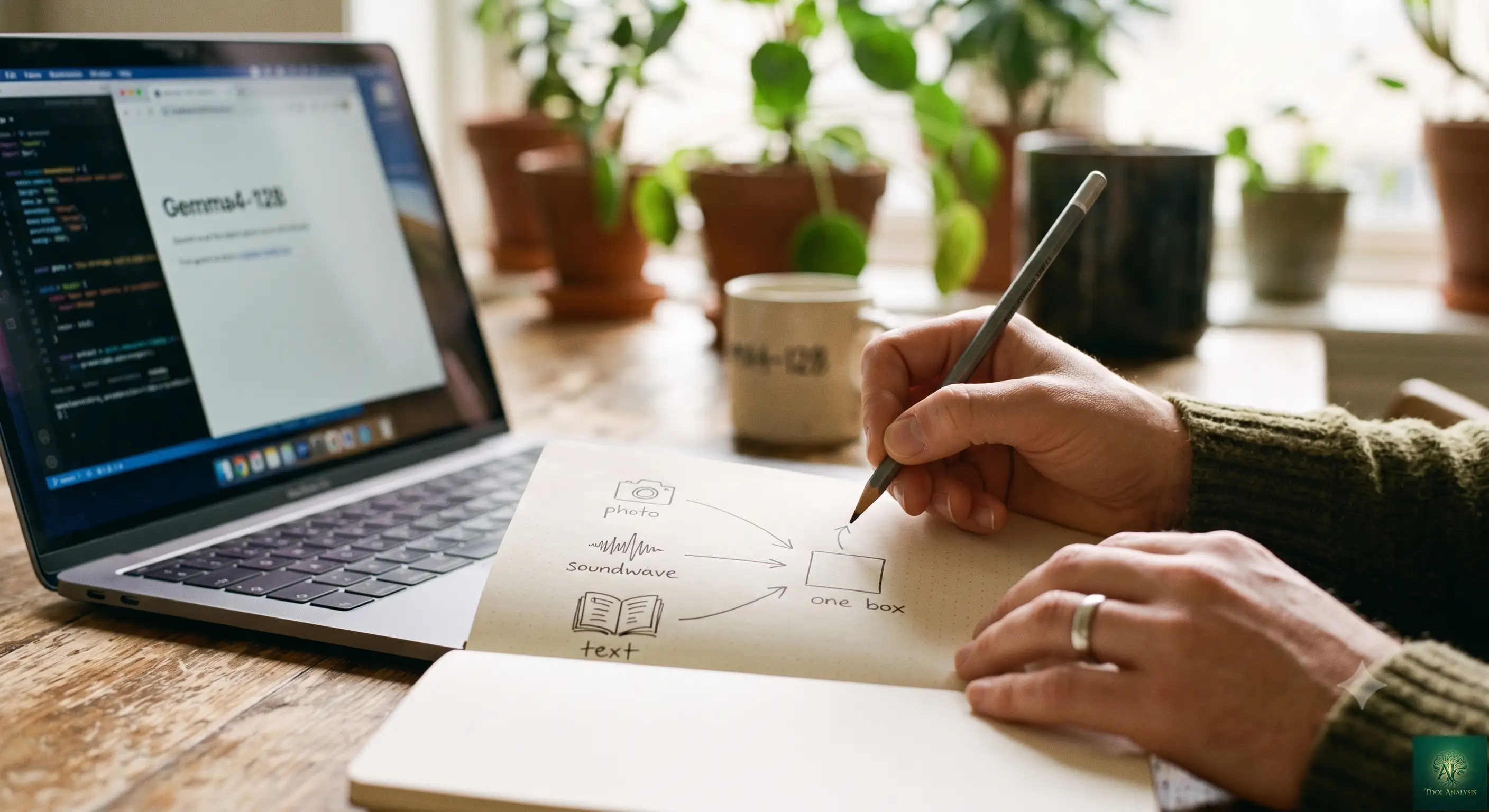
Gemma 4 12B fires the translators. Google calls this “encoder-free,” and the plain English version is that raw pixels and raw sound get projected straight into the same space the model uses for words.
The specifics are unusually clean. For images, Google replaced a 550 million parameter vision transformer with a single 35 million parameter matrix multiplication that takes raw 48×48 pixel patches. For audio, the 305 million parameter speech encoder was deleted entirely. Raw 16 kHz sound is chopped into 40 millisecond slices, each one a 640 number vector, and fed directly to the model. You can read the full breakdown in the Gemma 4 Technical Report.
💡 Key Takeaway: Deleting the encoders is what makes this model small and fast, but it also means the language backbone is now doing the seeing and hearing itself. Remember that trade — it explains every strength and every weakness in the rest of this review.
The Five-Minute Test
Here is what five minutes buys you. Install Ollama, run ollama run gemma4:12b, wait for a 7.6 GB download, and you have a model that will transcribe a voice memo, describe a screenshot, and write a Python script in the same conversation. No API key. No rate limit. No usage dashboard.
The audio piece is the part that surprised people. Until now, audio input in the Gemma family was restricted to the tiny edge models. This is the first mid-sized Gemma that hears. If you have been paying for transcription, that changes your maths, and it puts local hardware in the same conversation as tools like the open-source model in our Qwen3-TTS review.
🔍 REALITY CHECK
Marketing Claims: “Benchmark performance nearing our 26B model.”
Actual Experience: True on several tests, and false on others. Gemma 4 12B actually beats the 26B on Tau2 telecom (54.4% vs 43.0%), IFBench (74.0% vs 72.0%) and Terminal Bench Hard (18.0% vs 14.0%). But it loses badly on Big Bench Extra Hard (53.0% vs 64.8%) and Humanity’s Last Exam (5.2% vs 8.7%). The harder and more open-ended the task, the wider the gap.
Verdict: “Nearing” is fair for everyday work and optimistic for hard reasoning. Also note that the headline jump over Gemma 3 27B compares Gemma 4 in thinking mode against Gemma 3 with thinking off. That is not apples to apples.
Getting Started: Your First 20 Minutes
Every Gemma 4 12B review skips this part, so here it is properly. You have four realistic paths to running the model, and the right one depends on how much control you want.
- Ollama is the fastest. One command, done. Best if you just want to talk to it.
- LM Studio gives you a chat window plus a model browser so you can pick your own quantization by file size.
- llama.cpp is where the tuning lives. One GGUF file handles text, images, and audio together, and the multimodal projector downloads automatically when you use the
-hfflag. - Google AI Edge ships downloadable macOS apps for the first time, plus a
litert-lm servecommand that exposes an OpenAI-compatible endpoint you can point existing tools at.

Pick Your Quantization
Quantization is just compression for model weights. Smaller file, slightly dumber model, much less memory. Here are the real file sizes from Unsloth’s GGUF release, which has passed 620,000 downloads in a single month.
| Build | File size | Who it suits |
|---|---|---|
| UD-Q2_K_XL | 4.66 GB | 8 GB cards, last resort only |
| Q4_K_M | 7.12 GB | The practical default |
| UD-Q4_K_XL | 7.37 GB | Slightly better quality, same class |
| Q8_0 | 12.7 GB | 16 GB cards wanting minimal loss |
| BF16 (full) | 23.8 GB | 24 GB cards and workstations |
The Gotcha Nobody Warns You About
Gemma 4 is a thinking model. It writes out its reasoning before it answers. If you call it through an OpenAI-compatible endpoint with default settings and a low token limit, the reasoning eats your budget and the content field comes back empty. Your app looks broken. It is not.
Two fixes: pass enable_thinking: false in your chat template arguments, or raise max_tokens substantially. Also pass --jinja to llama.cpp so the correct chat template loads. This one detail costs people an hour.
Two more settings worth knowing, straight from Google’s official model card: put images before your text in the prompt, and audio after it. Google says order matters for quality. Sampling should be temperature 1.0, top_p 0.95, top_k 64.
💡 Key Takeaway: If your first API call returns an empty response, you have not found a bug — the reasoning trace ate your token budget. Set enable_thinking: false or raise max_tokens, pass --jinja, and put images before your text. Five minutes here saves you an hour of debugging.
Features That Actually Matter
Four capabilities carry this model. Any Gemma 4 12B review that lists twenty features is padding, so here are the ones that changed how we actually used it, rated on what they deliver rather than what the spec sheet promises.
Native Audio Input ⭐⭐⭐⭐
Feed it a 16 kHz mono WAV and ask for a transcript. On Google’s own multilingual speech tests, the 12B posts a word error rate of 0.038 for Spanish and 0.030 for Italian, with English at 0.063. Translation quality on Russian to English hits 50.5 BLEU. Those are respectable numbers from a model with no speech encoder at all.
The catch is length. Google’s model card documents a maximum of 30 seconds of audio and 60 seconds of video at one frame per second. Google’s own launch demo processed a five minute keynote clip, which is well past that documented envelope. Treat long media as experimental rather than supported.

📬 Enjoying this review?
Get honest AI tool analysis delivered weekly. No hype, no spam.
Document and Image Reading ⭐⭐⭐
At full resolution the vision results are genuinely strong. InfographicVQA lands at 88.4%, MATH-Vision at 79.7%, MMMU Pro at 69.1%. For a model this size, reading a chart or a scanned invoice works.
But “full resolution” is a setting you control. Gemma 4 lets you cap how many tokens an image consumes, with budgets of 70, 140, 280, 560 or 1120. Lower budgets mean faster inference. They also mean less detail. And this is where the encoder-free trade shows its teeth.
🔍 REALITY CHECK
Marketing Claims: Encoder-free multimodality with no meaningful cost.
Actual Experience: Table 12 of Google’s technical report reruns the vision tests at a 280 token budget instead of 1120. InfographicVQA collapses from 88.4% to 58.7%, a 30 point fall. Document parsing error more than doubles, from 0.164 to 0.408. At that same budget, the far smaller Gemma 4 E4B scores better on document parsing (0.307) because it still has a real vision encoder doing the heavy lifting.
Verdict: Removing the encoder shifted visual understanding onto the language backbone, and the backbone needs plenty of tokens to do that job. If you are running OCR or document work, budget 1120 vision tokens and accept the slower inference. Do not use the fast default and then blame the model.

🔍 The Buried Benchmark: What Happens When You Lower The Vision Budget
256K Context and Tool Calling ⭐⭐⭐⭐
The context window is a notepad with 256,000 pages. Whether the model can find the right page is a separate question. On RULER at 128K it scores 91.2%, actually beating the larger 26B model. On MRCR, a harder needle-finding test, it manages 43.4%. Both numbers are true. The first tells you it can follow a long document. The second tells you not to rely on it retrieving one buried fact from a haystack.
Tool calling is native and improved noticeably in the July refresh. Google shipped an official Gemma Skills repository so agent harnesses can drive it directly, and the model demo built a working Gradio image processing app using OpenCode.
Gemma 4 12B Review: The Benchmark Numbers That Actually Matter
Every Gemma 4 12B review quotes GPQA Diamond because 78.8% from a 12B model is startling. Here is the fuller picture, with the model it replaces and the model it supposedly rivals.
| Benchmark | Gemma 4 12B | Gemma 4 26B A4B | Gemma 3 27B |
|---|---|---|---|
| GPQA Diamond | 78.8% | 82.3% | 42.4% |
| MMLU Pro | 77.2% | 82.6% | 67.6% |
| AIME 2026 | 77.5% | 88.3% | 20.8% |
| LiveCodeBench v6 | 72.0% | 77.1% | 29.1% |
| Codeforces Elo | 1659 | 1718 | 110 |
| Big Bench Extra Hard | 53.0% | 64.8% | 19.3% |
| Terminal Bench Hard | 18.0% | 14.0% | 4.0% |
| MMMU Pro (vision) | 69.1% | 73.8% | 49.7% |
Two honest caveats before you screenshot that table. First, Gemma 4 numbers are measured in thinking mode and the Gemma 3 27B column is not, so part of that enormous gap is a mode difference rather than pure capability. Second, Google published human preference scores on Arena for the 31B and 26B models but not for the 12B. Blind head-to-head human ratings for this specific model do not exist yet.
💡 Key Takeaway: Read this table as “what a 12B can now do,” not as a leaderboard position. The Gemma 3 column is measured with thinking off, so treat the eye-watering gaps there as generational plus mode, not generational alone. The 26B column is the honest comparison — and there the gap is roughly 4 to 11 points.
Pricing Breakdown: What You’ll Actually Pay
The model costs nothing. Apache 2.0 lets you use it commercially, modify it, and ship it inside a product. That is a real change from Gemma 3, which shipped under Google’s own source-available terms and made some legal teams nervous.
So the pricing section of any honest Gemma 4 12B review is really a hardware section.
| Setup | Cost | What you get |
|---|---|---|
| Weights | $0 | Apache 2.0, commercial use allowed |
| 8 GB GPU at Q4 | Hardware you may own | Works, tight, short contexts only |
| 16 GB GPU or Mac | Google’s stated target | Comfortable Q4 to Q8 with room for context |
| 24 GB GPU | Enthusiast tier | Full BF16 precision, long contexts |
| Hosted Gemma 4 API | Roughly $0.06 to $0.14 per 1M input tokens | No hardware, no privacy benefit |
The cost per use case calculation is straightforward. If you are currently sending 20 million tokens a month to a hosted model, a local setup removes that line item entirely and replaces it with electricity. If you send 200,000 tokens a month, buying a GPU to save $3 makes no sense, and something like Google AI Plus or the free tier in Google AI Studio is the rational choice.
🔍 REALITY CHECK
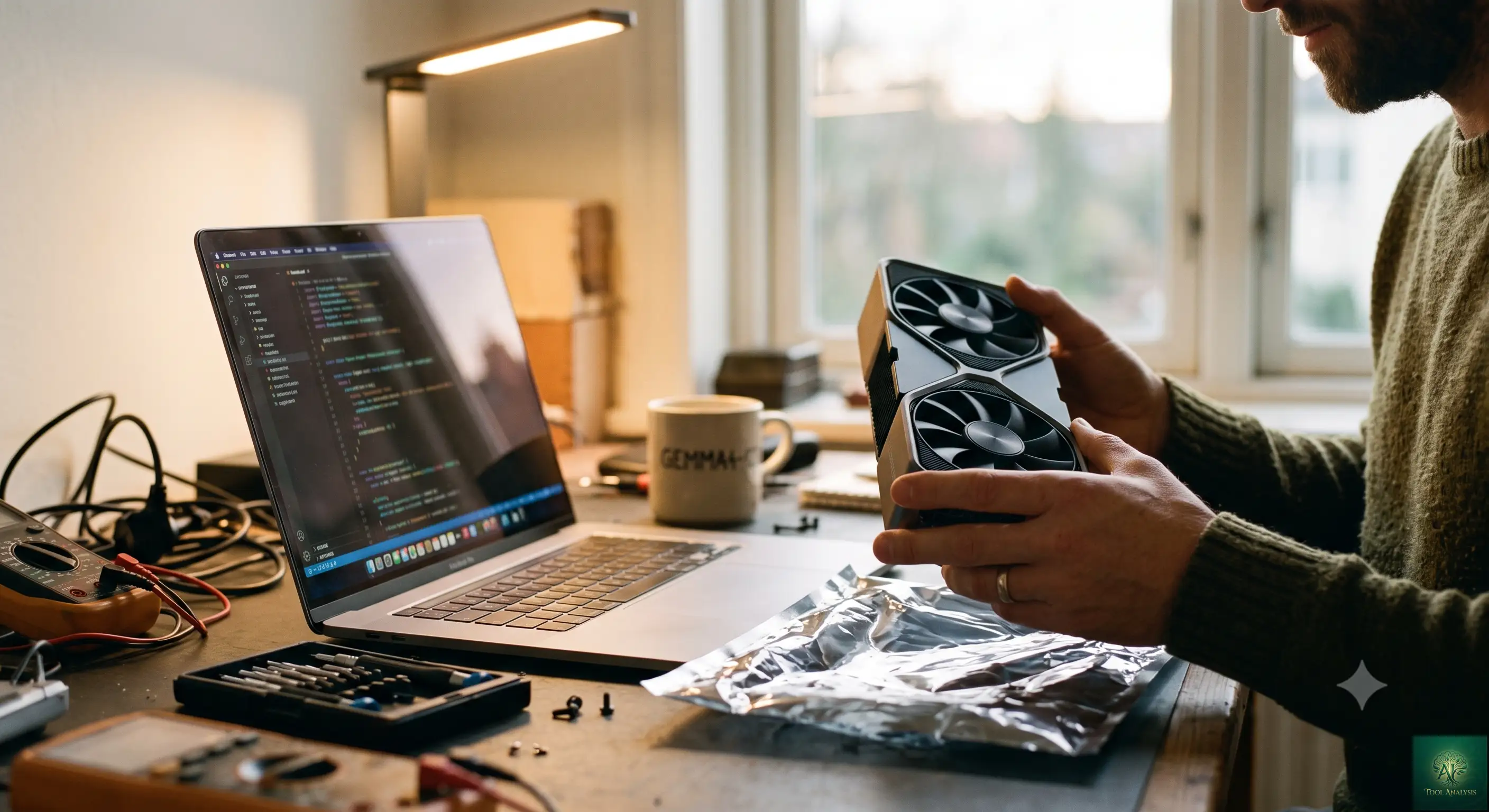
Marketing Claims: “Small enough to run locally with just 16GB of VRAM or unified memory.”
Actual Experience: That figure describes a quantized build, not the real model. Google’s own memory table lists the 12B at 24.0 GB in full BF16 precision and 7.65 GB quantized to Q4_0. The same table measures the key-value cache at 32,000 tokens, not the advertised 256,000. Long contexts consume additional memory that the headline number does not include.
Verdict: 16 GB is honest for everyday chat and short document work at Q4. It is not honest for full precision, and it is not a 256K context promise. Size your machine for the context length you actually plan to use.
Head-to-Head: Which Local Model Should You Run?
The fair comparison is not raw leaderboard position. It is capability per gigabyte of memory, because most famous open models do not fit on your laptop at all.
| Criteria | Gemma 4 12B | Gemma 4 26B A4B | Gemma 4 E4B |
|---|---|---|---|
| Quantized footprint | About 7.4 GB | About 16.2 GB | About 2.3 GB |
| Audio input | Yes | No | Yes |
| Context | 256K | 256K | 128K |
| Hard reasoning | Good | Better | Weak |
| Document parsing at low res | Weakest of the three | Strong | Strong |
| Winner for | Laptop multimodal | Desktop reasoning | Phones and edge |
Verdict per category: the 26B A4B wins on pure reasoning and it wins comfortably. The E4B wins on anything battery powered. The 12B wins the specific slot Google built it for, which is a laptop that needs to see and hear. Nothing else in that slot currently does all three modalities in one file.
🕸️ Three Models, Five Benchmarks — Where The 12B Actually Sits
Against non-Google open models, the picture is more contested, and no Gemma 4 12B review should pretend otherwise. Community consensus through late June leaned toward Qwen 3.6 27B for pure text coding on Apple Silicon, with Gemma 4 holding the multimodal crown. For the heavyweight end of the open model field, our DeepSeek review covers models that need a data centre.
Who Should Use This (And Who Shouldn’t)
Choose Gemma 4 12B if you handle data that cannot leave your machine. Medical notes, legal exhibits, internal recordings. The compliance argument alone justifies the setup time, and nothing gets logged anywhere.
Choose Gemma 4 12B if you are building an agent that makes hundreds of small calls. Every retry is free. That changes what you are willing to experiment with.
Stick with the 26B A4B if your work is text reasoning on a desktop with headroom. The gap on hard reasoning is real and you do not need audio.
Stick with a hosted model if you need current knowledge. Gemma 4’s training data stops in January 2025. For a model released in mid 2026, that is roughly 17 months of missing world. It will confidently describe a stale version of reality, and no amount of prompting fixes that.
Skip entirely if you want a coding agent that competes with subscription tools. LiveCodeBench 72.0% is strong for a local model and still well behind the plans compared in our GLM Coding Plan review.
What Developers Are Actually Saying
The r/LocalLLaMA response was immediate and mostly about hardware, which gave this Gemma 4 12B review more real numbers to work with than usual. Within a day of launch, developers were posting measured throughput rather than opinions, which is the healthiest possible sign for a local model.
One widely shared test on a 12 GB RTX 3060 reported 1,152 tokens per second on prefill and 33.3 tokens per second generating, at a Q5 build with 4K context and flash attention enabled. Another developer measured about 21 tokens per second on an RTX 4060. Those are mid-range gaming cards, not workstations.
The praise pattern is consistent: people like that one file handles three modalities instead of chaining three tools together. The complaint pattern is tooling maturity. A performance regression in multi-token prediction on llama.cpp remained open through mid July, and the chat template needed a manual override for a stretch before quantization publishers caught up.
Adoption is not in doubt. Google reported the Gemma 4 family crossing 150 million downloads, and a single community GGUF repository for the 12B has passed 620,000 downloads in a month.
The Road Ahead
Predictions belong in a separate box from tested facts, so treat this section of the Gemma 4 12B review accordingly. Based on Google’s release cadence and its published signals, three things look likely in the near term.
Short term: continued runtime fixes. The July refresh pattern of updating weights in place, without a version bump, suggests Google is treating Gemma 4 as a living release. Expect more silent improvements and check your local copy periodically.
Medium term: speculative decoding maturing. Google shipped dedicated multi-token prediction drafters, and Ollama reported roughly doubled coding-agent throughput on Apple Silicon once those landed. The gains are real but backend-dependent today.
Long term: other labs copying the encoder-free design. Stripping separate vision and audio encoders is the cleanest known route to shrinking multimodal models for edge devices. If that pattern spreads, this release looks less like an incremental model and more like a turning point.
FAQs: Your Questions Answered
Q: Is Gemma 4 12B really free?
A: Yes. The weights ship under Apache 2.0, which permits free use, modification, and commercial deployment. This is a genuine upgrade over Gemma 3, which used Google’s own source-available Gemma Terms of Use rather than a standard open source licence.
Q: What hardware do I actually need?
A: A 16 GB GPU or a Mac with 16 GB of unified memory is the comfortable target at Q4. An 8 GB card can run a smaller quantization with short contexts. Full BF16 precision needs roughly 24 GB and is only worth it if you are fine-tuning or evaluating quality loss.
Q: Can it replace a paid transcription service?
A: For short clips in supported languages, largely yes. Word error rates on Google’s tests are competitive. The 30 second documented audio limit means you will need to chunk longer recordings yourself, so a purpose-built service still wins on convenience for hour-long files.
Q: Is my data safe?
A: When you run it locally, nothing leaves your machine. That is the single strongest argument for this model. If you access it through a hosted provider instead, normal provider privacy terms apply and the local advantage disappears.
Q: How does it compare to ChatGPT or Claude?
A: It does not compete at the frontier and is not meant to. On Humanity’s Last Exam it scores 5.2%. What it offers instead is privacy, zero marginal cost, and offline operation. Different product, different job.
Q: What is the learning curve?
A: About twenty minutes if you use Ollama or LM Studio. Longer if you go the llama.cpp route and want control over quantization, context size and GPU offload. The thinking-mode gotcha is the main trap for newcomers.
Q: Why did my document OCR results get worse than expected?
A: Almost certainly your vision token budget. Gemma 4 supports 70, 140, 280, 560 and 1120 tokens per image, and document accuracy drops sharply at the low end on this specific model. Raise the budget to 1120 for OCR and PDF parsing.
Q: Do I need to re-download after the July update?
A: If you use tool calling or agent workflows, yes. The refreshed chat template improved tool call reliability and the repository name did not change, so nothing in your tooling will warn you. If you only chat with it casually, the difference is minor.
Q: Is this Gemma 4 12B review based on the current build?
A: This review reflects the post-July-16 refreshed weights and chat template, plus Google’s published technical report from June 19, 2026. Given that Google updates in place, verify against the model card before you commit to production.
Final Verdict
The short version of this Gemma 4 12B review: the model collapses three things that used to be a trade-off into one download. Multimodal capability, local deployment, and a clean commercial licence. A year ago you picked two.
The half point comes off for the parts Google’s marketing skips. The vision resolution cliff is real and underdocumented. The 16 GB claim quietly assumes quantization and a short context. The January 2025 knowledge cutoff will bite anyone asking about recent events. And updating weights in place without a version number is convenient for Google and awkward for anyone running evaluations.
✅ What We Liked
- ✓ 78.8% on GPQA Diamond from a file that fits in about 7.4 GB
- ✓ Apache 2.0 licence — commercial use, modification and redistribution allowed
- ✓ First mid-sized Gemma with native audio input, and no speech encoder to load
- ✓ Text, image and audio in a single GGUF instead of three chained tools
- ✓ Zero marginal cost per call, which changes what you are willing to experiment with
- ✓ Runs on mid-range gaming cards: ~33 tok/s generation on a 12 GB RTX 3060
❌ What Fell Short
- ✗ InfographicVQA falls from 88.4% to 58.7% at a 280 vision token budget
- ✗ The “16GB” claim quietly assumes Q4 and a 32K context, not 256K
- ✗ January 2025 knowledge cutoff — roughly 17 months stale at launch
- ✗ Documented audio limit is 30 seconds, so long recordings need chunking
- ✗ Weights updated in place with no version bump, which breaks reproducible evals
- ✗ MRCR long-context retrieval sits at 43.4% — not a haystack search tool
Use Gemma 4 12B if you want private multimodal AI on hardware you already own and you are willing to spend twenty minutes configuring it properly.
Stick with a hosted model if you need frontier reasoning or current information more than you need privacy.
Try it today: pull the weights from Hugging Face, grab a quantized build from Unsloth’s GGUF release, or read Google’s official developer guide first.


Founder of AI Tool Analysis. Tests every tool personally so you don’t have to. Covering AI tools for 10,000+ professionals since 2025. See how we test →
Stay Updated on Local AI Models
Don’t miss the next major update. Subscribe for honest AI coding tool reviews, price drop alerts, and breaking feature launches every Thursday at 9 AM EST.
- ✅ Honest Reviews: We actually test these tools, not rewrite press releases
- ✅ Price Tracking: Know when tools drop prices or add free tiers
- ✅ Feature Launches: Major updates covered within days
- ✅ Comparison Updates: As the market shifts, we update our verdicts
- ✅ No Hype: Just the AI news that actually matters for your work
Free, unsubscribe anytime. 10,000+ professionals trust us.
Want AI insights? Sign up for the AI Tool Analysis weekly briefing.
Newsletter

Related Reading
Explore more AI model reviews and local deployment comparisons:
- DeepSeek Review for the heavyweight end of the open model field
- Google AI Studio Review if you would rather not manage hardware
- Gemini Flash Review for the hosted Google model when you need current knowledge
- GLM Coding Plan Review for a subscription coding agent comparison
- Qwen3-TTS Review for another open-source model handling audio
- Best AI Developer Tools 2026 for the paid alternatives
- Free AI Tools Review for more zero-cost options we have tested
- How We Test AI Tools for our methodology
Last Updated: August 4, 2026
Gemma 4 12B Version Tested: Post-July-16, 2026 refreshed weights and chat template (google/gemma-4-12B-it)
Next Review Update: September 3, 2026
Have a tool you want us to review? Suggest it here | Questions? Contact us