
ChatGPT Go vs Plus comes down to one question: what does the extra $12 a month buy you? In the US, ChatGPT Go costs $8 a month and Plus costs $20. Go keeps the same chat model as the free plan and gives you more room for uploads, images and memory, and it may show ads. Plus moves you to GPT-6 Sol with thinking levels, expanded deep research and Codex, faster replies and no ads.
Here is the part most comparisons skip: free ChatGPT already has unlimited everyday text chats, so Go does not buy you more chatting. Everything below comes from OpenAI’s own pricing and help pages, read on October 17, 2026. For the wider picture, see our ChatGPT review and our guide to the $100 Pro plan and dots.
⚡ TL;DR: ChatGPT Go vs Plus
💰 Price: Go is $8 a month and Plus is $20 in the US. Both are monthly only, with no annual plan.
🧠 The model gap: Go chats on the same model as Free (GPT-6 Luna, rolling out, per OpenAI). Plus chats on GPT-6 Sol with Medium and High thinking.
📦 What Go adds over Free: higher limits on uploads, images and data analysis, memory, a 54K context window instead of 27K, and 4 GB of storage.
💡 Our take: Go only if you keep hitting Free’s tool limits and don’t mind ads. Plus if ChatGPT is part of your work.
⚠️ The catch: Go is the only paid personal plan that may show ads, and the Ads-Free switch is for Free accounts only.
📑 Quick Navigation
🎯 ChatGPT Go vs Plus: The Short Answer
Put the three cheapest ChatGPT tiers side by side and the pattern is simple. Go is Free with bigger tool limits. Plus is a better model with work tools on top. This table comes from the compare table on OpenAI’s pricing page and its help pages, as of October 17, 2026:
| Free ($0) | Go ($8 a month) | Plus ($20 a month) | |
|---|---|---|---|
| Everyday text chats | Unlimited* | Unlimited* | Unlimited* |
| Chat model | GPT-6 Luna (rolling out) | GPT-6 Luna (rolling out) | GPT-6 Sol |
| Thinking levels | Think only | Think only | Medium and High |
| Instant context window | 27K (about 12 pages) | 54K (about 40 pages) | 54K (about 40 pages) |
| Uploads, data analysis, image creation | Limited | Higher limits | Expanded (per the Plus card) |
| Deep research and Codex | Limited | Limited | Included |
| ChatGPT Work | Limited (desktop app) | Limited (desktop app) | Desktop, web and mobile |
| Response times | Limited on bandwidth and availability | Limited on bandwidth and availability | Fast, priority access |
| Library storage | 500 MB | 4 GB | 20 GB |
| Ads | May appear | May appear | None |
*OpenAI’s footnote says usage “must be reasonable and comply with our policies”, and the Free and Go cards add “Unlimited text chats subject to abuse guardrails.”
Best for Go: people who keep hitting Free’s limits on uploads, images or data analysis and can live with possible ads.
Best for Plus: anyone who uses ChatGPT for real work most days and wants thinking levels, expanded deep research and Codex, ChatGPT Work on the phone and no ads.
Skip both if: you mostly ask quick questions. Free already covers unlimited everyday chat, as our guide to free AI plans explains.
🧩 What ChatGPT Go Actually Gets You Over Free
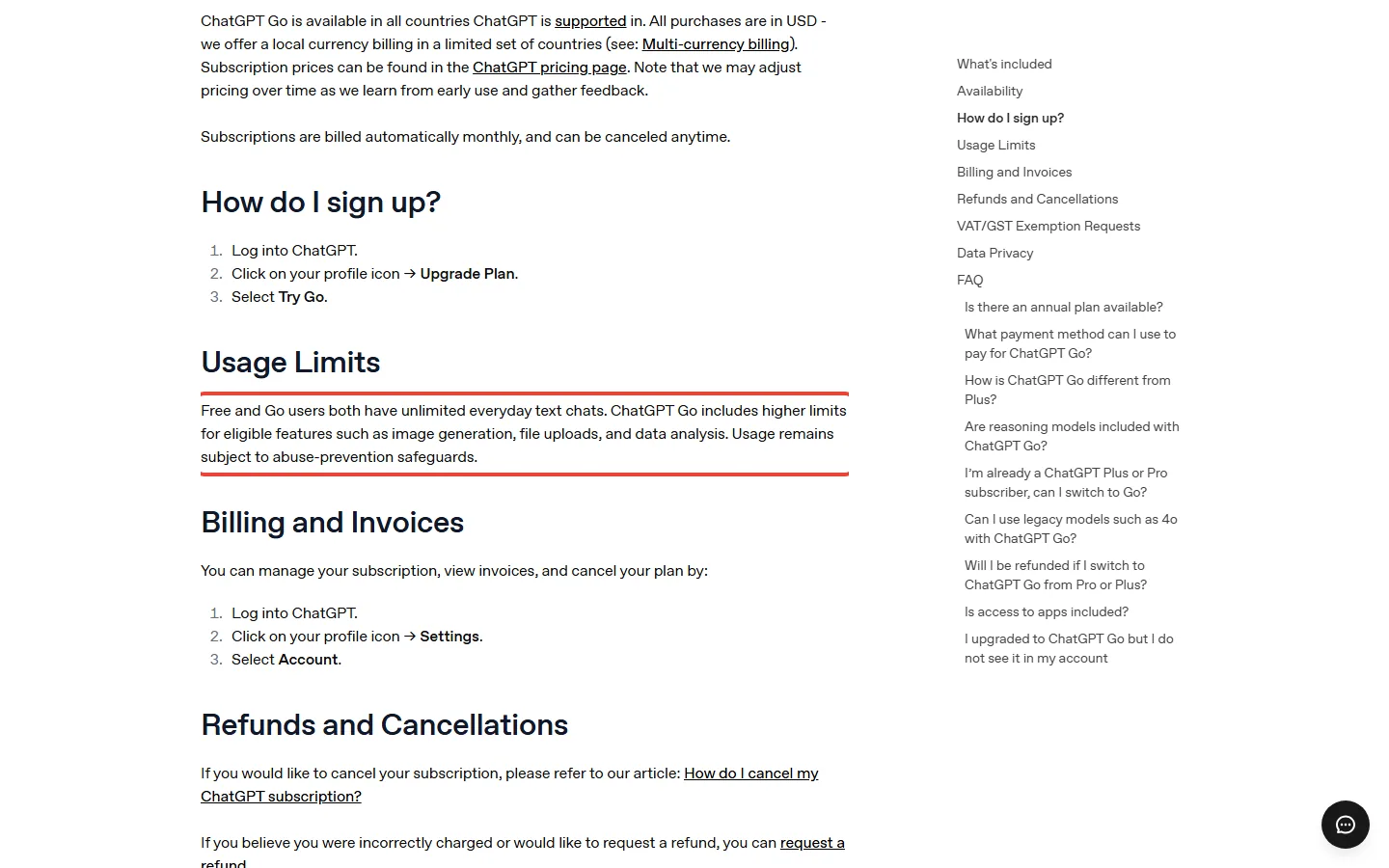
OpenAI’s Go help page sums up the plan in two sentences: “Free and Go users both have unlimited everyday text chats. ChatGPT Go includes higher limits for eligible features such as image generation, file uploads, and data analysis.” Think of Go as Free with a bigger backpack: the same brain, more room to carry files, pictures and memory.
Here is what the pricing table gives Go that Free does not, as read on October 17:
- Uploads, data analysis, vision and image creation: “Limited” on Free, included on Go. OpenAI calls these higher limits and publishes no number.
- Memory: “Limited” on Free, included on Go, and the same for memory with past chats.
- Voice with video and creating plugins: no on Free, yes on Go.
- Library storage: 4 GB on Go instead of Free’s 500 MB, per OpenAI’s release notes.
- A bigger context window: 54K in Instant mode instead of 27K, and 256K when it reasons, where Free’s is listed as “Varies”.
A context window is the notepad ChatGPT keeps for your conversation. On Free it fills after about 12 pages of text; on Go and Plus, about 40. When it is full, ChatGPT can lose track of the earliest parts of a long chat.
📏 GPT Instant Context Window by ChatGPT Plan (thousand tokens)
What stays the same on Go: the chat model, the slow lane on response times, and “Limited” deep research, Codex and ChatGPT Work. The Go help page also says Go does not include GPT-5.6 Sol or legacy models such as 4o.
🔍 REALITY CHECK
The claim: OpenAI’s January launch post says Go gives "10x more messages, file uploads and image creation than the free tier".
The fine print: Since August 2026, Free has unlimited everyday text chats too, according to OpenAI’s release notes, so the messages part no longer separates the plans. For uploads and images, OpenAI now only says "higher limits", with no number.
✅ Verdict: Go’s extra is tool room, not chat volume. Treat the 10x line as a January claim.
⏱️ What Your First Five Minutes on ChatGPT Go Look Like (Per OpenAI)
Going by OpenAI’s own help pages, here is what the first five minutes on Go look like:
- Sign up. Log into ChatGPT, click your profile icon, then Upgrade Plan and Try Go. Purchases are in USD, with local-currency billing in a limited set of countries, and you manage or cancel the plan under Settings, then Account.
- Upload something. A PDF, a spreadsheet or a photo. This is where Go differs from Free: uploads, data analysis and image creation move from “Limited” to Go’s higher limits.
- Ask a harder question with Think. Go users can pick Think on the web, or from the + menu in the mobile app. There are no Medium or High thinking levels on Go; those start at Plus.
If uploads and images are your day, Go stretches further than Free. If you reach for Think on most questions, that is the sign you want Plus. And if your account is in a region where ads are being tested, you may also see a labeled ad below an answer.
⚖️ ChatGPT Go vs Plus, Round by Round
This is where the extra $12 a month goes. Each round uses OpenAI’s own pages as of October 17.
Round 1: The model you chat with (Plus wins)
OpenAI’s GPT-6 announcement is plain about it: “GPT‑6 in ChatGPT is powered by GPT‑6 Sol for Plus, Pro, Business, and Enterprise tiers, and GPT‑6 Luna for Free and Go tiers.” The pricing table agrees: GPT-6 Sol, GPT-6.1 Sol and GPT-6 Astra are marked “No” for Free and Go and “Yes” for Plus.
GPT-6 Astra and GPT-6.1 Sol on Plus live only in ChatGPT Work and Codex. OpenAI’s models help page says “Plus plans include GPT-6 Astra in ChatGPT Work and Codex” and calls GPT-6.1 Sol “a model option for ChatGPT Work and Codex.” A separate Astra usage page estimates 5 to 45 Astra messages per five-hour window there and calls the ranges “estimates, not guaranteed message counts.” GPT-6 Pro in the chat window starts at Pro $100. Our ChatGPT Codex review covers the coding side.
Plus also gets thinking levels. The same models help page lists Medium and High as included on Plus, while Extra High and Pro need a Pro plan, and Free and Go get Think instead. One tip from that page: on Plus, Instant “doesn’t automatically switch to a higher thinking level for complex requests”, so pick Medium or High yourself when it matters.
Round 2: Memory and context window (a tie)
Both plans list the same window: 54K in Instant, about 40 pages of text, and 256K when reasoning, about 320 pages. So the ChatGPT Plus context window size is no bigger than Go’s. The table marks memory “Yes” on Go and “Expanded” on Plus, and storage grows from 4 GB to 20 GB.
Round 3: Speed (Plus wins)
Go’s response times are “Limited on bandwidth & availability”; Plus is “Fast”. OpenAI’s Plus help page adds “Priority access during high-traffic periods: Fewer interruptions even when demand is high.” Plus is not limitless either: it “may include usage limits such as message caps, especially during high demand.”
Round 4: Deep research, Codex and ChatGPT Work (Plus wins)
Deep research, apps for deep research and Codex are “Limited” on Go and included on Plus. ChatGPT Work is limited to the desktop app on Go and runs on desktop, web and mobile on Plus. The Excel, Word, PowerPoint and Google Sheets extensions are limited on Go and included on Plus.
Then there are rows that are simply missing on Go: Sites, Developer mode (beta), image generation with Thinking, interactive tables and charts, legacy models and early access to new features. If you want the image side in detail, our ChatGPT Images limits guide compares free and paid.
Round 5: Voice (close)
The table marks voice “Expanded” on both. OpenAI’s release notes from September 9 set Go at up to 3 hours a day with the smaller GPT-Live-1 mini voice model, and Plus at up to 3 hours with the full GPT-Live-1. A newer voice model, GPT-Live-1.1, started rolling out on October 15. Note one gap in OpenAI’s own pages: the Go help page still says Go’s voice has “the same usage limits as the Free tier.”
What both plans share
Projects and shared projects, custom GPTs (to use, since new GPT creation is not available on any personal plan), Library, scheduled tasks and the training opt-out are on both. The table marks scheduled tasks “No” on Free, although OpenAI’s release notes say Free users can create up to three active scheduled tasks.
🔍 REALITY CHECK
The claim: The Free card says "Unlimited text chats with GPT-6" and the Plus card says "Advanced reasoning models with GPT-6".
The fine print: Same name, different engines: GPT-6 Luna on Free and Go, GPT-6 Sol on Plus. And on October 17, OpenAI’s models help page and Go help page still said Free and Go get GPT-5.6 Luna, while the GPT-6 post and the pricing table say GPT-6 Luna.
✅ Verdict: "GPT-6" on every card does not mean the same model. Check the model picker, which is OpenAI’s own advice.
Put the five rounds together and the shape of the deal is clear.
💡 Key Takeaway: Go buys room; Plus buys a better model, thinking levels and work tools. If answer quality matters more to you than upload limits, Go is the wrong $8.
📢 ChatGPT Go Ads: The Catch on the $8 Plan
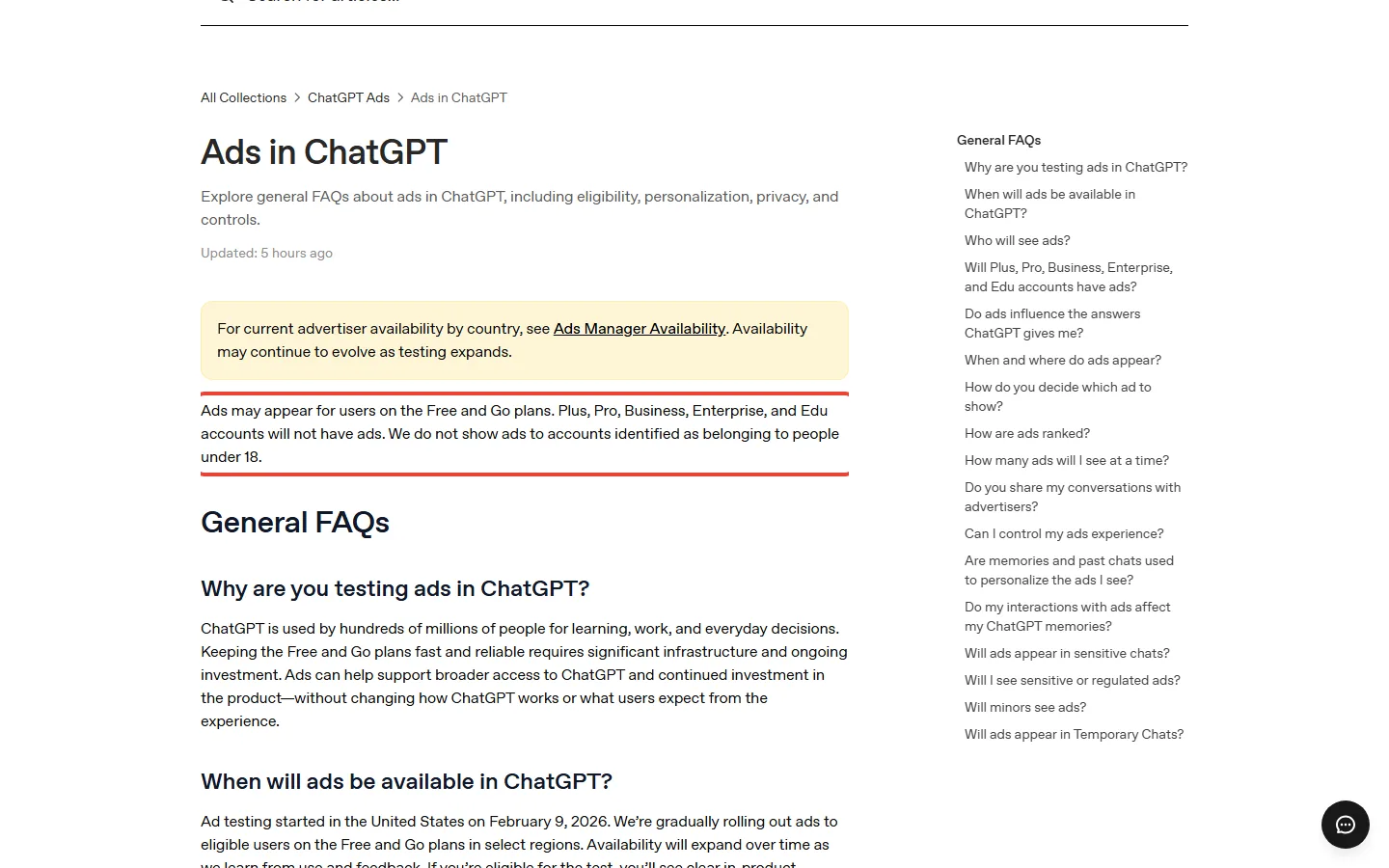
OpenAI’s ads help page says: “Ads may appear for users on the Free and Go plans. Plus, Pro, Business, Enterprise, and Edu accounts will not have ads.” The Go card on the pricing page says it too: “This plan may include ads.” That makes Go the only paid personal plan that may show ads.
Ad testing started in the US on February 9, 2026, and OpenAI is rolling it out to Free and Go users in select regions. Its release notes add Australia, New Zealand and Canada on April 16 and the UK on June 4. OpenAI says ads sit below a response, are clearly labeled and do not influence answers, and that it does not share your conversations with advertisers. There are no ads in Temporary Chats, near personal health, mental health or political topics, or for accounts identified as under 18. OpenAI is also testing a multi-image ad that shows while an image is being created.
Here is the part that stings. Free users can switch to Ads-Free, at the cost of lower limits and no image generation or deep research. Go users cannot. OpenAI’s answer to a Go user asking for Ads-Free: “Ads-Free is a Free-plan option. If you’re on a paid plan, you’d need to switch back to Free to use it, or upgrade to a plan that’s already ad-free (like Plus or Pro).”
🔍 REALITY CHECK
The claim: The Go help page still says "We may start testing ads in ChatGPT Go in the future."
The fine print: OpenAI’s newer ads help page and the Go card say ads may already appear on Go, and testing has run in the US since February. The two pages disagreed on October 17.
✅ Verdict: Go by the ads page: if you live where ads are being tested, Go may show them now, and you cannot turn them off.
💳 ChatGPT Go Price vs Plus Price: What You’ll Actually Pay
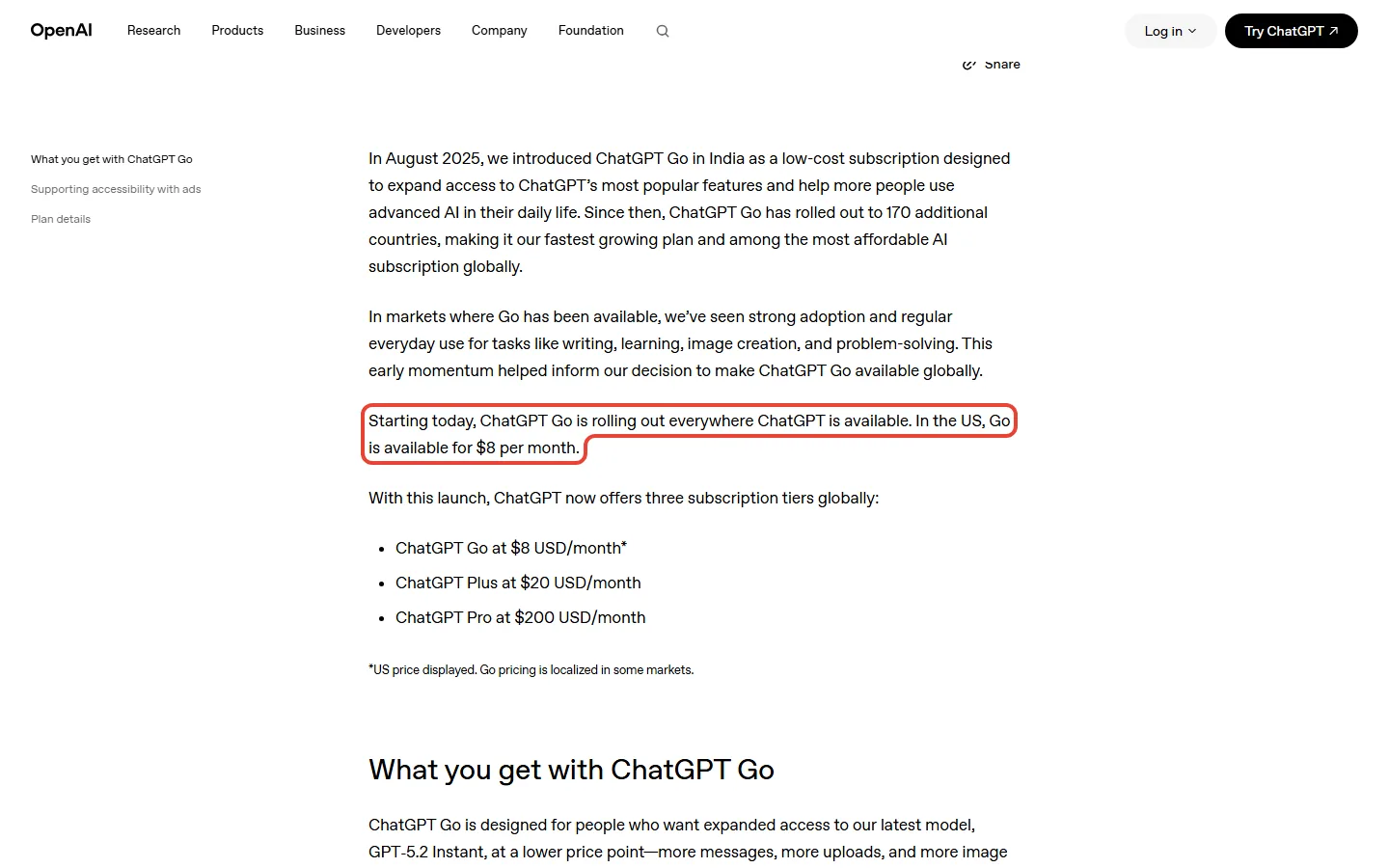
Here are the ChatGPT pricing tiers in US dollars. OpenAI’s Go launch post says “In the US, Go is available for $8 per month” and the Plus help page lists $20 a month, billed monthly.
| Plan | Monthly (US) | A year at the monthly price | Chat model | Ads |
|---|---|---|---|---|
| Free | $0 | $0 | GPT-6 Luna (rolling out) | May appear |
| Go | $8 | $96 | GPT-6 Luna (rolling out) | May appear |
| Plus | $20 | $240 | GPT-6 Sol | None |
| Pro 100 | $100 | $1,200 | GPT-6 Sol + Pro reasoning (GPT-6 Astra) | None |
| Pro 200 | $200 | $2,400 | GPT-6 Sol + Pro reasoning (GPT-6 Astra) | None |
| Pro 500 | $500 | $6,000 | GPT-6 Sol + Pro reasoning (GPT-6 Astra, with Ultrafast) | None |
The real-world cost math:
- Go to Plus: $20 minus $8 is $12 a month, $144 a year, or about $0.40 a day
- Plus costs 2.5 times as much as Go; put the other way, Go is 60% cheaper
- Per day: about $0.27 for Go and about $0.67 for Plus
- Per message: impossible to work out, because OpenAI publishes no message counts for chat on either plan
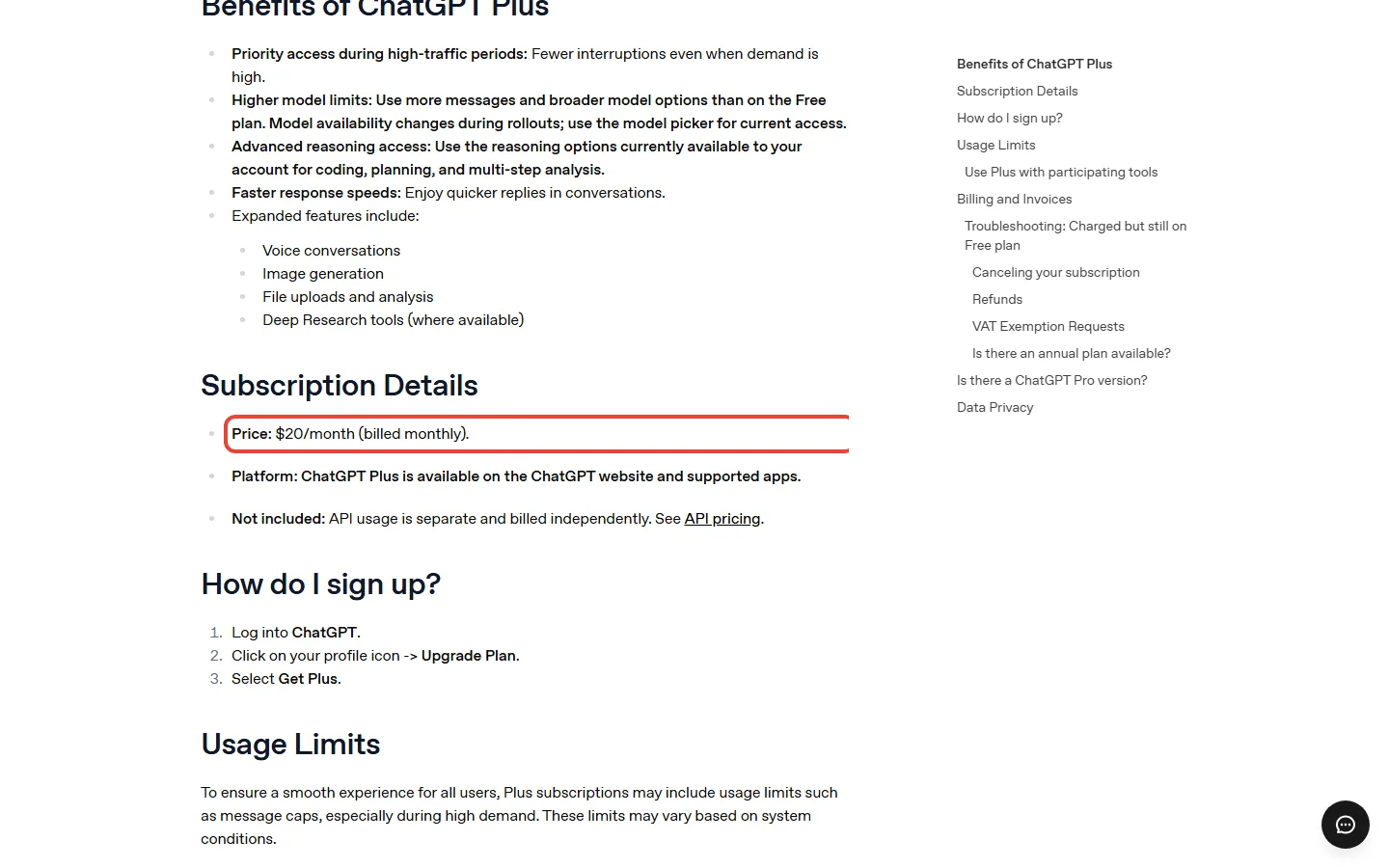
There is no annual discount to soften either number. OpenAI’s Go help page says: “Currently, we do not support annual billing or the option to pay for multiple months in advance for ChatGPT Go, Plus, or Pro subscriptions.” OpenAI’s Go launch post adds that Go “pricing is localized in some markets”, so your local price can differ from the US one, and the Go help page says OpenAI may adjust pricing over time.
🍩 Where a Year of ChatGPT Plus Goes ($240, US)
Two more money notes. Switching down from Plus to Go brings no refund: OpenAI says your Plus plan stays active until the end of the billing cycle, then the account moves to the Go rate. And the free 12-month Go offer that OpenAI ran in India is over: its release notes say “as of January 21, 2026, the promo has ended.”
🧭 Which ChatGPT Plan Should You Pick? (Who Should Pay)
Choose Free if: you chat, ask quick questions and draft the odd email. Everyday text chats are unlimited, and you can even switch to Ads-Free if ads reach your region.
Choose Go if: you keep hitting Free’s limits on uploads, images or data analysis, you want the bigger 54K window and memory, and possible ads do not bother you. Go is the budget pick for students and households who live in files and photos, not in hard reasoning.
Choose Plus if: ChatGPT is part of your work most days. You get GPT-6 Sol with Medium and High thinking, expanded deep research and Codex, ChatGPT Work on web and phone, faster replies and no ads. If you are weighing Plus against other $20 assistants, our Meta Muse vs ChatGPT comparison and Claude AI review cover the alternatives.
Upgrade to Pro if: you want GPT-6 Pro in the chat window or a dot working for you. Pro starts at $100 a month; our ChatGPT dots pricing guide explains the three Pro tiers.
Skip paying if: a cheaper or free assistant already covers you. Our DeepSeek vs ChatGPT and Google AI Plus review show two other routes.
Our two-host episode walks through every ChatGPT plan, from Free to the $500 Pro tier, if you prefer to listen:

💬 What Reviewers Are Saying About Go vs Plus
The “ads in a paid plan?” camp. When Go reached the US in January, tbreak wrote: “It is an interesting choice to include ads in a paid product,” adding that OpenAI seems to be positioning Go “as a utility upgrade rather than a premium experience.”
The “past free, fine without the newest models” camp. Chris Alarcon, who says he never subscribed to Go and worked from OpenAI’s pages, sums it up as: “Go is what you pay when you are past free, you keep hitting limits, and you are fine without the newest models.” For anything you will act on, his advice is to pay the extra $12.
The “casual vs work” camp. Dupple‘s comparison, updated in September, lands in the same place: “For casual chat, Go is the deal; for work, Plus is the right tier.”
The common thread: none of these reviewers argues Go is a cheaper Plus. It is a roomier Free, and the ads are the price of the discount.
🔭 The Road Ahead
Short term (next 3 months): expect OpenAI to bring its older help pages in line with the GPT-6 rollout, since two of them still named GPT-5.6 Luna for Free and Go on October 17. The new GPT-Live-1.1 voice model is rolling out, and OpenAI says ad availability “will expand over time”.
Medium term (6 to 12 months): OpenAI says it may adjust Go pricing over time as it learns from early use. Based on that wording, a price change or new regional prices for Go are possible; nothing is announced.
Long term: watch whether OpenAI ever publishes real limits for Go and Plus. Until it does, “Limited”, “higher limits” and “Expanded” are the only measures you get. We will update this post when the plans change.
❓ ChatGPT Go vs Plus: FAQs
Q: Is ChatGPT Go worth it?
A: It depends on what you do. Go is worth $8 a month if you keep hitting Free’s limits on uploads, images or data analysis and don’t mind possible ads. It gives you no better chat model and no more everyday chats than Free.
Q: What is the difference between ChatGPT Go and Plus?
A: Plus chats on GPT-6 Sol with Medium and High thinking and adds expanded deep research and Codex, ChatGPT Work on web and mobile, faster replies and no ads. Go chats on GPT-6 Luna (rolling out), like Free, with higher tool limits. Both have a 54K context window.
Q: How much is ChatGPT Go?
A: ChatGPT Go costs $8 a month in the US, billed monthly. OpenAI says Go pricing is localized in some markets, so your local price can differ, and there is no annual plan. Plus is $20 a month.
Q: Is ChatGPT Go free?
A: No, Go is a paid plan. OpenAI ran a free 12-month Go offer in India, but its release notes say the promo ended on January 21, 2026. Free ChatGPT itself already has unlimited everyday text chats.
Q: Does ChatGPT Go have ads?
A: It can. OpenAI’s ads help page says ads may appear on Free and Go, while Plus, Pro, Business, Enterprise and Edu have none. Go users cannot switch on Ads-Free, which is a Free-plan option.
Q: Does ChatGPT Go get GPT-6?
A: Yes, it is rolling out, but not the same GPT-6 as Plus. OpenAI says Free and Go use GPT-6 Luna and Plus uses GPT-6 Sol. Two OpenAI help pages still named GPT-5.6 Luna for Free and Go on October 17, so check your model picker.
Q: What is the ChatGPT Plus context window size?
A: 54K tokens in Instant, about 40 pages of text, and 256K when it reasons, about 320 pages. Go has the same numbers; Free has 27K in Instant and Pro has 128K.
Q: Can I share ChatGPT Go or Plus with my family?
A: No. OpenAI’s pricing page says Go, Free and Plus are designed for individuals, and the pricing page lists no family plan. Business plans for teams start at 2 users.
🏆 Final Verdict: Is $8 Enough?
Verdict: DEPENDS. For most people asking whether ChatGPT Go is enough, the honest answer is that Go is a roomier Free, not a cheaper Plus. If your problem is Free’s limits on uploads, images and memory, $8 a month fixes it. If your problem is answer quality, speed or work tools, only Plus or higher fixes it, starting at $144 a year more.
Our rating for ChatGPT Go’s value against Plus is 3.5 out of 5. It earns points for the bigger window and tool limits at $8, and loses them for the same chat model as Free, unpublished limits and ads you cannot switch off.
✅ Where Go Wins
- ✓ $8 a month, $12 less than Plus
- ✓ Same 54K context window as Plus
- ✓ Higher limits on uploads, images and data analysis than Free
- ✓ 4 GB of storage instead of Free’s 500 MB
⚠️ Where Go Falls Short
- ✗ Same chat model as Free, no thinking levels
- ✗ Deep research, Codex and Work stay limited
- ✗ May show ads, with no Ads-Free option
- ✗ No published message or upload numbers
Choose Go if you need more room than Free and nothing more. Stick with Plus if you rely on ChatGPT for work. Compare the plans yourself on OpenAI’s pricing page. Related: our ChatGPT review, Codex review and Perplexity review cover what else your money can buy.

Founder of AI Tool Analysis. Reads every pricing page, help article and footnote so you don’t have to. Covering AI tools since 2025. See how we research →
Related Reading
- ChatGPT Review 2026: GPT-6 Astra, the $500 Tier and What Changed
- ChatGPT Dots Pricing: Is the $100 Pro Plan Worth It?
- ChatGPT Codex Review 2026
- ChatGPT Images 2.5 vs Nano Banana 2.1: Free vs Paid Limits
- Meta Muse vs ChatGPT: Which $20 AI Agent Is Worth It?
- DeepSeek vs ChatGPT 2026: Is the Cheap One Better?
- Is Google AI Plus Worth It? Google AI Plus Review (2026)
- Free AI Tools 2026: What 13 Free Plans Really Give You
Stay Updated on AI Tool Pricing
Don’t overpay for AI tools. Get weekly pricing updates, new tier alerts, and honest reviews delivered to your inbox. No hype, no spam.
- ✅ Price-change alerts for every major AI tool
- ✅ New tier announcements as they happen
- ✅ Honest comparisons that cut through marketing
- ✅ Safety updates on the tools you rely on
Free, unsubscribe anytime.

Last Updated: October 17, 2026 | Facts checked: October 17, 2026 (prices, the plan compare table, models, ads rules and voice against OpenAI’s own pricing and help pages) | Next Review Update: October 24, 2026, when the GPT-6 Luna wording on OpenAI’s help pages and the ads rollout are re-checked.
Have a tool you want us to cover? Suggest it here | Questions? Contact us