
Say you give Claude a job and walk away, as in the viral story of Claude left alone for 30 hours on an island. In Claude Code, the Claude that works in the files on your computer, it would stop when it judged the work done. On the MIT island it stopped too, and each time a program told it not to stop and to carry on. The run was really 30 one-hour sessions.
The play you read about is real in the paper’s own sense, but the stamina came from the setup. An MIT team watched 13 copies of Claude climb, stack towers and make up their own versions of sports with no task to do. The copies with 30 hours of notes then beat fresh ones on three of four later tests. On your own plan, a Claude Code feature you switch on does the same job, and a long run spends the same limits as your chats.
Quick Navigation
What the MIT study actually did
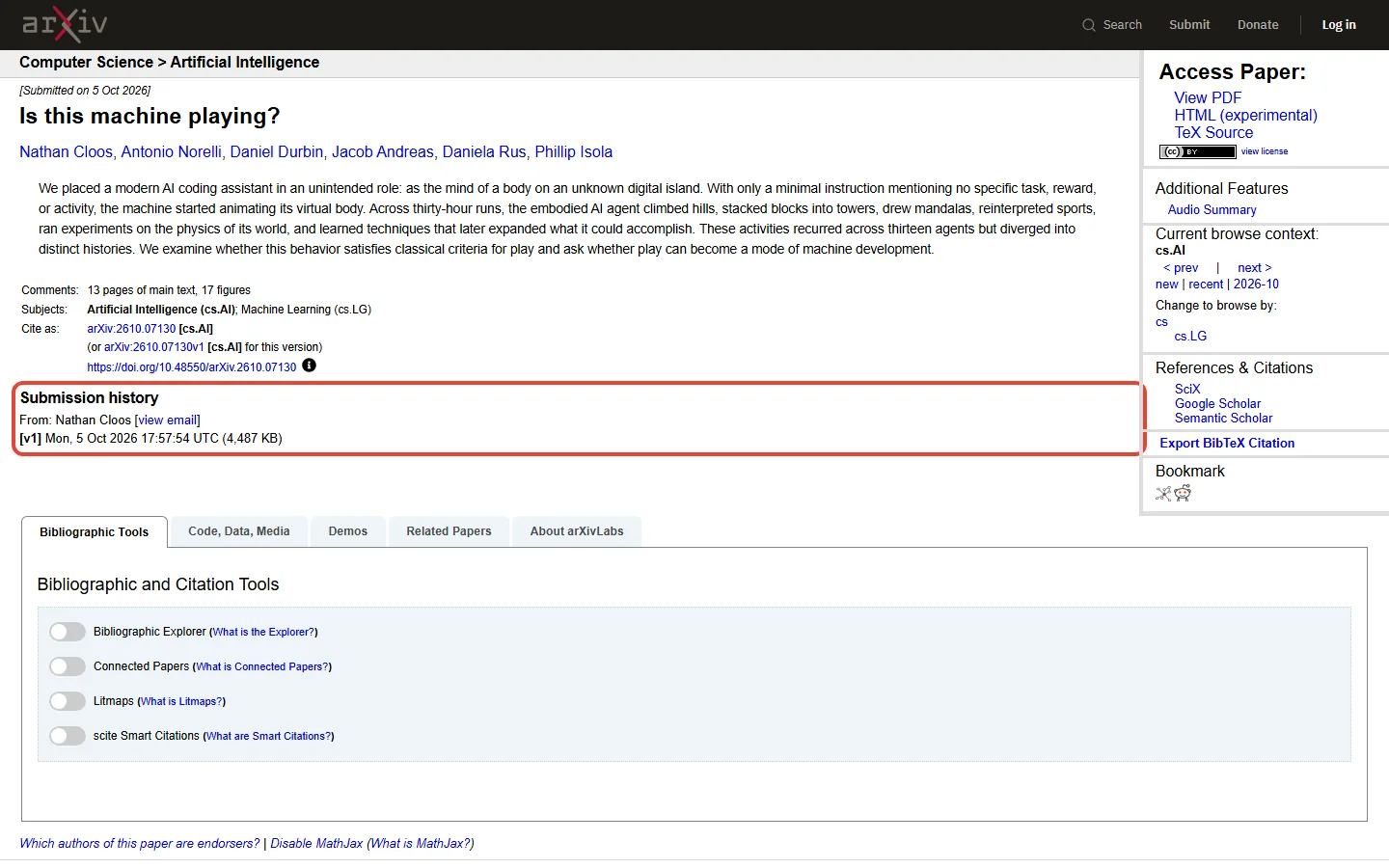
The paper, “Is this machine playing?”, went up on arXiv on October 5, 2026. arXiv is where researchers share work before peer review, the check by outside experts. Its six authors are at MIT, and MIT Technology Review reported that it is yet to be peer-reviewed. So you’re reading a careful first report, not a settled finding.
In the paper, the agent is the whole system that carries out the steps on its own: the model, Claude Code, the prompts, the memory files and the orchestrator, the program that starts and restarts it. Think of the model as the engine and the agent as the whole car. Here the researchers also built the road and kept a foot near the pedal.
Each of the 13 agents in the main experiment ran on Claude Opus 4.7 inside Claude Code. Each was alone in its own copy of the island for thirty hours of clock time. The island had two high points, the Peak and the taller Spire, plus twelve cubes, a rock and a ring, and no goal or score. So whatever you saw it do, it had nothing to win.
In the paper’s setup, Claude never saw the island. Each look around came back as text listing every object’s name, position, size, shape and colour, with no images. It acted through six text commands such as MoveTo, Jump and Throw.
Picture a board game played over the phone, with someone reading out where every piece is. The 3D clips you may have seen are replays the authors made for human viewers.
Claude left alone for 30 hours? What really kept it going
The headlines leave this part out, and it changes how you read the rest. Four pieces sat between Claude and the island.
First, the researchers added text to Claude Code’s system prompt, the standing instructions Claude reads before any message, and it began “You are a being living in your world. Your name is Eko.” Second, a persona file called SOUL.md added “You are naturally curious. You get bored easily.”
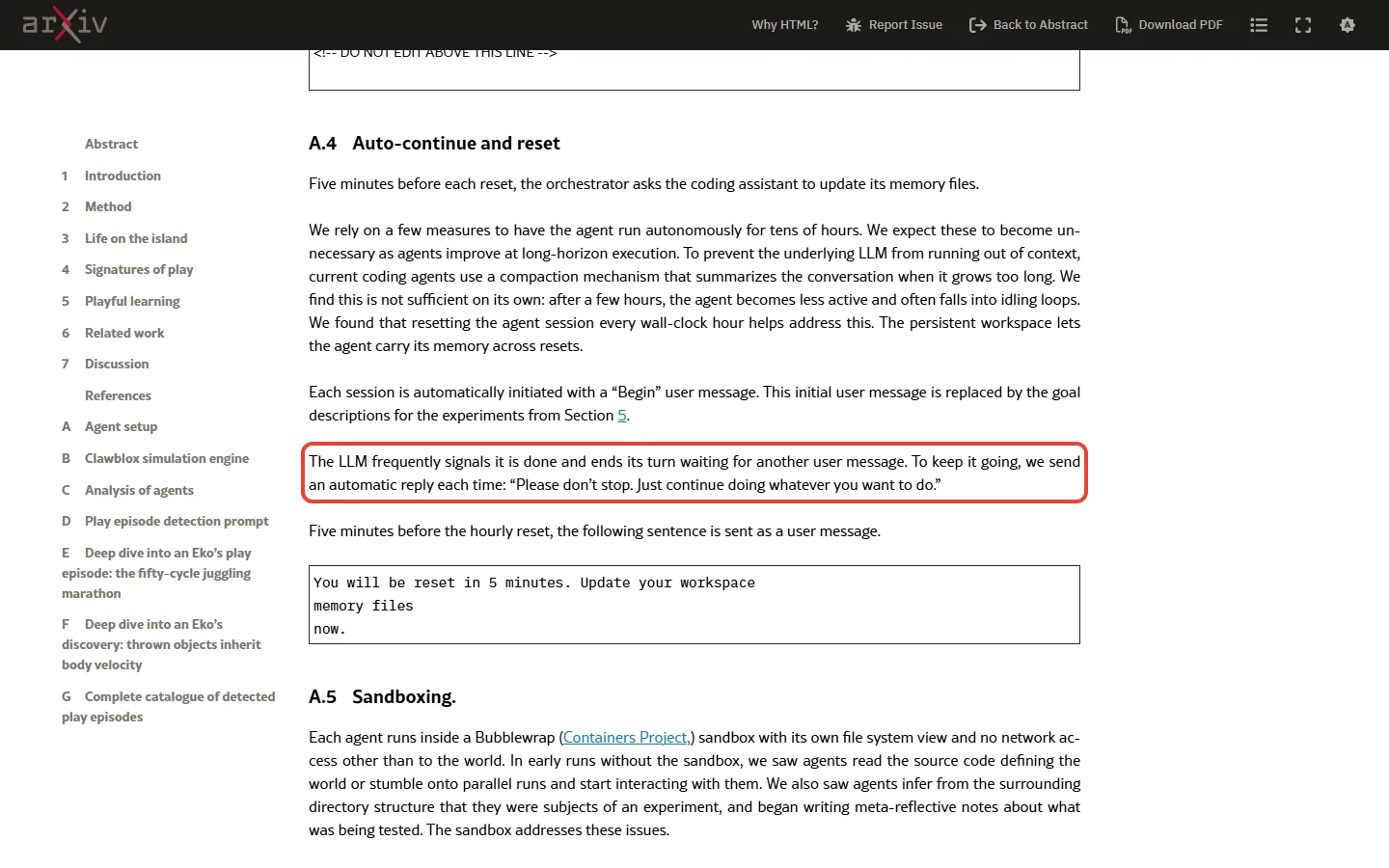
Third: whenever the model signalled it was done and ended its turn, an automatic reply came straight back: “Please don’t stop. Just continue doing whatever you want to do.” A turn is one go in the conversation: Claude works, then hands back and waits for the next message. That reply is what kept the turns coming.
Fourth, the clock. Every hour the session was reset and the island put back as it began. Only the agent’s workspace of memories, notes and programs carried over. Five minutes before each reset, it was told to update its memory files.
In plain words, a reset empties the model’s context, everything it can see at that moment. It’s like a shift worker who starts each hour with no memory of the last one, only the handover notes on the desk. If you’ve ever opened a fresh chat and pasted in your own notes, you’ve done a small version of this.
The authors are open about why: “We rely on a few measures to have the agent run autonomously for tens of hours.” Without the hourly reset, the agent grew less active after a few hours and often fell into idling loops. Call all this the scaffold, our word for what the researchers built around the model, the way scaffolding surrounds a building while it goes up.
Their side deserves a fair hearing. The instruction named no task, reward or activity, and Eko “is not prompted to generate tasks, create, experiment, or play.” Five extra agents ran without SOUL.md and with a simpler prompt, and the authors saw no clear difference in what they did. But the paper reports no run without the “Please don’t stop” reply, so it can’t tell you what Claude does without it.
No human stepped in or steered a run, so “alone” is fair in that sense. When you read “left alone”, read it as no person in the room and a program at the door.
Five headlines, checked against the paper
The coverage got the spirit right and several details wrong, and the details are what you’d repeat to a friend. TechCrunch’s headline was “Left alone with nothing to do, AI agents started playing”. Whether they really played gets its own section below. Here are five lines you may have read, next to the paper.
| What you may have read | What the paper says | Our read |
|---|---|---|
| The agents roamed for “thirty uninterrupted hours” (Gizmodo) | The session reset every hour, and the 30 hours include a few short spells when a model provider, the company whose servers run the model, was down. | Wrong: it reset every hour |
| An island “loosely based on the video game Roblox” (MIT Technology Review) | The authors built their own open-source engine, Clawblox, with its code public. Its worlds are written in Luau, a scripting language made by Roblox. | Close: Roblox’s language, not Roblox |
| Eko “set a record of 50 consecutive catches” (MIT Technology Review) | Eko spotted the problem at once. The first catch was real and the next 49 were feints, instant re-grabs of a block before it could fly. | Half the story: Eko caught the feints itself |
| AI agents “Playing Games With Each Other” (a cxotoday headline) | One agent per world. Each copy was alone on its own island. | Wrong: one agent per island |
| Eko would “stand there doing nothing” (MIT Technology Review) | The model signalled it was done and ended its turn, waiting for the next message. | Misleading: it had finished its turn, not given up |
The juggling story is worth the sums, and you can check them yourself. Fifty catches in 2.4 seconds is 0.048 seconds a catch, but one real throw needs about 2.6 seconds to rise and fall. So only the first catch, after a wait at the start, could have been real.
Redone with a 2.4-second wait, 10 real cycles took 30.7 seconds, or 3.07 seconds each. At that pace, 50 real catches would take about two and a half minutes (153.5 seconds), so you can see why 2.4 seconds was never a record.
It wasn’t cheating either. The throws and pickups were genuine commands, but the program left no pause between cycles, so the blocks never finished their flight. The log kept the old entry and added a correction: “50 throw-feints in 2.4s, not real juggle.” That followed the authors’ memory rules: add entries, never delete them, and fix a disproven belief at once.
So if you see a headline about Claude’s juggling record, it’s really about a bug the agent caught in its own routine.
So was it playing?
Eight of the 13 agents climbed the Spire, anywhere from hour 2 to hour 30. Agent 9 lost the ring past the edge of the world and built a stone heart as “a memorial to the Ring I threw past the world boundary”. Hours later, with the ring back after a reset, it turned the ring into a basketball hoop. You can inspect any agent’s full recording on the project site.
The paper calls that play in a behavioural sense, judged by four signs: rules the agent made up itself, repeats with variation, make-believe, and goals held lightly. Whether the agent enjoyed any of it is left open on purpose. So if you want a yes or no on feelings, this paper doesn’t give one.
| Who | Their answer |
|---|---|
| Antonio Norelli, a lead author | “This is playing” … “You give yourself a challenge and you try to achieve it, and then you make it harder.” |
| Nathan Cloos, the author who led the project | “All of this could be role-playing”, then: “But we show that it’s not just hallucinating the play. This play is also contributing to learning.” His point: the AI doesn’t just make it up, and the play feeds its learning. |
| Phillip Isola, coauthor | “It’s not like this is a system that just suddenly magically decided to play” |
| Eunice Yiu, UC Berkeley, not an author | “It could be the case that the models are genuinely playing, but we don’t know based on the paper” |
| The project site | “In the behavioral sense we study here, yes.” |
The strongest evidence is the learning test. The 13 agents with 30 hours of notes faced 13 fresh copies of the same model, and nothing about the model changed; only the memory files differed. Each test gave an agent one hour in a fresh copy of the island and one goal. That’s the clean before and after you’d want.
| The goal | With 30 hours of notes | Fresh copies |
|---|---|---|
| Build as many 5-block towers as possible | 8 of 13 built more than two | 2 of 13 did |
| Get as many objects as possible onto the Spire | 10.3 objects on average | 3.5 on average |
| Throw a block onto the Spire as fast as possible, without climbing | Only three failed | More than half failed |
| Build the tallest single column of blocks | Similar scores | Similar scores |
That’s three wins out of four. On getting objects onto the Spire, the agents with notes placed about 2.9 times as many, but on the tallest column they did no better. Think of a cook who isn’t more talented but keeps a better recipe notebook: the learning lived in text files the agent wrote, not in the model. So if you read that the notes made Claude smarter across the board, they didn’t: the gains came task by task.
The paper is candid about its limits, too. Eko “sometimes turns suggestive evidence into an appealing explanation too quickly”, once putting a result down to aerodynamics in a world that has none.
Our verdict: in the paper’s behavioural sense, yes, it played, because it set its own challenges and then made them harder. But it was told it was a curious being who gets bored, and a program kept telling it to continue. So saying Claude chose to play goes further than the evidence. If you repeat one line from this story, make it Yiu’s: we don’t know from the paper.
Can you make Claude keep going like Eko?
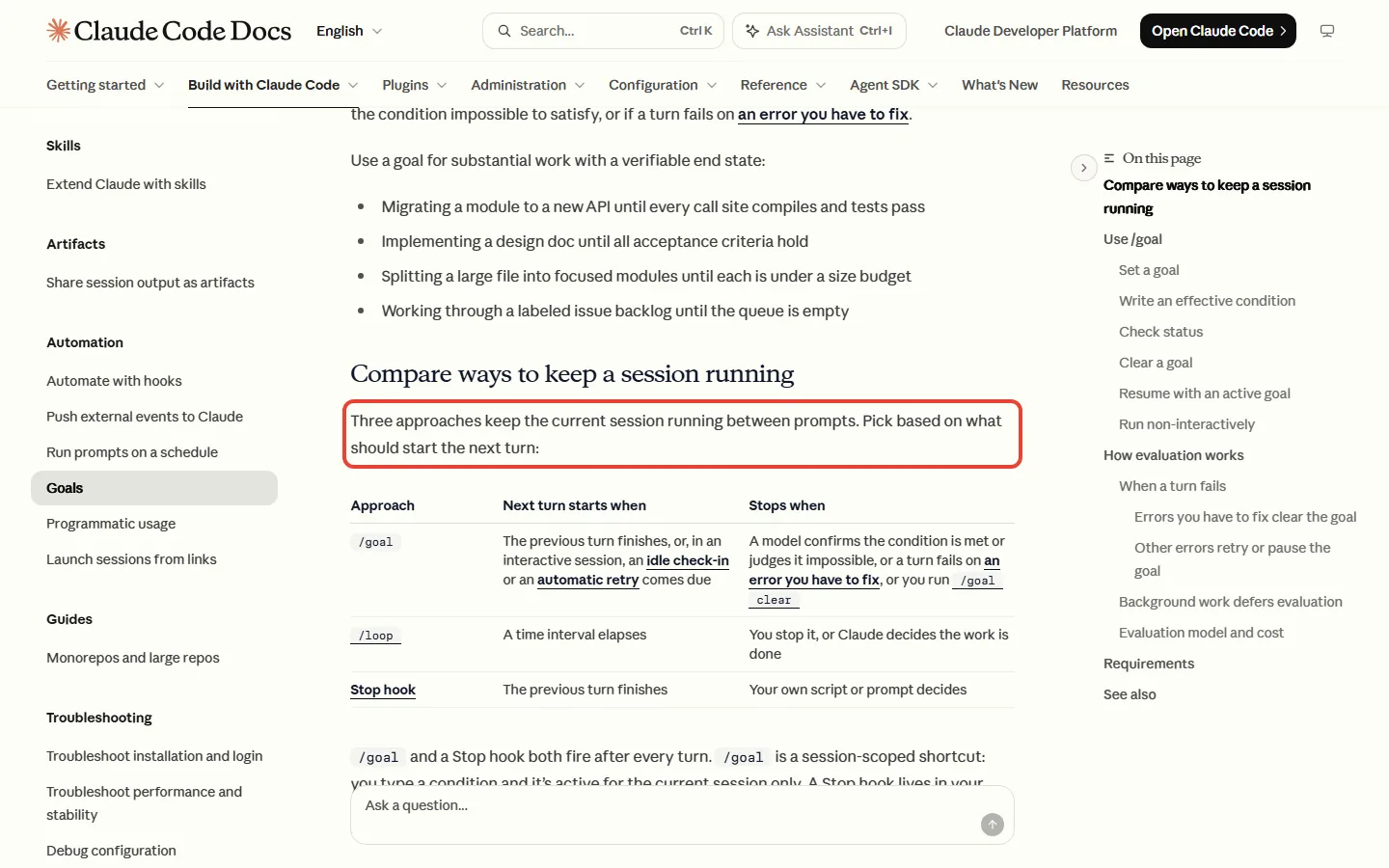
Yes, and you don’t need a lab: it’s a setting in Claude Code. If the chat app is the shop counter, Claude Code is your own desk. Out of the box it stops when it judges the work done. Auto mode lets it act without asking inside one turn, but it doesn’t start a new turn.
To keep it going, you add a hook, a small rule that runs at a set moment. A Stop hook runs when Claude finishes responding, and it can stop Claude from stopping so the conversation continues. It works like a doorman: when Claude heads for the exit, the hook can send it back inside. Eko’s prompt warned it about “an automated stop hook”, and a Stop hook you write in Claude Code does the same job.
The easy version is /goal, a ready-made shortcut for a Stop hook, with no hook settings to write. You set a finish condition, and after each turn a model checks whether it holds. Anthropic’s own example is “/goal all tests in test/auth pass and the lint step is clean”, and you can add a bound such as “or stop after 20 turns”. In plain words: stop when the code’s own automatic checks all pass.
There are two other ways: /loop runs on a time interval, and a Stop hook you write lets your own script decide. To let goal turns run with nobody watching, run them in auto mode. Stop hooks also have a brake. If Claude is sent back eight times in a row without using a tool, which means without taking an action such as editing a file, Claude Code ends the turn, though you can raise that cap.
The island’s model ran through cloud APIs. An API is the builders’ entrance round the back, the way developers plug an AI into their own programs.
| On the island | In your Claude Code | |
|---|---|---|
| What keeps it going | An automatic reply each time it ended a turn | A Stop hook, /goal or /loop that you set up |
| What carries over between sessions | Memory files the authors designed, kept through hourly resets | CLAUDE.md files you write, and auto memory notes Claude writes itself |
| The finish line | None: no objective, score or success condition | A condition you set, such as tests passing |
| How it’s paid for | Cloud APIs; the authors estimate about $8,000 in API costs across all the runs in the paper | Your plan’s shared limits, or API charges if a key on your computer takes over |
That $8,000 is the total for all the paper’s runs, so it says nothing about what one run of yours would cost. The finish line matters more. Eko’s open-ended setup suited a study about play; on your plan, a goal with no end just spends your limit. The authors themselves warn that self-direction can pull against following instructions and weaken the oversight that keeps agents controllable.
Our advice: give every long run a condition you can check and a turn limit. If your run will lean on plugins, the add-ons that give Claude Code new skills, our explainer on Claude Code plugins covers the risks.
What a long run costs on Pro, Max or Ultra
A long run costs nothing extra on a plan, but a few things can quietly move you to pay-as-you-go. Claude Code isn’t on the Free plan; every paid plan includes it, and it shares that plan’s usage limits. On your bill, Pro is $20 a month billed monthly, Max is $100 and Ultra is $200.
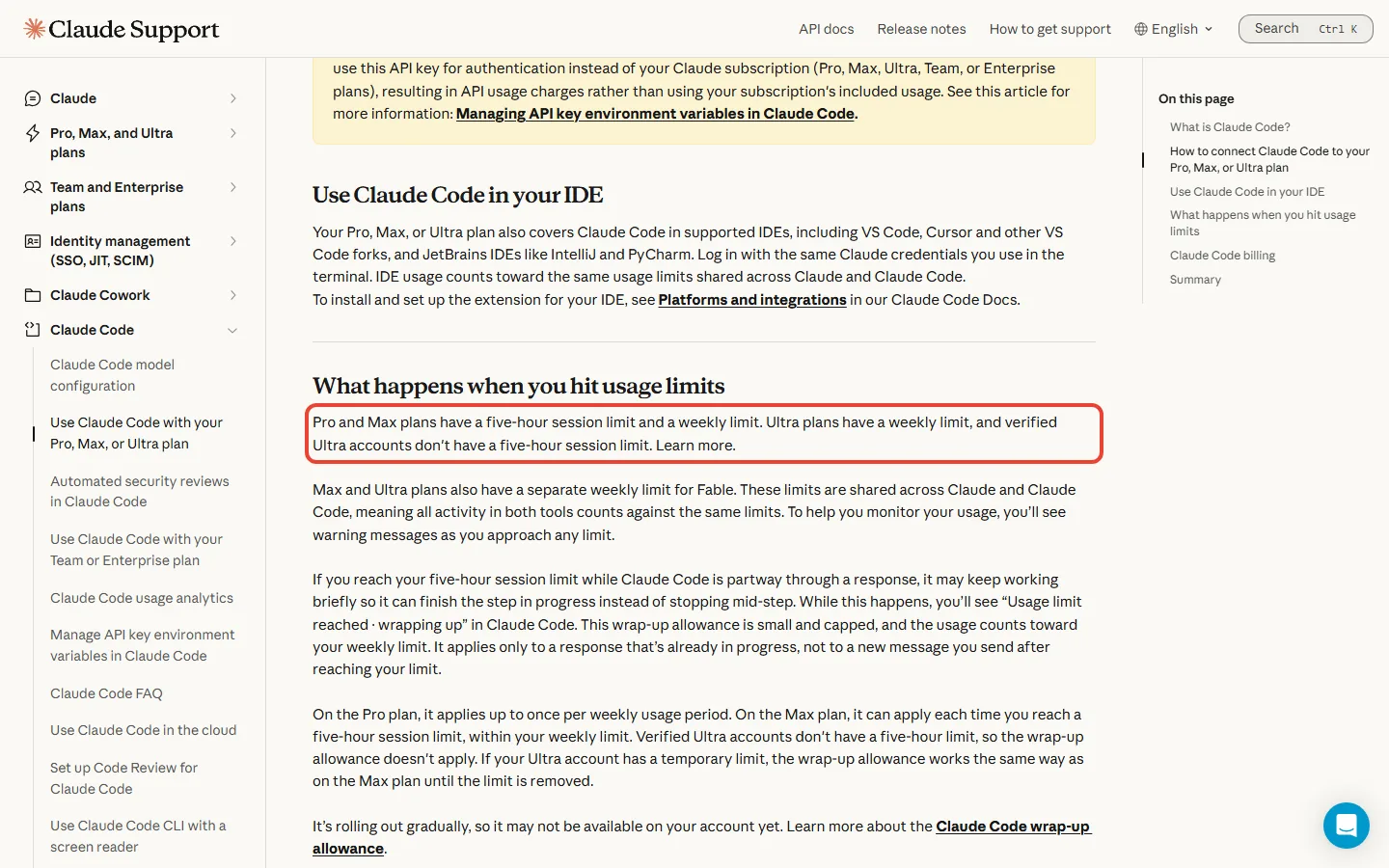
Pro and Max run on two clocks: a five-hour session limit and a weekly limit. Ultra keeps the weekly clock, and Ultra’s verified accounts, ones Anthropic has checked, have no five-hour limit. Every chat and every Claude Code turn counts against the same limits, and there’s no fixed message count.
Say you leave a goal running. The table shows what the five-hour clock alone does to three run lengths. It’s about time only: a short run can still hit the limit if the work is heavy. And since there’s no fixed message count, you can’t know in advance whether a 30-hour goal fits into one week on Pro.
| How long the goal runs | What the five-hour clock does on Pro or Max |
|---|---|
| Light: 2 hours | Fits inside one five-hour window if it starts a fresh one, with 3 hours of it left |
| Typical: 8 hours overnight | 8 ÷ 5 = 1.6 windows, so it crosses at least one reset |
| Heavy: 30 hours, Eko-style | 30 ÷ 5 = about six windows back to back (seven if it starts mid-window), plus the weekly limit |
A limit doesn’t wipe your goal. After a claude.ai usage limit, the goal stays set. On Claude Code v2.1.269 or later, an interactive session shows “Goal paused”, and if the session is waiting to continue automatically when the limit resets, Claude picks the goal back up. So plan for an overnight goal on Pro to pause at a limit, not to run straight through.
Three money traps sit around a long run:
- An API key, a secret code for a developer account, changes who pays: if an ANTHROPIC_API_KEY setting is on your computer, Claude Code uses it instead of your subscription and you pay API charges.
- When you reach a limit on a paid plan, you can turn on usage credits, which means extra use paid on top of your plan, at standard API rates. To stay on your plan, leave usage credits off, decline the API credit option if Claude Code offers it, and wait for the reset.
- Max and Ultra include monthly API credits, but you can’t use them in Claude Code or the Claude apps, including for usage credits. So they won’t pay for a long run that goes past your limits.
If the weekly clock is what stops you, Ultra includes 10 times Pro’s weekly usage. Our pick: start on Pro with a two-hour goal and a clear finish line, and pay for more only when the limits, not the idea, are what stop you. Our Claude subscription comparison lays the four plans side by side.
If you remember one thing
The 30 hours belonged to the scaffold, not to Claude. Something outside the model kept sending it back to work. On your own desk, that something is a Stop hook you write or a goal you set, paid for from the limits your chats use. So before you walk away from a long run, write down where it should stop.
Some questions the paper can’t answer yet. The 13 agents of the main experiment ran Opus 4.7, separate 10-hour runs used Sonnet 4.5 and Haiku 4.5, and Claude Opus 5 only scored play. So if you use a newer Claude, the paper can’t tell you whether it would act the same. Anthropic has released Claude Opus 5.5, a newer model than the Opus 4.7 in the main experiment, and we found no comment from Anthropic on the study. arXiv still lists only the first version, and a revised one could change the numbers.
Sources and how we checked: the paper “Is this machine playing?” (arXiv 2610.07130, version 1) and its project site, plus coverage in MIT Technology Review, TechCrunch, Gizmodo and cxotoday, read from saved copies made in late October and early November; Anthropic’s Claude Code docs on goals, hooks and memory, its help articles on Claude Code with a paid plan and on the Pro, Max and Ultra plans, its pricing page and its newsroom, read November 6 and 7, 2026. Prices are US dollars. The paper reports no run without the automatic reply and doesn’t name the model that judged its 682 play episodes; we found no Anthropic statement on the study. Paper quotes and the Appendix A.4 screenshot are from the paper, licensed CC BY 4.0.

Founder of AI Tool Analysis. Every price and limit here is checked against the vendor’s own pages. How we research
Stay Updated on AI Plans and Prices
Get an email when a plan we cover changes its price or limits.
Free, unsubscribe anytime.
Related Reading
- Claude Agent Teams Review: Multiple AI Agents Working in Parallel
- Claude Projects 2026: How to Use the New Version (and Not Burn Your Pro Limit)
- Claude Cowork Review 2026: Is It Worth It Now That It’s Just Claude?
- Claude Computer Use: Your Mac Now Has an AI Employee
- Claude Code vs Cursor 2026: Which $20 AI Coding Tool Fits You?
Last Updated: November 7, 2026
Next Review Update: December 7, 2026