If you saw headlines about an AI math proof of a famous problem, the work is real, but smaller than it sounded. Nobody proved the Riemann hypothesis, the prime-number puzzle from 1859 that is still officially unsolved. Anthropic says an unreleased Claude raised a proven floor, the share of the puzzle’s key points that sit where Riemann predicted, from 41.6% to 67.2%. OpenAI’s claim, from an AI it hasn’t released, is a proof of a weaker cousin, the quasi-Riemann hypothesis.
Our view: you should trust each result exactly as far as its checking goes. A check by Lean, a program that checks each step of a proof, is strong evidence that the proof is right, not that the headline is. And you can’t sign up for either model, the AI that produced these results: no plan page names them, so whatever you pay for today gets you public models only.
Lean keeps coming up for a reason. It is a programming language that lets a computer check a mathematical proof, line by line. Think of it as a spell-checker for logic. It won’t write the argument for you, but it flags any step that doesn’t follow from the one before, and it never gets tired or impressed.
Quick Navigation
What was actually proved, and what wasn’t
The two claims sound alike in headlines, but they are different kinds of result. That matters to you, because a check can only vouch for what was actually claimed. The puzzle itself lives in the zeta function, the formula behind it.
Picture that function’s special points, its non-obvious zeros (the ones the puzzle is about), as cars on a road. Riemann proved they all drive inside a strip between 0 and 1. The Riemann hypothesis says every one of them sits exactly on the centre line, at 1/2. A car off that line would mean the primes follow a very surprising pattern, which is why mathematicians care so much.
You may have read that computers have looked at an enormous number of these cars: Quanta reports that the first 12 trillion sit on the line. That still isn’t a proof, because the road never ends: you can’t check your way to the last car. The cars are only a comparison: the zeros are numbers.
Claude’s result is a head count. Anthropic says at least 67.2% of the cars are now proven to be on the centre line. That is a floor: when you see 67.2% quoted, read it as at least, not as a finding that the rest are off the line.
If you open the paper, its summary says “at least two thirds”. Anthropic’s 67.2% matches a slightly better figure in the paper, 0.6725, reached with one extra refinement.
OpenAI’s result is a lane rule. The quasi-Riemann hypothesis asks only that every car stays inside a lane “narrower than the known strip between zero and 1”.
OpenAI’s 7/8 work claims every car stays between 1/8 and 7/8 of the way across, for the zeta function and its close relatives, the Dirichlet L-functions. A second, 11/12 paper claims a looser lane. For you, the difference is simple: Claude’s result counts cars, and OpenAI’s fences them in.
Is OpenAI’s quasi-Riemann proof a big deal? If you ask the experts Quanta spoke to, yes. Stanford’s Jared Duker Lichtman called it “the most significant AI-for-math achievement so far, by quite a margin”. Maksym Radziwiłł told Quanta that, in a sense, most consequences of the Riemann hypothesis already follow from the quasi version.
It still isn’t the big prize you may have read about. Alex Kontorovich, a Rutgers number theorist, was blunt on Lex Fridman’s podcast: “I’m already impressed with quasi-RH, but it’s not RH.” The Claude paper puts the Riemann hypothesis out of reach of its method, and number theorists doubt OpenAI’s techniques can take 7/8 down to 1/2. So if a headline tells you AI solved the Riemann hypothesis, you can stop reading there.
What “checked by Lean” means, in plain words
This is the part that decides how far you can trust any of it. A normal proof is an essay for other experts, who read it and agree or object. A Lean proof, or formalization, is the same argument rewritten so a machine can follow every step.
You write it line by line, and the computer says whether each line follows from the one before. Proofs build on Mathlib, Lean’s shared library of formal mathematics. It works like the dictionary behind the spell-checker: the agreed definitions a proof can lean on.
The Lean manual’s own toy examples show the idea. A one-line proof that 2 + 2 is not 5 passes. Ask Lean to prove that 1 is not equal to 1, and it doesn’t get talked into it: it reports that the claim is false. For you, that is the whole appeal: a checker that a confident write-up can’t charm.
Two words come up in every write-up. A “sorry” is Lean’s placeholder for a step nobody has proved yet, like an IOU left inside the proof. Lean can still show its check marks, its sign that a proof went through, when something the proof relies on contains one. That is why you want to see the words sorry-free.
Axioms are the starting rules a proof may assume, like the rules printed inside a board game’s box. A clean result should report only Lean’s three standard ones, so the proof plays by the same rules as everyone else’s.
The strictest check has a name, comparator, and the manual treats it as the gold standard. It builds the proof in a sandbox, a walled-off space, so the code you’re checking can’t interfere. It replays the proof through Lean’s kernel, its core checker, through a second, independent checker, or through both. Then it confirms that what was proved matches a trusted challenge file, the statement written down in advance.
Think of comparator as an exam with a sealed question paper. It makes sure the answer you hand in answers the question on that paper, not one you wrote for yourself. The manual keeps it for high-risk cases, including unaligned AI, meaning an AI that may not do what its makers intended. It also files un-reviewed AI-generated proofs under “malicious”, a technical term for code that “goes out of its way to trick or mislead the user”, not an accusation.
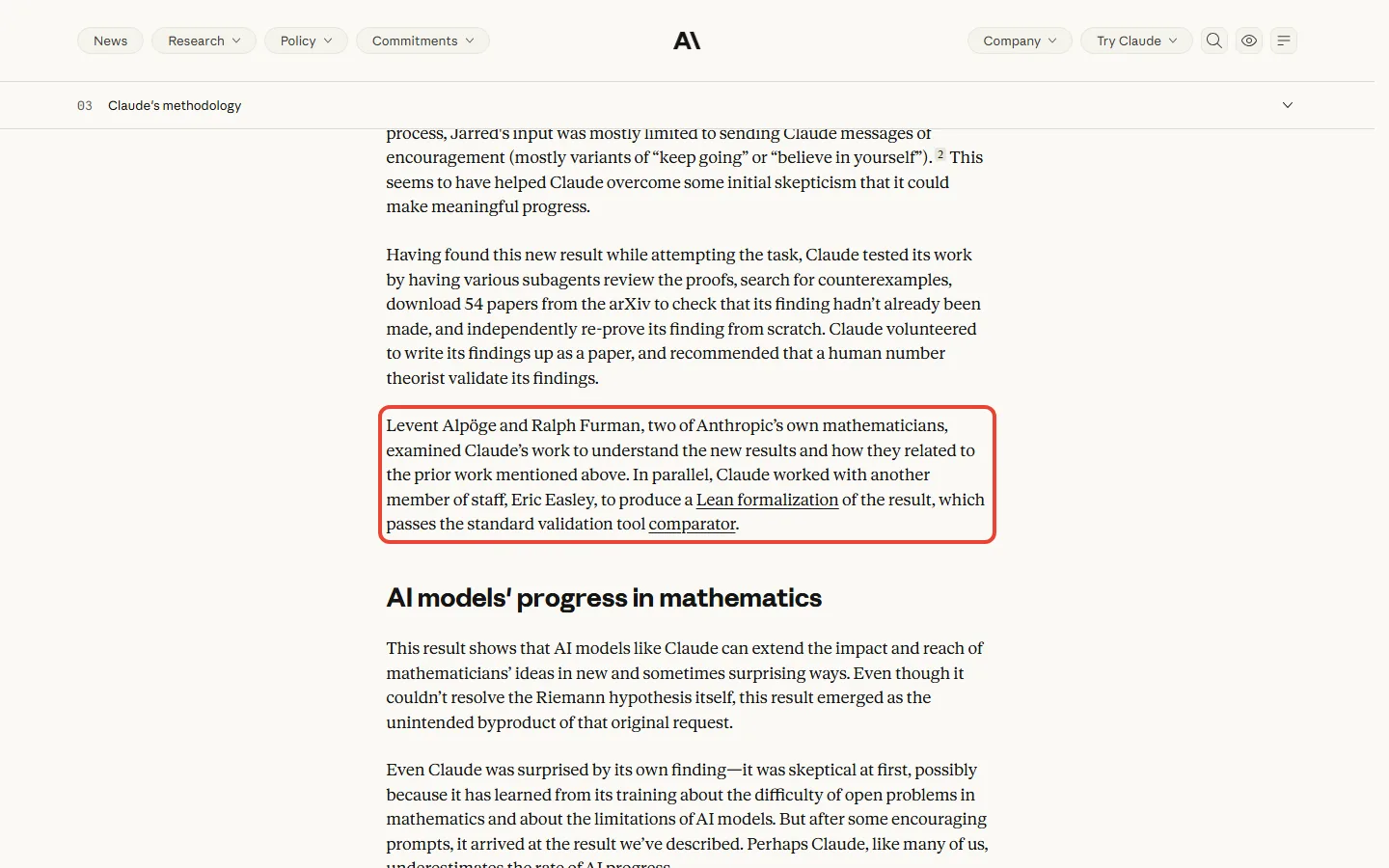
Anthropic names comparator as the check its Lean proof passes, and it is the strictest one the manual describes. Passing it is a serious claim, and you can check it yourself if you have the patience, as the plans section below explains.
The one thing Lean can’t check for you
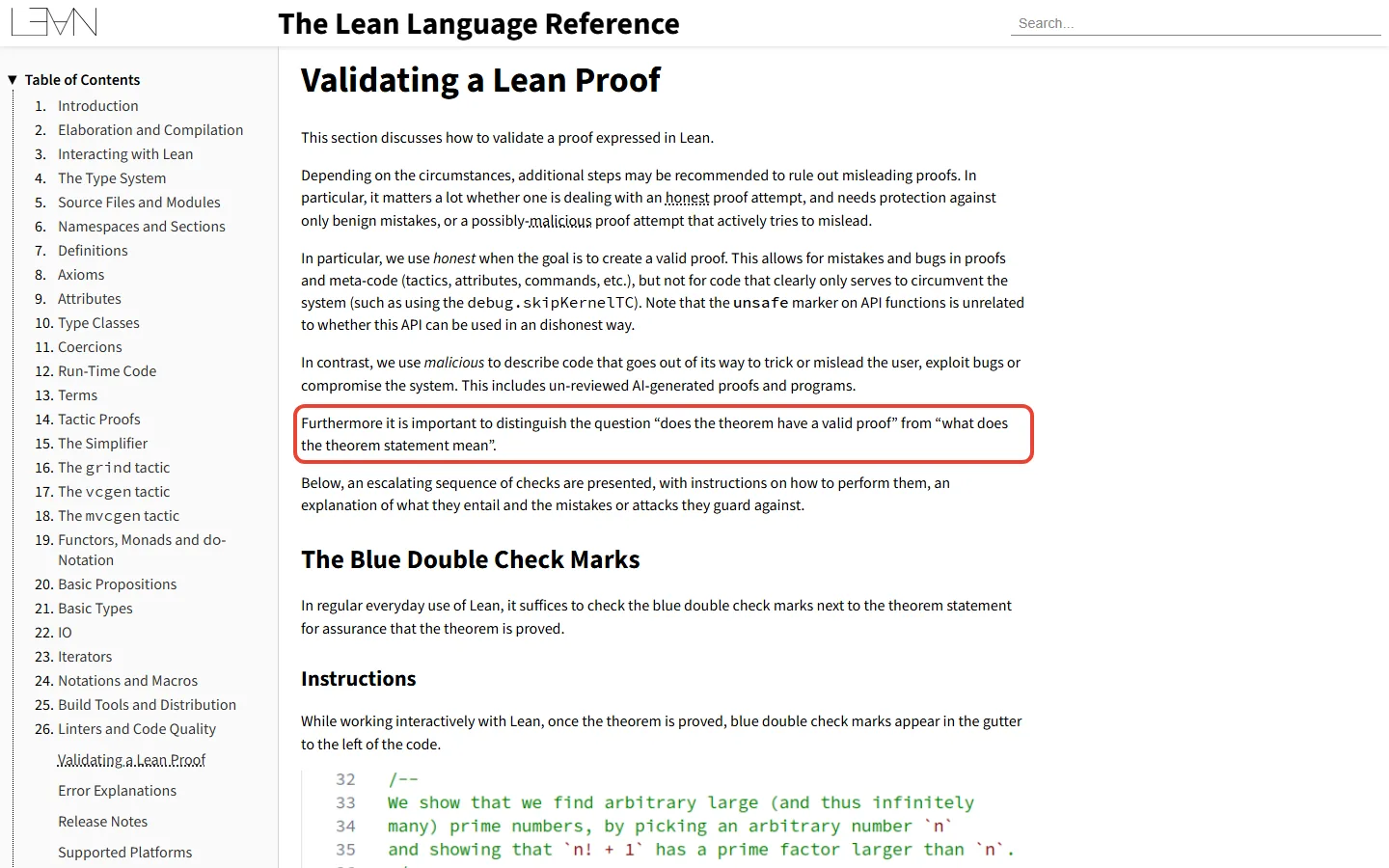
A Lean check answers one question: does this proof prove this statement? The manual separates that from a second question, “what does the theorem statement mean”. That second question is the one a headline is really about.
A perfect answer to the wrong exam question still scores zero. If the statement file says something slightly different from what the paper claims, Lean will certify a flawless proof of the wrong thing, and you’d never know from the check marks.
Anthropic’s repository, the public folder where it posts its Lean files, is frank about this too. Its list of what a skeptical reader still has to trust includes Mathlib’s definitions, the statement file, the Lean kernel and comparator’s own assumptions. That list is the honest meaning of machine-checked: the trust moves to the statement and the tools, it doesn’t vanish.
Matching question to answer is real work. In late October, OpenAI adjusted the Lean files for one of its other results so the names in its challenge file and its solution file lined up. Think of it as making sure the exam paper and the answer sheet use the same question numbers. It was a small fix, and a reminder that a person has to do the matching.
That is why the experts sound more careful than the headlines you read. Kontorovich’s verdict on the quasi-Riemann formalization: a sorry-free proof of a statement already in Mathlib gives him “100% confidence that the proof is right”, though he still had technical details to go through. On another formalization he gave the flip side: when a statement is elementary, built only from basic ideas, “There’s no semantic alignment to check”. In plain words, you have no gap to look for between what the file says and what the words mean.
Statements about zeta zeros are not elementary, so someone has to read them for you. Ankur Moitra of MIT would “trust Lean formalizations to some extent for some of the technical building blocks”, and adds that “someone’s gotta review all these AI-generated papers”. So read a Lean check as a strong claim about the proof and a weaker one about the headline, and ask who read the statement.
“Passes comparator” vouches for the answer, not the question
Anthropic’s research post: the Lean version “passes the standard validation tool comparator”
What the Lean manual says comparator still assumes: “No human error or misleading presentation of the theorem statement in the trusted challenge file.”
What it means for you: the machine stands behind the proof; a person still has to stand behind the statement.
Who checked what, result by result
Here are this year’s four claims side by side. Each row shows who makes the claim, what a machine checked and which people have read it. Use it to see how solid each one is before you share it.
| Result | Who claims it | Machine check | Human reading |
|---|---|---|---|
| At least 67.2% of zeta zeros on the line | Anthropic, from an unreleased research version of Claude | Anthropic says its Lean version passes comparator; the repository calls it complete and sorry-free, with no axioms of its own declared | Validated by two Anthropic mathematicians, the paper’s authors; two outside experts examined it on short notice |
| Quasi-Riemann with 7/8: no zeros beyond 7/8 | OpenAI, from an unnamed internal model; a 199-page paper | OpenAI’s Lean files cover it for zeta and every Dirichlet L-function | Mathematicians set it aside to focus on the shorter paper |
| Quasi-Riemann with 11/12, a weaker bound | OpenAI, written with human assistance; 49 pages | No Lean formalization in OpenAI’s repository | Experts largely agree the result is correct; their write-ups were unpublished when Quanta reported |
| 7/8 nudged down to 0.874957 | Baiying Liu, in a paper on arXiv, the public research archive, that follows OpenAI’s strategy | The author says it “has been formalized by Lean” | A preprint, shared publicly by its author; it moves the lane’s 7/8 edge by about 0.00004 |
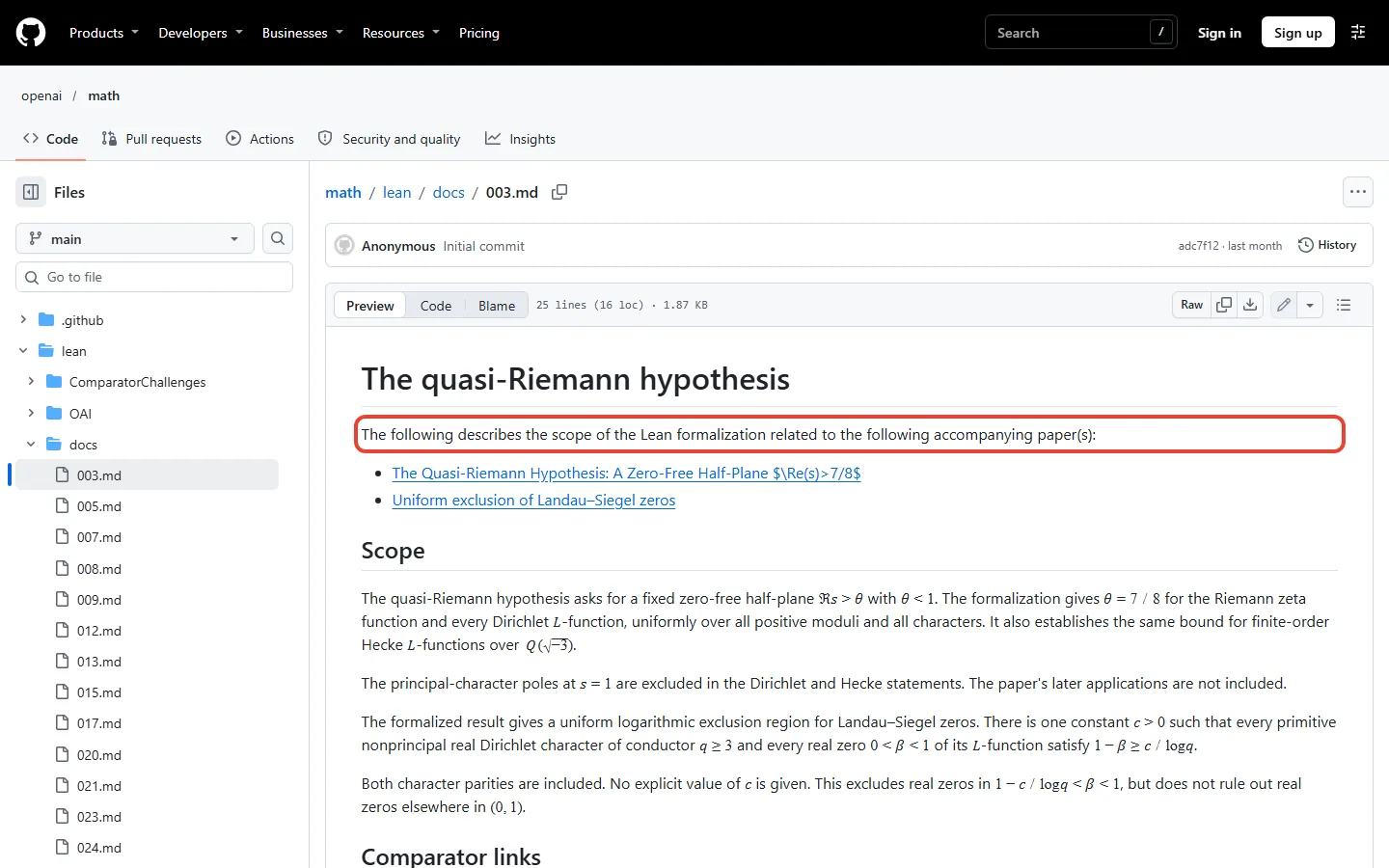
Notice the twist in OpenAI’s rows. The machine check sits on the long 7/8 paper, while the human reading sits mostly on the 49-page 11/12 paper, which has no Lean check. That sounds worse for you than it is.
Because 7/8 is the tighter lane, the 7/8 statement in OpenAI’s Lean files already covers the 11/12 one. What lacks a machine check is the shorter, separate argument the experts are reading, not the bound you care about. So the fair status for OpenAI’s result: machine-checked by OpenAI’s own account, and largely accepted by the experts who worked through the shorter paper. Peter Sarnak still won’t call it “a Theorem” until humans check and understand all the details. For you, that means treating it as probably right but not yet settled.
For Claude’s result, the machine evidence Anthropic reports is strong. The people it says validated the proof are its own staff, the paper’s two authors. The two outside experts it names examined the paper on short notice and sent comments, a first outside read rather than a full check. If you pass either result on, say who checked it.
Three questions for the next AI math proof headline
- What exactly was proved? A floor, a lane, or the full Riemann hypothesis? When the headline is bigger than the paper’s statement, believe the paper.
- Did a machine check that exact statement? Look for a Lean file, the words sorry-free, and ideally a comparator run. Lean files for many of a company’s proofs are not Lean files for all of them.
- Has someone outside the company read the statement and the argument? Until that happens, treat it as a strong claim, however clean the Lean check.
A result that clears all three is about as solid as new mathematics gets. One that clears only the first is a press release, and you can say so.
How much of OpenAI’s pile of math papers has a Lean check?
OpenAI didn’t publish one proof; its catalogue holds 721 manuscripts in 373 families, groups of related papers. The number to remember is 42%: about that share of what OpenAI calls its top-line results have Lean formalizations. OpenAI’s README, the read-me file at the front of its repository, doesn’t define a top-line result, so read it as roughly its main results. On the rest, the README gives you the warning itself: “Some of the unformalized results could have issues.”
Think of the catalogue as a lab notebook rather than a textbook. The README’s own phrase for the manuscripts is “a form of raw research data, rather than polished academic papers”. It has been corrected already: in early October, OpenAI withdrew three manuscripts after a sign error, a plus where a minus belonged or the reverse, and revised 14 others.
Why test on open problems at all? The README’s answer is that its old math tests had saturated. A benchmark is like a puzzle book with the answers in the back: once the models solve nearly every puzzle, it tells you little. So OpenAI widened its tests to open research problems, and you should treat any single result from that catalogue as a lead until you find its Lean file.
Can you use the AI that did this math?
Not by name, and not yet. Anthropic’s model is “an unreleased research version of Claude”, and OpenAI’s is an unnamed internal model. OpenAI says it is working to release its model responsibly, but gives no date, and no plan page from either company names either one.
Buying a plan today is like buying a ticket to a museum’s public galleries: you see the current collection, not the pieces still in the restoration lab. Don’t read OpenAI’s line about “three hours of ChatGPT Pro thinking compute” as a promise to subscribers either. That figure is an average for results from the unreleased model’s standard procedure, its normal way of working. OpenAI’s README puts its quasi-Riemann work among the exceptions to that procedure, with no compute figure of its own.
What you can buy is the public line-up. On Claude, Pro is $20 a month, or $200 a year up front, about $17 a month; Max is $100 and Ultra $200. Fable, Anthropic’s top public model, is paid with usage credits on Pro, extra use you spend on top of the plan, while Max and Ultra include it for up to half the weekly limit. Our Claude plan guide and Fable explainer go through the limits.
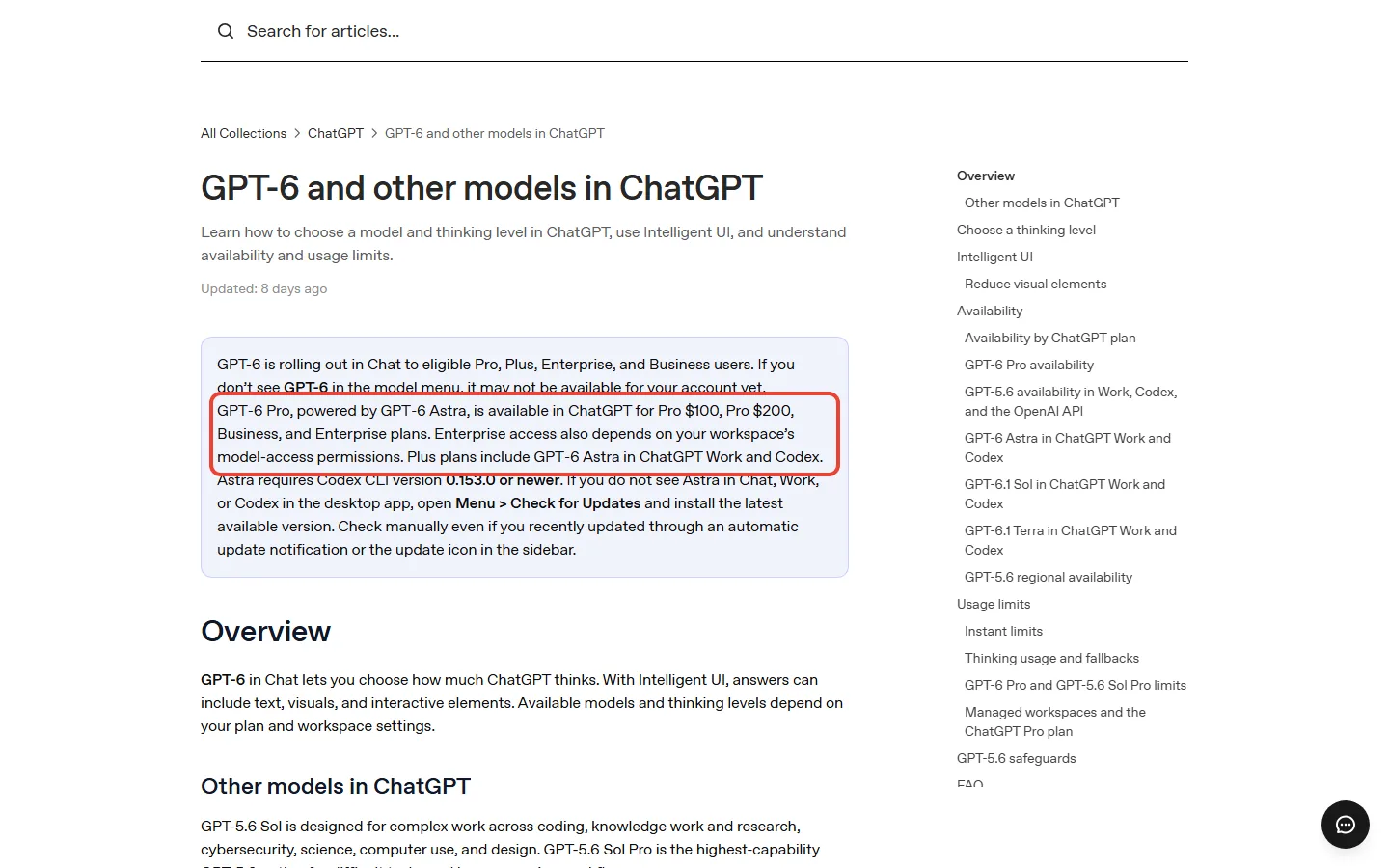
On ChatGPT, Plus is $20 a month with no yearly plan. GPT-6 Pro, which runs on GPT-6 Astra, is where OpenAI’s two help pages differ. The models page lists it for Pro $100, Pro $200, Business and Enterprise; the Pro tiers page says Pro 100 and Pro 500 keep their weekly GPT-6 Pro message limits in Chat. If GPT-6 Pro is the reason you’d pay, check the plan page before you upgrade.
| What you want | Plan | Per month | Per year |
|---|---|---|---|
| Read the papers and the Lean files | Claude Free, or no plan at all | $0 | $0 |
| One AI to talk the math through | Claude Pro or ChatGPT Plus, paid monthly | $20 | $240 |
| The same, paid yearly | Claude Pro, annual | about $17 | $200 |
| Two AIs to compare answers | Claude Pro and ChatGPT Plus | $40 | $480 |
| GPT-6 Pro in chat, or heavy Claude use | ChatGPT Pro 100 or Claude Max | $100 | $1,200 |
The cheapest way in costs nothing. Anthropic’s Lean files are public under the Apache-2.0 licence, an open licence, so you can download them and re-run the check. Be ready for a real job: the README budgets several gigabytes of disk, and several hours of computer time if you build Mathlib without its cache of already-built files. The full comparator run also needs Linux and a set of developer tools.
Say you want one AI to help you read the papers and talk through the math. A $20 plan kept for a year is 20 x 12 = $240. Claude Pro’s yearly option is $200 up front, which saves $40, while ChatGPT Plus has no yearly plan at all. Paying for both to compare their answers doubles the bill to $480 a year.
If you need GPT-6 Pro in chat, the cheapest Pro tier is $100 a month, or $1,200 a year, five times what Plus costs; Claude Max costs the same. Our look at the $100 ChatGPT Pro plan covers who that tier suits.
Our call: the $100 tiers only make sense if you already need GPT-6 Pro or heavy Claude use for other work. For help reading the papers, $20 is the ceiling.
What we’d do, depending on why you’re asking
- You’re just curious: read Quanta’s article and the Lean manual’s page on validating proofs. Together they explain this better than any headline.
- You study math or computer science: start from the files, not the press. Anthropic’s repository lists what you still have to trust, and OpenAI’s Lean document spells out which papers its check covers.
- You want an AI to help with math: one $20 plan, on Claude’s yearly price if you’ll keep it. Our Opus 5.5 vs Sonnet 5.5 comparison helps you pick the model, and the ChatGPT review covers the other side.
- You’re sizing up the next “AI proved it” story: run the three questions above, and call it a claim until someone outside the company has read the statement.
- You were hoping to use the model that did it: wait. Neither company gives a release date, and we’d rather you keep your money than upgrade on a guess.
Sources and how we checked: Anthropic’s research post, its arXiv paper and its formal-math repository were captured on October 28, 2026, as were OpenAI’s October 6 post on its math results, Clay’s Riemann hypothesis page and the Lex Fridman Podcast #503 episode page. OpenAI’s two quasi-Riemann paper pages were captured on October 26, 2026, and Baiying Liu’s arXiv paper was read on November 7, 2026. OpenAI’s math repository README, history, commits and Lean documents, and the Lean manual’s page on validating proofs, were read on November 7, 2026. Quanta Magazine’s October 19 article was captured on October 26, 2026, and the podcast’s transcript is dated October 26, 2026. The Claude pricing page and OpenAI’s help pages on Plus, Pro tiers and GPT-6 Pro were read on November 6 and 7, 2026. Prices are US dollars. On those reads, OpenAI’s repository had no Lean formalization of the October 5 (11/12) paper, and neither company named a release date or a plan for its math model. We did not run Lean or re-check any proof ourselves; this guide reads the published sources. More background is in our Claude review.

Founder of AI Tool Analysis. Every price and limit here is checked against the vendor’s own pages. How we research
Stay Updated on AI Plans and Prices
Get an email when a plan we cover changes its price or limits.
Free, unsubscribe anytime.
Related Reading
- GPT-6 Astra: Who Can Use It, What It Costs, and Did It Really Solve Chess?
- Claude Subscription 2026: Free vs Pro $20 vs Max $100 vs Ultra $200
- Claude Fable Review
- Claude Opus 5.5 vs Sonnet 5.5: Which One Should You Use on the $20 Plan?
- ChatGPT Review 2026: Which Plan to Pay For
- ChatGPT Dots Pricing: Is the $100 Pro Plan Worth It?
Last Updated: November 7, 2026
Next Review Update: December 7, 2026