

Jev is the strangest AI model I’ve reviewed this year: it can’t write a single sentence. You hand it text, ask a yes/no, pick-one, or rate-it question, and get back a probability your code acts on in a fraction of a second. This Jev review shows why that’s more useful than it sounds.
⚡ TL;DR – The Bottom Line
What It Is: A decision-only AI model from TypeSafe. You ask yes/no, pick-one, or rate-it questions about text and get back probabilities, not sentences.
Best For: Developers doing high-volume ticket routing, moderation, prompt-injection screening, agent guardrails, or model routing.
Price: $0.042 per million input tokens, output free. No free tier, and the $5 signup credit is currently paused for new accounts.
Our Take: 13x faster and 1/22 the cost of Claude Opus 5 on OpenRouter’s Banking77 test. The best per-dollar decision engine we’ve covered.
⚠️ The Catch: It trails Opus 5 by 3.3 accuracy points, calibration varies by dataset, and it can’t write a single word.
📑 Quick Navigation
Jev Review: The Bottom Line
The short version of this Jev review: $0.042 per million input tokens, free output, and no free tier (the $5 signup credit is paused for new accounts). The catch is that it trails Claude Opus 5 by 3.3 points on a public classification test and can’t write anything.
Best for: developers routing tickets, gating agents, or trimming an AI bill the way our Claude Code Router test did. Skip if: you want a chatbot. Claude is still the right tool for that.
What Jev Actually Does
Think of Jev as a smart if-statement. Code easily checks “does this cart have three items?” but not “does this customer sound furious?” Until now, that second check meant a slow, pricey chat-model call.
TypeSafe, a San Francisco lab founded by former OpenAI researcher Diogo Almeida, built Jev for only that second kind of check. It launched September 15, 2026, and Vercel says nearly 13% of its paid AI Gateway teams tried it within 24 hours.
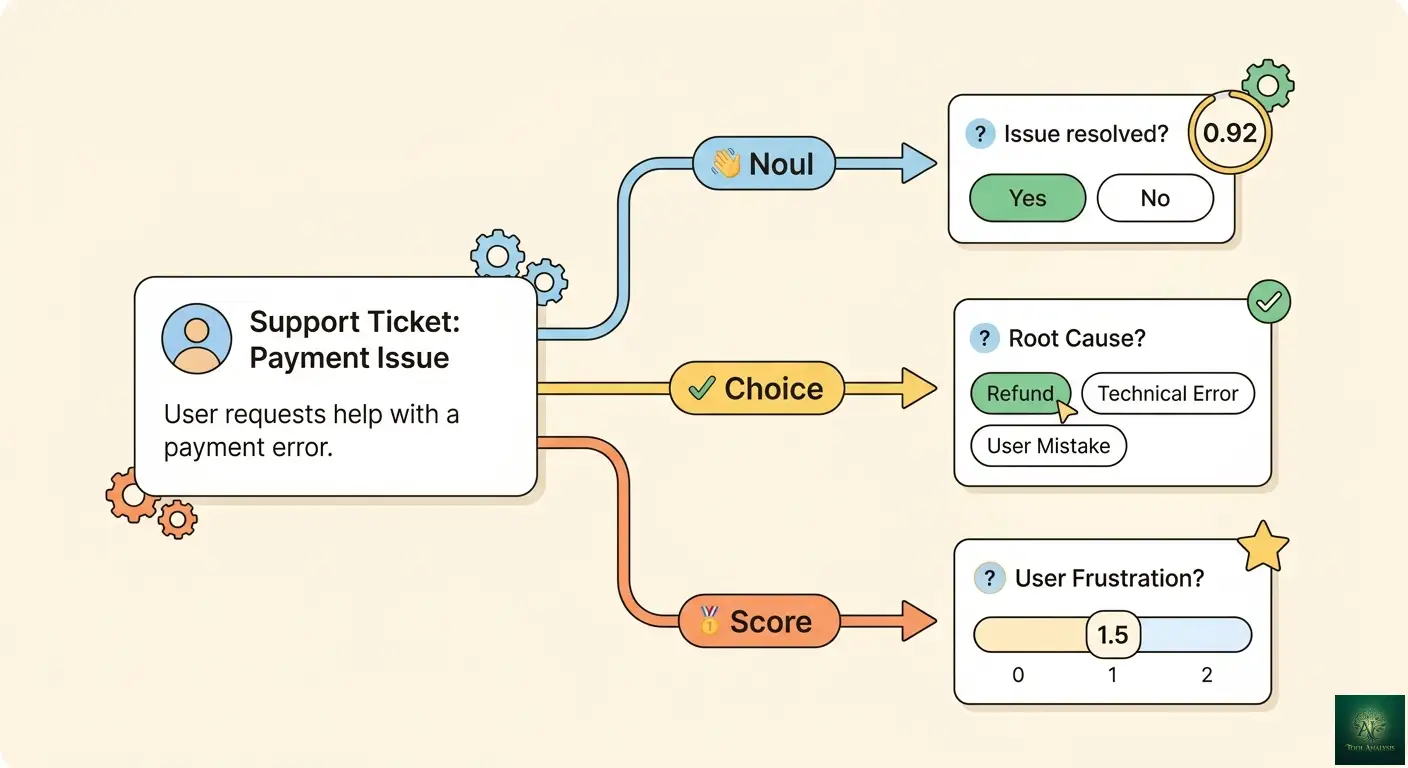
You get three question types. Noul answers yes or no with a probability from 0 to 1. Choice picks from a list you write, up to 255 options. Score rates on a scale you describe in plain English.
The Five-Minute Test
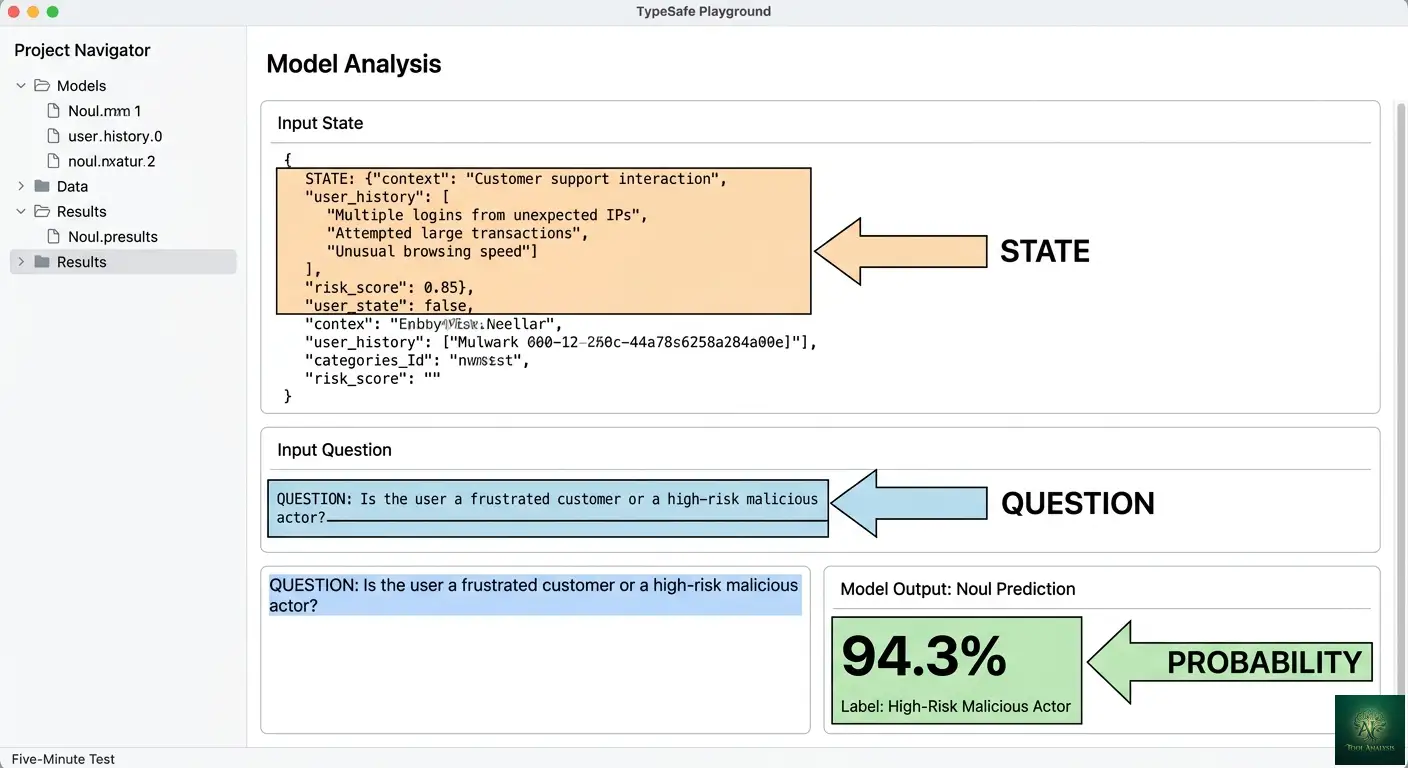
Every Jev review should start with this test, because it shows the whole idea in one request. Paste this into the Playground as the state: {"message": "I've contacted you three times, and I'm still waiting."}. Then add one Noul question: “Does the message express frustration?”
The message never says “angry,” so a keyword filter misses it. Jev catches the meaning anyway and hands back a number your code compares against your threshold.
[TEST RESULT: Paste the Noul probability and elapsed milliseconds from your own Playground run here. Then change the message to “Thanks, everything works now” and add the new probability for contrast.]
Before and after: in TypeSafe’s side-by-side demo, GPT-5.6 Terra took 8.566 seconds and $0.013880 to answer questions like this. Jev took 0.114 seconds and $0.000081.
🔍 REALITY CHECK
Marketing Claims: “Zero Hallucinations”
Actual Experience: That means Jev can never return an answer outside the options you defined. It can still pick the wrong option. In an independent Banking77 run it misclassified 234 of 3,080 messages, and in a test by Every it missed one of seven planted defects that Claude Fable 5.1 caught.
Verdict: No type errors, yes. No wrong answers, no. Keep a confidence threshold and a human review lane.
Getting Started: Your First 30 Minutes
The waitlist is gone. Signups reopened September 27 after a week-long pause, but new accounts no longer get the $5 starter credit. TypeSafe paused it after abuse and says it’s working to bring it back. Add a few dollars; this Jev review’s five-minute test costs well under a cent.
Spend your first ten minutes in the Playground. Paste state (plain text, JSON, or an array), add questions, pick a type for each, and hit run. No code required.
Next, create an API key and install @typesafe-ai/sdk (JavaScript) or typesafe-sdk (Python). Your first real call is client.systemOne() with a state object and named questions.
One surprise: TypeSafe’s service runs from the US West Coast, and so do its published speed tests. Calling from Europe or South Asia adds network time on top of the quoted 70 to 500 milliseconds.
[TEST RESULT: Add your measured round-trip time from Pakistan here.]

Common Issues in Your First Week
Getting 429 errors? Limits are 100K tokens and 40 requests per second, and they’re shifting as TypeSafe adds GPUs. The SDKs retry automatically; raw HTTP callers need their own backoff.
Answers look oddly wrong? Jev reads literally. It answers the question you wrote, not the one you meant, so spell out edge cases.
Counting or dates going sideways? Math, counting, and date comparison are documented weaknesses. Do that in code.
💡 Key Takeaway: If a question needs arithmetic, dates, or a chain of “if A, then B” logic, keep that in your code. Give Jev only the fuzzy judgment call, worded literally, and it behaves.
Features That Actually Matter
Star ratings in this Jev review are based on TypeSafe’s documentation and the independent tests cited below.
Noul: Yes/No Decisions ⭐⭐⭐⭐⭐
The one you’ll use most. “Is this a refund request?” “Is this prompt a jailbreak?” One probability back, and you set the cutoff.
The strongest proof: Vercel’s CEO said Jev replaced a GPT Luna safety reviewer in its fx tool, running up to 18x faster at p95 and more accurately. That’s production, not a demo.
Choice: Pick From Your List ⭐⭐⭐⭐
Choice picks one option and returns a probability for each. Always add an “other” option, or Jev forces every message into your buckets.
The best evidence is Simon Smith’s reproducible Banking77 experiment: 77 banking intents, 3,080 test messages. With 24 relevant labeled examples per request, Jev hit 92.40%, just 1.26 points behind a fine-tuned BERT model, for $0.44 total.
Score: Rate on Your Scale ⭐⭐⭐
Score rates on levels you describe, like “0: calm, 1: annoyed, 2: furious,” and returns a weighted average such as 1.5. Great for ranking by urgency, weak for exact numbers, so use it for “is this above my line?” only.
Many Questions, One Call ⭐⭐⭐⭐⭐
Ask about frustration, intent, and urgency in one request. Jev answers them side by side instead of word by word, which is where the speed comes from. Questions can’t see each other’s answers, so “if A, then ask B” logic lives in your code.
Calibrated Confidence ⭐⭐⭐
The pitch: a 0.9 means Jev is right about 90% of the time, so you can automate above 0.9 and send the rest to a human.
🔍 REALITY CHECK
Marketing Claims: “Every decision includes an estimate of how confident the model is.”
Actual Experience: True, every answer ships with a probability. But an independent pre-registered check called ASSAY-001 returned a split verdict: well calibrated on one intent dataset (CLINC150), overconfident on another (Banking77).
Verdict: Useful, not gospel. Test the thresholds against 100 or so labeled examples from your own data before you automate anything.
Features That Sound Better Than They Are
You can force Jev to spell out text by chaining choices, but TypeSafe’s own known-limitations page says it works badly and slowly. And English gets the best accuracy, so test Urdu or Hindi tickets before you trust them.
🌐 Jev Feature Strength Profile (Our Star Ratings)
Jev Pricing Breakdown: What You’ll Actually Pay
This part of the Jev review is short, because pricing is simple: $0.042 per million input tokens, and output is free. The official models page lists current rates and limits.
| Access Route | Price | What You Get | Watch Out For |
|---|---|---|---|
| TypeSafe direct | $0.042 per 1M input, $0 output | Playground and usage dashboard (the $5 signup credit is paused for new accounts) | Rate limits (100K tokens/sec, 40 requests/sec) can change without notice |
| OpenRouter | Same $0.042 per 1M input | One key for all your models, plus the new Jev Router | Listing shows a 32K context window |
| Vercel and Cloudflare AI Gateways | Billed through the gateway | Jev inside your existing gateway setup | Check each gateway’s own rate card and SDK requirements |
| Enterprise | Custom | Higher limits, zero data retention option | Requires contacting sales |
Cost Per Real Job
For this Jev review I priced two real jobs. Say your support desk classifies 2,000 tickets a day. At about 1,100 tokens each (the ticket plus three questions), that’s 2.2 million tokens daily, or roughly $0.09 a day. That’s under $3 a month.
Now a heavier setup. In the Banking77 run, 24 labeled examples per request pushed each call to about 3,400 input tokens. The 3,080-message test still cost $0.44, about $0.14 per 1,000.
Hidden Costs to Flag
Every example you add is billed on every call. Examples lifted Banking77 screening accuracy from 79.2% to 90.3%, so they’re worth it, but that’s where your bill grows.
TypeSafe also admits it can’t prove the price isn’t subsidized, though it expects prices to fall. The free alternative is a model you already pay for, like DeepSeek or Gemini Flash, forced into structured outputs.
💡 Key Takeaway: Your Jev bill is driven by how much context you send, not how many answers you get. Start with one-line category descriptions, and add labeled examples only where accuracy actually falls short.
📬 Enjoying this review?
Get honest AI tool analysis delivered weekly. No hype, no spam.
Jev vs Claude Opus 5 vs a Fine-Tuned Classifier
The head-to-head in this Jev review uses one task for everyone: sort banking support messages into 77 intents. Answers are graded against human labels, not another model’s guesses.
| Model | Accuracy | Median Speed | Cost per 1,000 | Setup Effort | Can Write Text? |
|---|---|---|---|---|---|
| Jev 1.13 (one-line intent descriptions) | 81.0% | 175 ms | $0.11 | Minutes | No |
| Jev 1.13 (24 retrieved examples) | 92.4% | About 0.53 s including retrieval | $0.14 | An afternoon | No |
| Claude Opus 5 | 84.4% | 2,266 ms | $2.42 | Minutes | Yes |
| Fine-tuned BERT (2020 paper) | 93.7% | Not measured | Not measured | Training run required | No |
In this Jev review, the first and third rows come from OpenRouter’s own Banking77 test, where Jev landed 3.3 points behind Opus at 13x the speed and 1/22 the cost. The second row is the GitHub experiment above.
💎 Cost vs Accuracy on Banking77: Where’s the Sweet Spot?
Cheap models? In LiteLLM’s routing benchmark, Jev was 5.43x faster than Claude Haiku at 96% lower cost. LiteLLM wrote its own answer key, so treat accuracy there as directional.
Winners: accuracy goes to the fine-tuned classifier, with Jev-plus-examples close behind. Speed and cost go to Jev by an order of magnitude. Flexibility goes to Opus 5 and models like Claude Fable, which can also explain and write.
My recommendation: use Jev as the first pass and escalate low-confidence cases. AY Automate reported that a 0.80 confidence gate, escalating the rest to GPT-5.6 Terra, matched Terra’s accuracy at about a quarter of the cost.
🔍 REALITY CHECK
Marketing Claims: “193.6x Faster, 444.6x Cheaper.”
Actual Experience: TypeSafe itself says those figures sit on the higher end of real-world gains and come from evals its own team wrote. OpenRouter measured 13x faster and 1/22 the cost against Opus 5. Every measured about 25x faster than Fable 5.1.
Verdict: Real 10x to 25x gains are still huge. Budget with those numbers, not the homepage.
Who Should Use Jev (And Who Shouldn’t)
Here’s who this Jev review recommends it for. Choose Jev if you run high-volume decisions: ticket routing, moderation, prompt-injection screening, or picking which model handles each request.
Choose Jev if you’re building agents and want a cheap check before every tool call. Coding agents like Claude Code or Cursor can write the integration for you in minutes.
Stick with ChatGPT or Claude if the task needs writing or step-by-step reasoning. Stick with a fine-tuned classifier if you need every accuracy point, offline operation, or have stable labeled categories.
Skip entirely if you don’t write code. There’s no app and no chat window. For no-code automation, n8n is a better starting point.
💡 Key Takeaway: If you make the same judgment thousands of times a day, Jev pays for itself on day one. If you make it ten times a day, the chat model you already pay for is simpler.
What Developers Are Actually Saying
For this Jev review I tracked reactions on X, Hacker News, and developer blogs, since Reddit has been quiet. The launch post pulled close to 40 million views in under a week.
The praise is about adoption. Vercel, Cloudflare, LangChain, and Langfuse added Jev within days, which fits naturally into the agent frameworks developers already use. OpenRouter then built Jev Router on it and reported 82% more tasks completed than its existing Auto Router.
The fairest skeptic test came from Every. Its CEO found Jev about 25x faster and roughly 1/580 the cost of Claude Fable 5.1, but it missed one of seven planted defects Fable caught.
The complaints are about framing. Hacker News commenters argued the speed comparisons aren’t apples to apples, since a chat model writing full JSON does more work. The AkitaOnRails blog called out the jargon-heavy homepage and its unanchored “193x” figure.
Quiet adoption continues. Since the launch coverage this Jev review draws on, community SDKs and MCP servers have appeared for languages TypeSafe doesn’t officially support yet.
Enterprise signals are loud. TypeSafe raised a $40 million seed led by DCVC at about a $200 million valuation, and reports say it’s discussing a roughly $1 billion round near a $10 billion valuation. Nothing is confirmed.
The Road Ahead: What’s Coming
Short-term (3 months): Jane Manchun Wong spotted TypeSafe testing “semantic lints” that flag questions that don’t fit their type. The jev-preview alias points at the current model, which suggests a slot waiting for a new build.
Medium and long-term (6+ months): Based on TypeSafe’s launch notes, expect falling prices and possibly image input, since its Doom demo doesn’t use images “yet.” Signals, not promises.
FAQs: Your Questions Answered
Q: Is there a free version of Jev?
A: No free tier. New accounts got $5 in credit at launch, but TypeSafe paused that for new signups on September 27. One cent still covers a couple hundred typical calls.
Q: Is Jev worth it for developers?
A: Yes, if you make the same kind of judgment thousands of times a day. For occasional, one-off checks, the chat model you already use is simpler.
Q: Can Jev replace human support triage?
A: Partly. It routes the clear cases while low-confidence tickets go to a person. It can’t write replies.
Q: Is my data safe with Jev?
A: TypeSafe says Jev is not trained on customer requests or responses. Zero data retention is available for enterprise customers.
Q: How does Jev compare to ChatGPT or Claude?
A: Different jobs. ChatGPT and Claude write and reason, while Jev only decides. On a 77-intent classification test it came within 3.3 points of Claude Opus 5 at 1/22 the cost.
Q: What’s the learning curve?
A: The Playground takes minutes. Writing literal, unambiguous questions takes a few days of testing on your data.
Q: Is Jev’s context window 32K or 64K tokens?
A: Both, which is why launch coverage disagrees. The docs allow 64K tokens per request in total, but only 32K for the state plus the longest single question.
Q: Does Jev work for non-English content?
A: Yes, but English is where accuracy is best. TypeSafe recommends testing on your own content before relying on it for other languages.
Q: Can I fine-tune or self-host Jev?
A: No. Every account uses the same weights. You customize answers through the state, instructions, and criteria you send with each request.
Q: Is this Jev review sponsored?
A: No. TypeSafe didn’t pay for or review this Jev review, and every benchmark cited is linked or named so you can check it.
Q: Which version does this Jev review cover?
A: Jev 1.13 (jev-1.13.0), the only version released so far. The jev-latest and jev-preview aliases both point to it.
Jev Review Verdict: 4/5
My Jev review score is 4 out of 5. It does one narrow job, typed decisions at high volume, better per dollar than anything I’ve covered, and never breaks your schema.
✅ What We Liked
- ✓ $0.042 per million input tokens with free output
- ✓ 13x faster than Claude Opus 5 on OpenRouter’s Banking77 test
- ✓ Answers always fit your schema, so no parsing failures
- ✓ Many questions answered in parallel in a single call
- ✓ Already on OpenRouter, Vercel, and Cloudflare gateways
❌ What Fell Short
- ✗ Trails Opus 5 by 3.3 points without added examples
- ✗ Calibration varies by dataset (split ASSAY-001 verdict)
- ✗ Can’t write text, count, or compare dates reliably
- ✗ No free tier, and the $5 signup credit is paused
It loses a point because accuracy trails frontier models, calibration varies by dataset, and the loudest benchmarks come from TypeSafe itself. So is Jev worth it? For the right workload, clearly yes.
Use Jev if you route, classify, or gate thousands of items a day. Stick with Claude or ChatGPT if you need words, and see our best AI developer tools guide for the rest of your stack.
Try it today: sign up at the TypeSafe console and run the five-minute test above. It costs well under a cent.


Founder of AI Tool Analysis. Tests every tool personally so you don’t have to. Covering AI tools for 10,000+ professionals since 2025. See how we test →
Stay Updated on AI Developer Tools
Don’t miss the next major update. Subscribe for honest AI coding tool reviews, price drop alerts, and breaking feature launches every Thursday at 9 AM EST.
- ✅ Honest Reviews: We actually test these tools, not rewrite press releases
- ✅ Price Tracking: Know when tools drop prices or add free tiers
- ✅ Feature Launches: Major updates covered within days
- ✅ Comparison Updates: As the market shifts, we update our verdicts
- ✅ No Hype: Just the AI news that actually matters for your work
Free, unsubscribe anytime. 10,000+ professionals trust us.
Want AI insights? Sign up for the AI Tool Analysis weekly briefing.
Newsletter

Related Reading
Explore more AI developer tool reviews and comparisons:
- Claude Code Router Review: Cut Your AI Bill by 80%?
- Top AI Agents for Developers 2026: 8 Tools Tested
- AI Agent Frameworks 2026: Which One Should You Build On?
- Best AI Developer Tools 2026: 12 Tested for Real Engineering
- Claude Fable Review: Anthropic’s First Public Mythos-Class Model
- MCP Explained: Why Every Developer Needs It
- DeepSeek Review: The Budget Model for Structured Outputs
- n8n Review 2026: The Best Free Zapier Alternative?
Last Updated: September 30, 2026
Jev Version Tested: Jev 1.13 (jev-1.13.0)
Next Review Update: October 30, 2026
Have a tool you want us to review? Suggest it here | Questions? Contact us