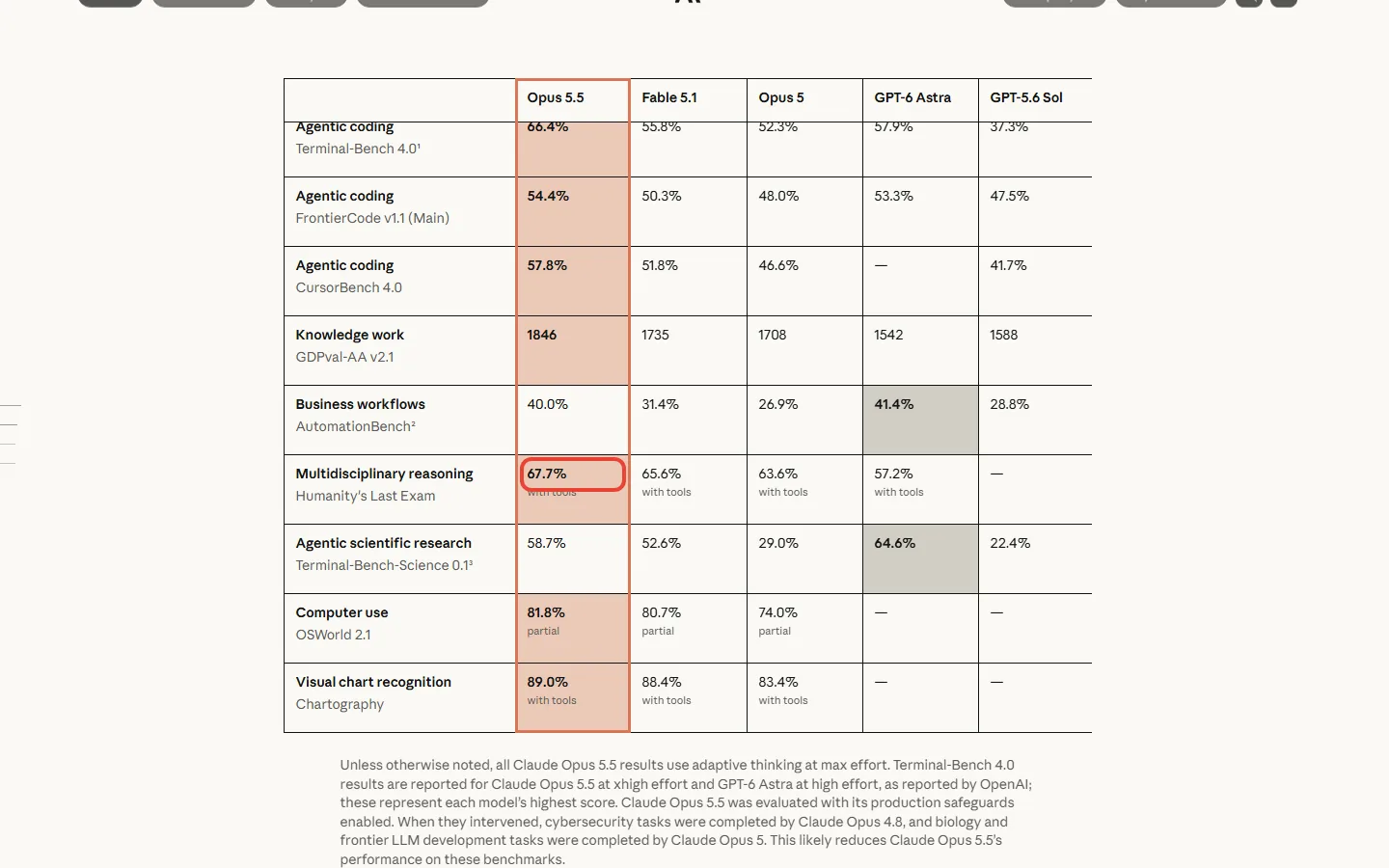
Is the singularity here? On the evidence, not yet. The headline number, 67.7% for Claude Opus 5.5 on Humanity’s Last Exam, is Anthropic’s own open-book score. The scoreboard run by the group that co-created the exam gives you a lower figure for the same AI: 55.4%.
Jack Clark, a co-founder of Anthropic, put “The singularity is here.” in the published text of his IMF lecture, but he meant AI speeding up science until people struggle to keep up. On the older meaning, a mind smarter than ours that builds the next one, the evidence falls well short. The AI you use is racing ahead on exams, doing real but narrow work in the lab, and far from the growth the boldest economic forecast needs. None of that should change your subscription: keep paying for the $20 plan whose app you already open.
Think of the two meanings as two different alarms. One rings when the car is going so fast you can’t read the road signs. The other rings only when the car starts designing the next car with nobody at the wheel. Clark’s alarm is the first.
Quick Navigation
Which “singularity” do the headlines mean?
Clark’s meaning is about pace. In his published lecture text, he describes AI that would “drastically increase the pace of overall scientific and technical progress, making things move so quickly that it is hard for humans to keep up.” By that yardstick, he thinks we are in “the early stages of the singularity”. If AI news already feels faster than you can follow, that is his point.
The stronger meaning comes from Vernor Vinge, in a 1993 paper for a symposium sponsored by NASA’s Lewis Research Center. For Vinge, a smarter-than-human mind was “the essence of the Singularity”. He wrote that he would be surprised if it came before 2005 or after 2030. Count from today and you have 4 years left on his own clock.
Vinge himself notes that the word is older. John von Neumann, as recalled by Stan Ulam, used it in the 1950s for ordinary progress, which is closer to Clark’s pace than to a smarter-than-human mind. So when you see the headline, ask which meaning it uses. The pace version can be partly true while Vinge’s is still far off.
Is the singularity here? The five tests, scored
Each row pairs a claim about AI models, the AIs that write the answers you read, with the strongest check we could source. “Claimed” means a lab or a person says it. “Checked” means someone outside the lab shows it; where the only check is the lab’s own detailed figures, the row says “lab’s own”.
| The test | What was claimed | What the check shows | Our read |
|---|---|---|---|
| 1. Is AI speeding up its own research? | Clark: almost 10 times the code; Anthropic: over 80% of merged code written by Claude | METR relayed a second-hand estimate of about 1.5x from another METR team, which could not share its evidence | Unclear |
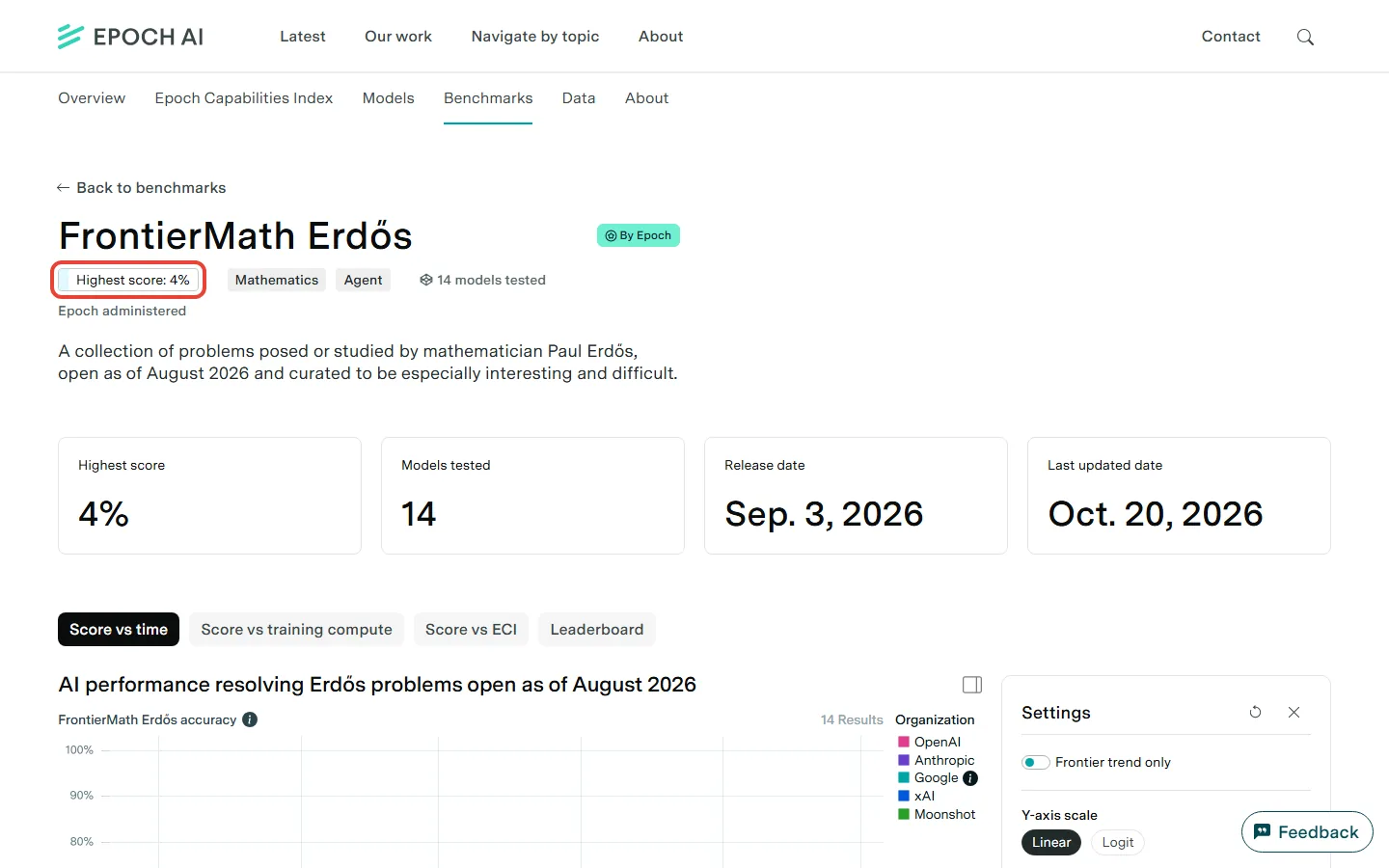
| 2. Is AI doing new maths and science? | Clark: Humanity’s Last Exam from 8% to 67.7%; FrontierMath from 2% to 94% | The board run by one of the exam’s co-creators puts the same model at 55.4%; the best model scores 4% on 68 open maths problems, with one try each | Ahead on exams; most open problems still standing |
| 3. Is it finding real things? | Clark: AI-designed viruses, drugs in trials, AI running lab equipment | Reported finds in encryption (Anthropic’s own write-up) and web security (Wiz Research, which used the AI); the drug work is mostly preclinical (lab’s own) | On track, but narrow |
| 4. Is it showing up in the economy? | Clark: US GDP of 44 trillion by 2030 | Lab’s own: that is Anthropic’s extreme scenario, which by our sum needs about 7.5% real growth a year on average. Outside: the US government’s estimate is 3.4% annualized for the third quarter of 2026 | Behind |
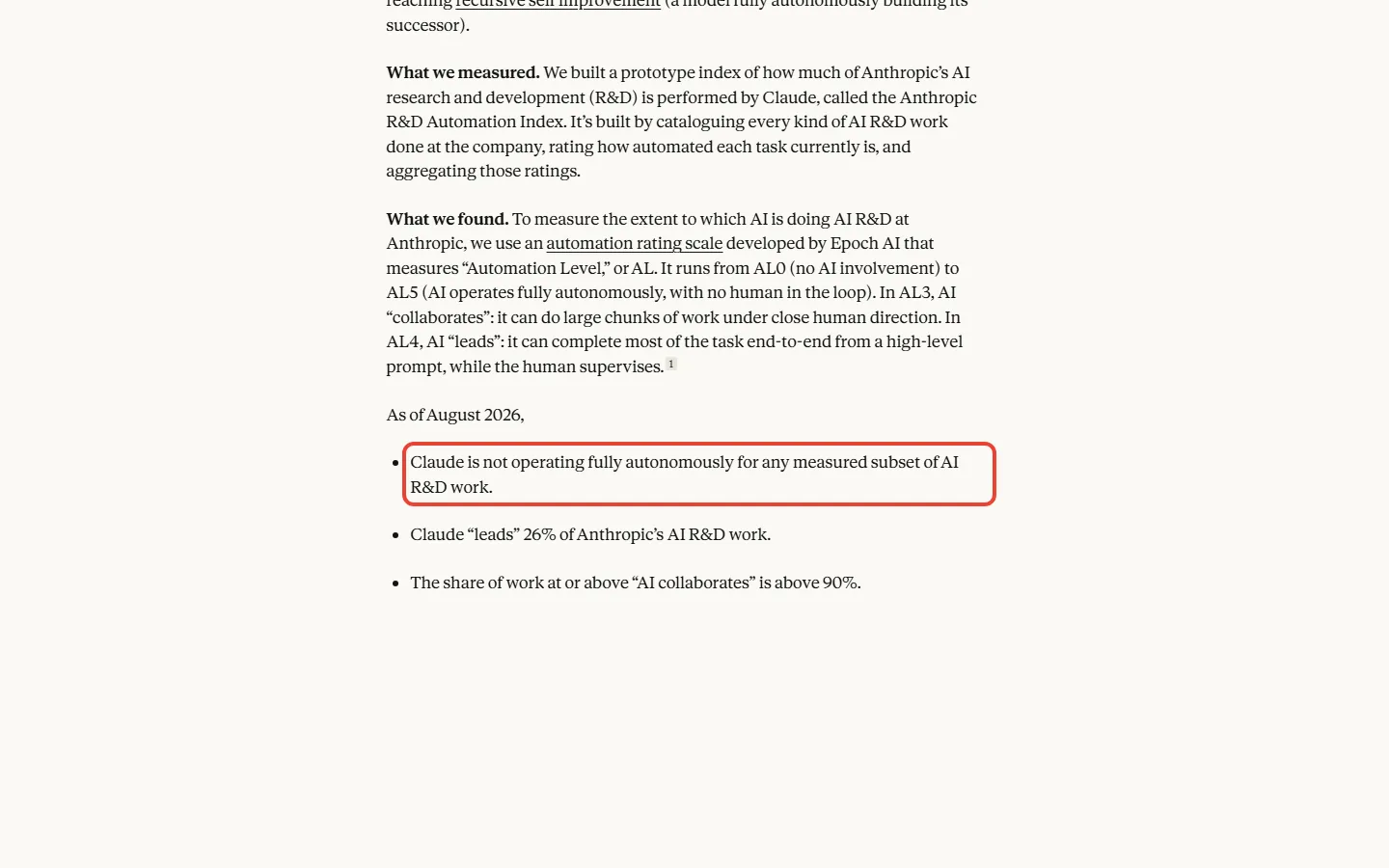
| 5. Is AI building the next AI on its own? | Clark: AI “is contributing to its own development” | Lab’s own: Anthropic’s index shows full autonomy on none of the measured work. Outside: METR finds Opus 5.5 unlikely to fully automate AI research | Not yet |
Test 1: Is AI speeding up its own research?
If AI were speeding up its own research, you would see it here first, and it would speed up everything after it.
Clark’s figure: Anthropic’s researchers now produce “almost 10 times the amount of code” they did in the company’s first four years. On Anthropic’s own page, which Clark co-wrote, the numbers are smaller and more careful. By May 2026, Claude was writing more than 80% of the code Anthropic merges, and in the second quarter the typical engineer merged 8x as much code a day as in 2024. Notice who did the measuring: the lab itself.
That same page calls the 8x “almost certainly an overstatement of the true productivity gain”. Code volume works like a word count on an essay. A student who writes eight times the words hasn’t written an essay eight times better, and you wouldn’t grade them that way.
The outside estimate is thinner than it looks. METR, an evaluator that tested Opus 5.5 before release, relayed a figure of about 1.5x acceleration, “1.5 years in 1 year”, from a separate METR team. That report was “highly experimental and preliminary”. Its team could not share the evidence and did not give the time period, and Anthropic could review and edit METR’s summary.
In plain words, you are asked to trust a figure whose evidence wasn’t shared. METR’s own conclusion is modest: Opus 5.5’s development was “at least somewhat accelerated by AI but is unlikely to have been dramatically accelerated by AI”. So this test is unclear: the big numbers are a lab grading itself, and the outside number is second-hand.
Test 2: Is AI doing new maths and science?
This is where the headline numbers live. You need to ask two questions: how AI does on exams with known answers, and on problems nobody has solved.
Humanity’s Last Exam: the lab’s number and the outside number
Humanity’s Last Exam is a benchmark, a standard scored test for AI: 2,500 hard questions across over a hundred subjects, each with a closed answer that can be marked. Picture yourself sitting one final exam covering everything from advanced chemistry to classical literature, with no essay questions.
Clark’s version: the top AI scored 8% when the exam launched in January 2025, and Claude Opus 5.5 led with 67.7%. That 67.7% is Anthropic’s own launch score, run with tools at maximum effort, its highest thinking setting. With tools means the model could use software tools while it answered. It’s like an open-book exam: a fair test, just not the same test as the closed-book one.
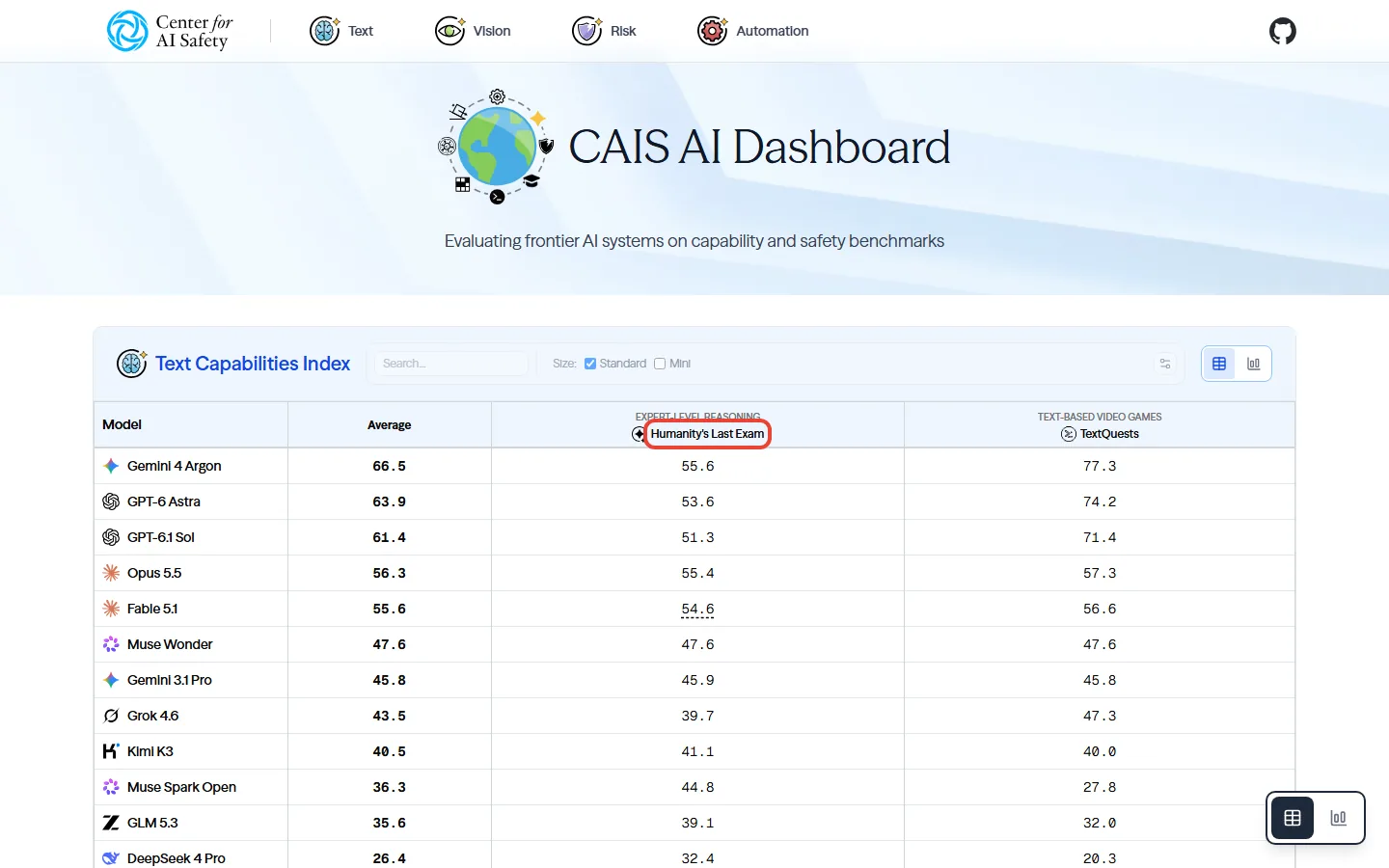
The CAIS dashboard, a public leaderboard that ranks AI models by score, is run by the Center for AI Safety, which co-created the exam. There, the same model scores 55.4%, which is 12.3 points lower. A second board, Scale’s, has no entry for Opus 5.5 or Gemini 4 Argon at all, so you can only compare the models it lists.
| Model | CAIS board (Humanity’s Last Exam) | Scale board (Humanity’s Last Exam) |
|---|---|---|
| Gemini 4 Argon (Google) | 55.6 | No entry |
| Claude Opus 5.5 (Anthropic) | 55.4 | No entry |
| Claude Fable 5.1 (Anthropic) | 54.6 | 46.50 (plus or minus 2.00) |
| GPT-6 Astra (OpenAI) | 53.6 | 54.80 (plus or minus 1.94), ranked first among the models Scale lists |
Even the exam’s makers warn that a high score “would not alone suggest autonomous research capabilities”. And they are planning for the day it runs out of room: in September they released HLE-Diamond, a follow-up question set, for when frontier AI “begins to hit the noise ceiling” on the original.
A test near its ceiling works like a ruler that’s too short. Once everyone reaches the end, it can’t tell you who is taller. So a lead of a point or two on this exam tells you very little.
Can AI solve maths nobody has solved?
FrontierMath is a few hundred hard maths problems, curated and graded by professional mathematicians. Clark’s figures are 2% at launch, and “Now, they get 94%.” He doesn’t tell you which part of the test he means.
The hardest part, Tier 4, shows a top score of 100%, and the whole set was updated in June to fix errors in 42% of its problems. So this ruler is running short too. FrontierMath was also developed with funding from OpenAI, which has exclusive access to a subset of the problems. So one lab can see questions the others can’t; weigh OpenAI’s scores here with that in mind.
Every test above has known answers. Give AI open problems and you get a different picture. Epoch’s FrontierMath Erdős set gives each model one try at 68 unsolved problems, with a $300 budget and 72 hours each, and the best score is 4%.
Since August, 17 of the 68 have been solved by anyone, with or without AI, which is 25%. Many fell at once to OpenAI’s October release of over 700 proofs. In other words, these problems do fall, just rarely to one AI try on a fixed budget. If you want one number for AI on new maths under those rules, make it that 4%.
Then come the labs’ own reports, each checked to a different degree:
- Fermat’s Last Theorem. Claude wrote a complete computer-checked proof in 11 days in Lean, a language where a machine checks every step. What’s new is the checking, not the maths, so you are looking at known maths, now checked by machine, not a discovery.
- Navier-Stokes. Quanta reported OpenAI mathematicians’ announcement that 10,000 AI agents, AIs that carry out the steps on their own, had found a blow-up in these fluid equations, a point where their answers break down. Quanta called the claim “not without controversy”, a paper argues the Lean proof doesn’t match the written one, and the Clay Institute still files the problem under Active. If you saw a headline saying AI solved a Millennium Prize problem, this is the one, and it isn’t settled.
- The Exponential Time Hypothesis (ETH), a long-held guess about how hard one kind of logic puzzle is, used in hundreds of papers. OpenAI says its system proved it false, and Anthropic says a Claude model refuted it too, in a result it calls “purely asymptotic and says nothing about solving formulas in practice”. An independent working group led by Russell Impagliazzo will examine OpenAI’s proof and has published no verdict yet. Until it does, file this under claimed, not confirmed.
Those reports come with corrections, too: OpenAI’s maths repository has withdrawn three manuscripts and revised 14 others. Our read: ahead on exams, with most open problems still standing. You can trust the exam scores more than the breakthrough headlines.
Test 3: Is AI finding real things outside the exam room?
Exams are one thing. You would expect a singularity to show up as discoveries people can use. Clark’s list is striking: AI-designed viruses, drugs in trials “in large part designed by AI”, and AI running lab equipment remotely. His text names no drug, study or lab, so you can’t check that line.
The finds with a write-up behind them are real but narrow:
- Encryption history. Anthropic reports that an internal model worked out, in under half an hour, how the seeds for five NIST elliptic curves were made. The curves are part of a cryptography standard, and the seeds are the starting numbers they were built from. It is “not a cryptographic break”: it leaves Anthropic more confident the curves have no backdoors, hidden ways in, so nothing got weaker for you.
- Web security. Wiz Research used Gemini 4 Argon and GPT-5.6 Sol to hunt bugs in PHP, a web programming language, and, in Wiz’s words, Argon made an “invaluable contribution to finding the vulnerability”.
- Medicines. Anthropic works with six organizations developing new medicines. All of it is “still at an early stage” and mostly preclinical, the stage before clinical trials.
Think of these as a sharp detective closing cold cases, not a new police force. For you, the point is that AI finds real things when experts aim it at a narrow problem. Our read: on track, but narrow, and the drugs-in-trials line stays Clark’s, unchecked.
Test 4: Is it showing up in the economy?
This is the test you would feel in your pay and your prices, and on our read it is the furthest behind. Clark writes that in Anthropic’s own modelling, under “singularity-esque conditions”, US GDP could reach 44 trillion by 2030, and adds, “This sounds outlandish”.
That 44 is the extreme case in Anthropic’s scenario chart: $44.4 trillion at 2025 prices, against $36.3 trillion in the substantial case and $34.1 trillion in the modest one. Some outside economists who reviewed the model felt the extreme scenario is “better read as a thought experiment than a scenario”.
You can do the sum yourself. US GDP in 2025 was $30.86 trillion, so $44.4 trillion is about 44% more: 44.4 / 30.861 = 1.439. Spread over five years, that takes about 7.5% real growth a year on average, because 1.0755 x 1.0755 x 1.0755 x 1.0755 x 1.0755 = 1.439. Real growth means growth after inflation is taken out.
Today’s figure is far lower: the US economy grew at an annual rate of 3.4% in the third quarter of 2026, in the advance estimate from the US Bureau of Economic Analysis (BEA), the government agency behind the GDP figures. An annual rate is one quarter’s pace scaled up to a full year, the way you might quote a monthly bill as a yearly cost. The 3.4% is an early figure that gets revised. The extreme case needs about 2.2 times that pace, averaged over five years, and we are nowhere near it yet.
One more trap hides in the chart. Its +32.4% compares 2030 with AI to 2030 without it, not 2030 to today. Picture two versions of your 2030 salary, one with a promotion and one without. The gap between them says nothing about what you earn now.
So if a headline tells you AI will add trillions by 2030, check whether it is quoting the extreme bar. On this test, AI is behind.
Test 5: Is AI building the next AI on its own?
This is Vinge’s meaning, and the wall that should decide your answer to the headline. Clark’s text says AI “is contributing to its own development”. Contributing is a long way from building the next AI alone, and that is what this test asks about.
Anthropic’s page on recursive self-improvement, an AI fully designing and building its own successor, was co-written by Clark. Read its answer before you believe any headline: “We are not there yet, and recursive self-improvement is not inevitable. But it could come sooner than most institutions are prepared for.”
Anthropic also keeps an index of its AI research work, graded from AL0, no AI involvement, to AL5, no human in the loop. Think of it like the levels for self-driving cars, from you steering to no steering wheel at all. It’s a comparison, not Anthropic’s method.
By August 2026, Claude ran fully autonomously on none of the measured work. It led 26% of it, and more than 90% was at least a collaboration. So Claude is already a heavy helper inside Anthropic, but not the boss.
Keep two caveats in mind. Anthropic uses its own models as the judges, and humans keep one edge “for now”: research taste, meaning which problems matter, which results to trust and when an approach is a dead end.
If the headlines worried you, the outside view is calmer. METR judged Opus 5.5 “unlikely to be able to fully automate AI R&D”, that is, research and development.
Even Clark urges care: “We will need to move extremely carefully here, because otherwise we could lose control of the technology.” So, not yet. Treat today’s AI as a quick helper you point at a problem, not one that picks the problem for you.
Does any of this change which $20 AI plan you should pay for?
No, and your wallet can relax. On the CAIS board, Gemini 4 Argon scores 55.6%, Opus 5.5 55.4% and GPT-6 Astra 53.6%, so the best models from Google, Anthropic and OpenAI sit within 2 points of each other. Anthropic itself calls benchmark margins “a less reliable guide to real-world differences” at this level. A 2-point lead is not a reason to switch apps.
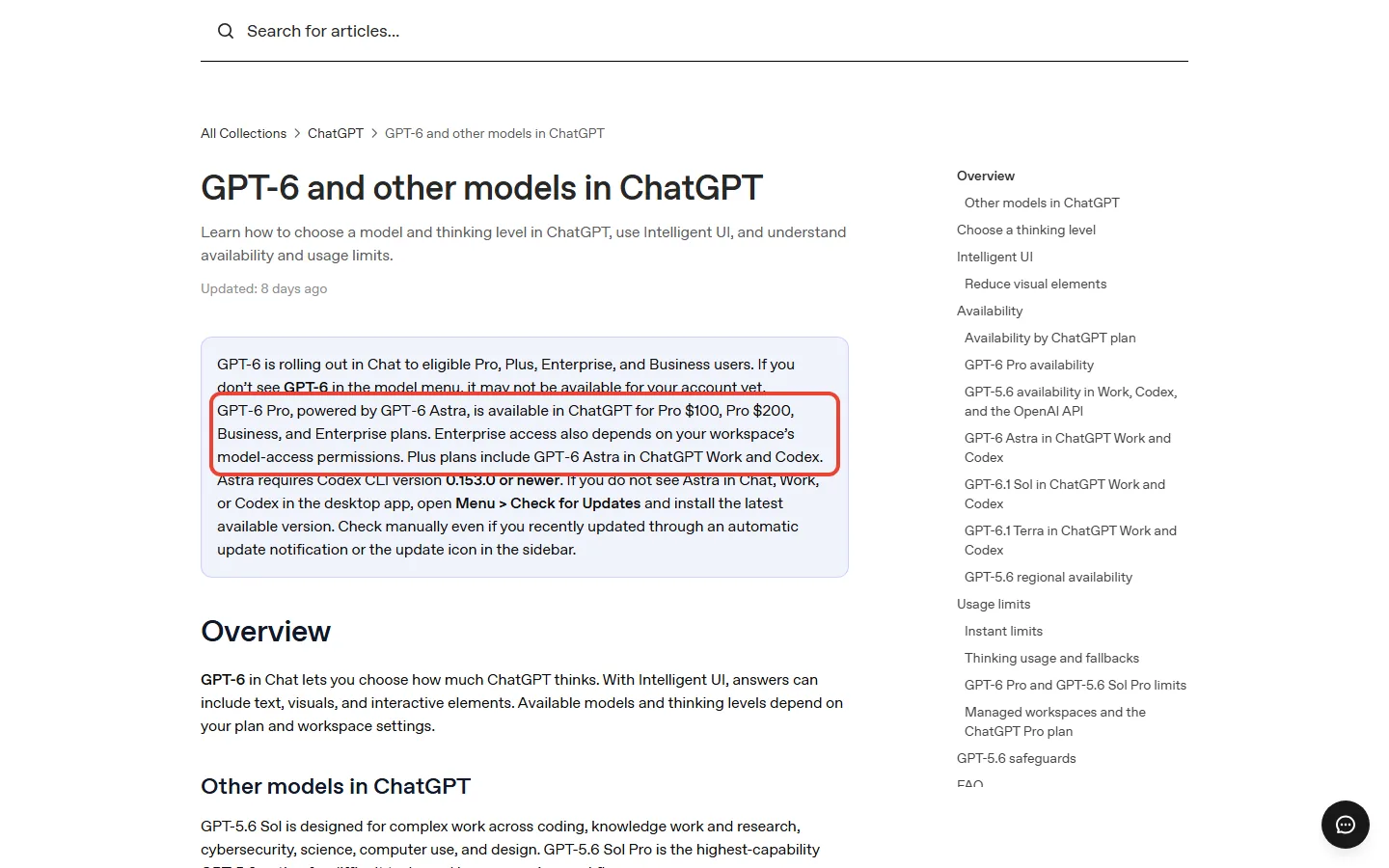
What does differ is the door you use. Think of Chat, the plain chat box, as the shop counter, and a coding tool that works in your files as your own desk. Each $20-class plan reaches its lab’s best-scoring model on the CAIS board, but ChatGPT Plus keeps GPT-6 Astra away from the counter. You get it only in ChatGPT Work, OpenAI’s agent for longer tasks, the kind that end in finished documents, and in Codex, its coding tool.
| Plan | Price | Where you reach the lab’s top model | The limit to know |
|---|---|---|---|
| Claude Pro | $20 a month, or $17 a month on the annual plan ($200 up front) | Opus 5.5 through Research, Claude’s in-depth search mode on paid plans; Fable only with usage credits, meaning extra use you pay for on top | A five-hour limit and a weekly limit, like two clocks, across all models |
| ChatGPT Plus | $20 a month, billed monthly | GPT-6 Astra only in ChatGPT Work and Codex; in Chat, where GPT-6 has rolled out, GPT-6 Sol answers | Astra in the chat box on a personal plan starts with Pro 100, at $100 a month |
| Google AI Pro | $19.99 a month | Gemini 4 Argon is included | Argon in AI Mode is in select countries only |
At three levels of use, your bill looks like this.
| How you use AI | What you pay | What you reach |
|---|---|---|
| Light: a few questions a week, free plans only | $0 | No Opus on Claude Free; GPT-5.6 Luna on ChatGPT Free; a Flash-Lite model on Gemini Free |
| Typical: one $20-class plan | $240 a year ($239.88 for Google AI Pro; $200 for Claude Pro paid yearly) | That lab’s best-scoring model, with ChatGPT’s in Work and Codex only |
| Heavy: all three $20-class plans | $59.99 a month, $719.88 a year | Three models within 2 points of each other on the CAIS board |
| Astra in the ChatGPT chat box | Pro 100: $1,200 a year | GPT-6 Pro, powered by Astra, with usage limits |
Say you use ChatGPT every day and want Astra in the chat box itself. Pro 100 costs $100 a month, 5 times Plus. That is $80 more a month and $960 more a year, and even Pro doesn’t include unlimited use of GPT-6 Pro.
Our call: keep the $20 plan for the app you already open, and skip Pro 100 unless you live in the chat box and the hard problems are your job. Paying for all three buys you three nearly tied models, so one is enough for you. Our guides to who can use GPT-6 Astra, Opus 5.5 vs Sonnet 5.5 on the $20 plan and Google AI Ultra vs Pro go plan by plan.
What would change our verdict
We would move from “not yet” if any of these happened. You can watch for each one yourself:
- Clay moves Navier-Stokes to Solved. Its rules need publication, at least two years and general acceptance in the maths community, so you can expect a long wait.
- The ETH working group gives its verdict on OpenAI’s claim that the Exponential Time Hypothesis is false.
- Anthropic’s index shows full autonomy on any measured slice of AI research work.
- Growth data bends. The next GDP estimate is due on November 25, 2026, and the extreme scenario needs about 7.5% a year on average.
Until one of those happens, read “The singularity is here.” as a claim about pace, made by someone at a lab. Choose your AI plan on price and on the app you use; our ChatGPT plan guide and Claude review are the place to start.
Sources and how we checked: Jack Clark’s published lecture text, Import AI 477 (parts of the speech were ad-libbed and are not in it, so we quote only the text); Vinge’s 1993 paper; the Humanity’s Last Exam site; the CAIS and Scale boards; Epoch AI; METR’s Opus 5.5 report; Anthropic’s research and plan pages; OpenAI’s GPT-6 help article, release notes and plan pages; Google’s Gemini plan pages; Clay; Quanta; BEA and FRED. Pages were read on November 2 and 3, 2026, and the plan pages, OpenAI’s release notes and the Scale board were read on November 6 and 7; prices are US dollars. Leaderboards move, and outside reviews of the ETH claims were still pending on November 7.

Founder of AI Tool Analysis. Every price and limit here is checked against the vendor’s own pages. How we research
Stay Updated on AI Plans and Prices
Get an email when a plan we cover changes its price or limits.
Free, unsubscribe anytime.
Related Reading
- GPT-6 Astra: Who Can Use It, What It Costs, and Did It Really Solve Chess?
- Claude Subscription 2026: Free vs Pro $20 vs Max $100 vs Ultra $200 (Which One?)
- Is Gemini 4 Argon Free? Which Google AI Plan Gets It (2026)
- Claude Mythos Preview: Anthropic’s Most Powerful AI Found 27-Year-Old Bugs (And You Can’t Use It)
- Claude Fable Review: Anthropic’s First Public Mythos-Class Model
Last Updated: November 7, 2026
Next Review Update: December 7, 2026