

This Replit Agent review tests the May 2026 product — Replit’s autonomous full-stack app builder that turns plain-English descriptions into deployed working applications. The headline question for buyers in 2026 isn’t “can Replit Agent build apps” — it can — but “is it the right pick versus Lovable, Bolt by StackBlitz, v0, or just hiring a contract developer for a weekend.” This replit agent review answers that honestly across the dimensions that matter: actual output quality, what gets shipped vs what needs cleanup, deployment friction, ongoing costs, and the honest verdict for the personas who reach for prompt-to-app tools (solo founders shipping MVPs, non-coders prototyping internal tools, knowledge workers building personal automation, students learning by building). Spoilers: yes for MVP/prototype work, mixed for production-ready apps.
Watch: Replit Agent Hands-On Overview
See full-stack app generation in real time
⚡ TL;DR – The Bottom Line
What This Is: Honest Replit Agent review of the May 2026 product — autonomous full-stack app builder powered by Claude Opus 4.7 + Gemini 3.1 Pro.
Best For: Solo founders shipping MVPs, non-coders prototyping internal tools, knowledge workers building personal automation, students learning by building.
Pricing: Free tier (limited), Replit Core $25/mo, Teams $35/mo. Deployment costs (compute + storage) sit on top per usage. Verify current pricing on replit.com — Replit adjusts tiers periodically.
Our Take: Best-in-class for MVP/prototype generation in May 2026. The full-stack scaffolding + auth + database + deployment workflow is genuinely magic. Output needs cleanup for production use; hand-tune anything client-facing.
⚠️ The Catch: Deployment costs can stack quickly if your app gets traction — watch the compute/storage line items, not just the subscription tier.
📑 Quick Navigation
Replit Agent Review — The Bottom Line
- You’re a solo founder shipping an MVP: Yes, this Replit Agent review unambiguously recommends it. The “describe app → working deploy” workflow lands in 10-15 minutes for typical CRUD apps. Backend, frontend, database, auth, and deployment all handled inside one tool. The MVP-to-validation cycle compresses meaningfully.
- You’re a non-coder prototyping internal tools: Yes. Replit Agent shines exactly here — turning a clear functional description into a working tool you can share with your team for feedback. Polish-quality is good enough for internal use; perfect-quality isn’t the goal.
- You’re a knowledge worker building personal automation: Yes for self-contained tools (a personal dashboard, a custom scheduler, a niche calculator). Less ideal for tools that need to integrate with corporate systems behind authentication boundaries.
- You’re a developer who could code this yourself: Use Replit Agent for prototypes and throwaway code; use Cursor or Claude Code for production work where you need full control. Replit Agent’s autonomy is a feature for non-coders, a bug for engineers who want to direct the work step-by-step.
- You need production-grade enterprise apps: Skip Replit Agent for that use case. The output is good enough to ship as MVP; not good enough to deploy to thousands of users without significant cleanup. Use Replit for validation, then rebuild in your real production stack if the idea proves out.
What Replit Agent Actually Does
Replit Agent is an autonomous app-building agent that runs inside the Replit cloud development environment. You describe an app in plain English (“a Reddit-like discussion board with categories, voting, and user accounts”), the Agent scaffolds the code, sets up the database, adds authentication, deploys it to a live URL, and iterates on bugs as you report them. The whole loop happens inside one browser tab — no local environment setup, no terminal commands, no configuration files for non-coders to puzzle over.
Under the hood, Replit Agent now runs on a model-choice combination of Claude Opus 4.7 and Gemini 3.1 Pro — pick per task or let Replit route automatically based on workload. The model upgrades through 2026 (Opus 4.6 → 4.7, Gemini 3 → 3.1 Pro) made the Agent meaningfully more reliable at multi-step build sequences, particularly the “scaffold + populate + debug” loop that’s the core workflow.

What Changed Since Late 2025
- Model-choice landed. Late 2025 Replit Agent ran on a single underlying model. May 2026 ships model choice — Claude Opus 4.7 or Gemini 3.1 Pro per task. Practical: pick Opus for harder logic problems, Gemini for cost-sensitive bulk generation.
- Full-stack autonomy matured. The “scaffold + database + auth + deploy” sequence that was patchy in late 2025 became reliable in early 2026. Typical CRUD apps now hit working deployment in 10-15 minutes from a clear prompt.
- Pricing structure intact. Free tier, Replit Core $25/mo, Teams $35/mo. Verify current pricing on replit.com — Replit adjusts subscription tiers periodically. Deployment costs (compute + storage) remain usage-based and stack on top of the subscription.
- Deployment costs visibility improved. The “your app costs more than your subscription” surprise that bit early users in 2025 became less of a footgun — the Replit dashboard now surfaces deployment costs more clearly upfront.
- Competitive pressure from Lovable + Bolt + v0. The prompt-to-app market sharpened through 2026. Lovable closed the gap on full-stack scaffolding; Bolt added stronger frontend specialization; v0 stayed dominant on prompt-to-React-component. Replit’s distinguishing strength remains the integrated cloud environment + deployment.
Your First Deploy in 10 Minutes
The first-deploy workflow is genuinely magic. Sign up for Replit (free), click “Create with Agent,” describe what you want (“a habit tracker app where users can log daily habits and see streaks”), pick a tech stack (or let Replit choose) and click Build. Agent works through scaffolding, database setup, frontend, auth, and deployment — you watch the multi-step execution in real time, intervening only if something goes off-track. First working deploy lands in 10-15 minutes for a typical small app.

The genuinely useful onboarding pattern: pick one specific personal-tool idea you’ve had for a while, describe it to Replit Agent in detail (audience, features, data model, auth requirements), let it build, then iterate via follow-up prompts. The 30-minute investment exposes you to the full prompt-to-deploy workflow and gives you a personal artifact to keep using.
Real Test: Building a Reddit Clone
The standard “test the prompt-to-app workflow” exercise is asking the tool to build a Reddit-style discussion board — non-trivial enough to expose limitations, well-defined enough to evaluate consistently. Replit Agent in May 2026 handles this in roughly 25-30 minutes for a working basic version (categories, posts, voting, user accounts, authentication, persistent database). Total cost: subscription + ~$0.50 in deployment costs to keep the test running for a week.
Quality vs hand-built: 70-80% of a contract-developer first sprint. The Agent ships working code, but the database schema is rough, the UI uses default styling, edge cases (concurrent voting, vote manipulation, content moderation) aren’t handled. For an MVP that proves the idea works, this is fine. For shipping to real users at scale, you’d rewrite ~40% of what the Agent generated.

Replit Agent Review: Features That Matter
Full-stack autonomy (the moat)
The single most defensible feature. Most prompt-to-app tools handle one layer well — v0 for components, Lovable for full-stack-ish, Bolt for in-browser builds. Replit Agent handles the entire stack inside its own cloud environment: backend API, frontend UI, database schema, authentication setup, and deployment to a live URL. No tool integration friction; no “which step do I do next” puzzle for non-coders.
Model choice (Opus + Gemini)
The 2026 differentiator. Replit Agent now lets you pick the underlying model per task — Claude Opus 4.7 for harder logic problems and complex reasoning, Gemini 3.1 Pro for bulk code generation and multimodal work. Or leave the choice to Replit’s automatic routing. Either way, you’re not locked into one vendor’s quality ceiling.
Live deployment included
Every Agent build deploys to a live Replit URL automatically. No separate hosting setup, no DNS configuration, no DevOps. For MVPs and prototypes this removes the biggest friction in the “build something to test” workflow. For production apps you’d typically migrate off Replit’s hosting eventually, but the on-ramp is meaningfully smoother.
Iterative refinement via follow-up prompts
Replit Agent treats your initial prompt as draft 1, not final spec. You can ask “make the voting buttons larger” or “add email verification” or “cache the post list” and the Agent re-routes the relevant changes without rebuilding from scratch. This is what makes prompt-to-app actually useful — your apps evolve through conversation rather than being one-shot generations.
Cloud environment integration
Code, database, deployment, secrets management, environment variables — all live in one Replit workspace. For non-coders this is essential; for developers transitioning from local-first workflows it takes adjustment but pays back in collaboration friction (share a working URL, not “clone this repo and follow these 7 setup steps”).
🔍 REALITY CHECK
Marketing Claims: “Build production apps in minutes — no coding required.”
Actual Experience: “Build apps in minutes” is honest. “Production apps” oversells what the Agent ships out-of-the-box. The output is genuinely working software with real database, real auth, real deployment — but production-grade means handling edge cases, scale, security hardening, and design polish that the Agent doesn’t fully address. For internal tools, MVPs, prototypes, and personal apps, “production-ready enough” is true. For consumer apps that will face real load and real bad-actor traffic, expect cleanup before shipping.
Verdict: “Working app in minutes” is true. “Production-ready in minutes” is marketing exaggeration. Match expectations to use case (MVP yes, public consumer launch needs work).
Replit Agent Review: Pricing Reality
| Tier | Price (verify current) | What You Get | Best For |
|---|---|---|---|
| Free | $0 | Limited Agent usage, public Repls only, basic deployment | Trial / personal experiments |
| Replit CoreSWEET SPOT | ~$25/mo | Full Agent access, private Repls, more compute, model choice (Opus + Gemini) | Solo founders, prosumers |
| Replit Teams | ~$35/mo per user | Core features + team collaboration, shared workspaces, admin controls | Small teams building together |
| Deployment costs | Usage-based | Compute (per always-on hour), storage, bandwidth — sit on top of subscription | Watch carefully if app gets traction |
Pricing tip: deployment costs are the line item that bites. Subscription is predictable; deployment costs scale with how active your apps are. A successful MVP that gets traction can run $50-100/mo in compute alone. If your app starts working, plan to migrate to dedicated hosting (Vercel, Railway, AWS) before you cross $100/mo in Replit deployment costs — that’s roughly the breakeven point against most alternatives.
📬 Find this Replit Agent review useful?
Get our weekly AI dev tool reviews — Replit / Cursor / Claude Code / Lovable / Bolt updates and pricing changes.
Replit Agent vs Cursor vs Lovable vs Bolt
| Dimension | Replit Agent | Lovable | Bolt by StackBlitz | Cursor 2 |
|---|---|---|---|---|
| Full-stack autonomy | Best in classWIN | Strong | Strong (browser) | N/A (IDE, not auto-builder) |
| Deployment included | Yes (Replit hosting) | Yes | Yes (StackBlitz) | No |
| Local-first option | No (cloud only) | No | No (browser only) | Yes |
| Model choice | Opus + Gemini | Single model | Single model | Multi-model |
| Best for | Non-coders, MVPs, full-stack | Solo founders, MVP iteration | Browser-first prototyping | Engineers, production code |
| Entry pricing | $25/mo Core | $20/mo | $20/mo | $20/mo Pro |
| Deployment cost ceiling | Usage-based (can stack) | Hosted, predictable | Hosted, predictable | N/A (you bring hosting) |
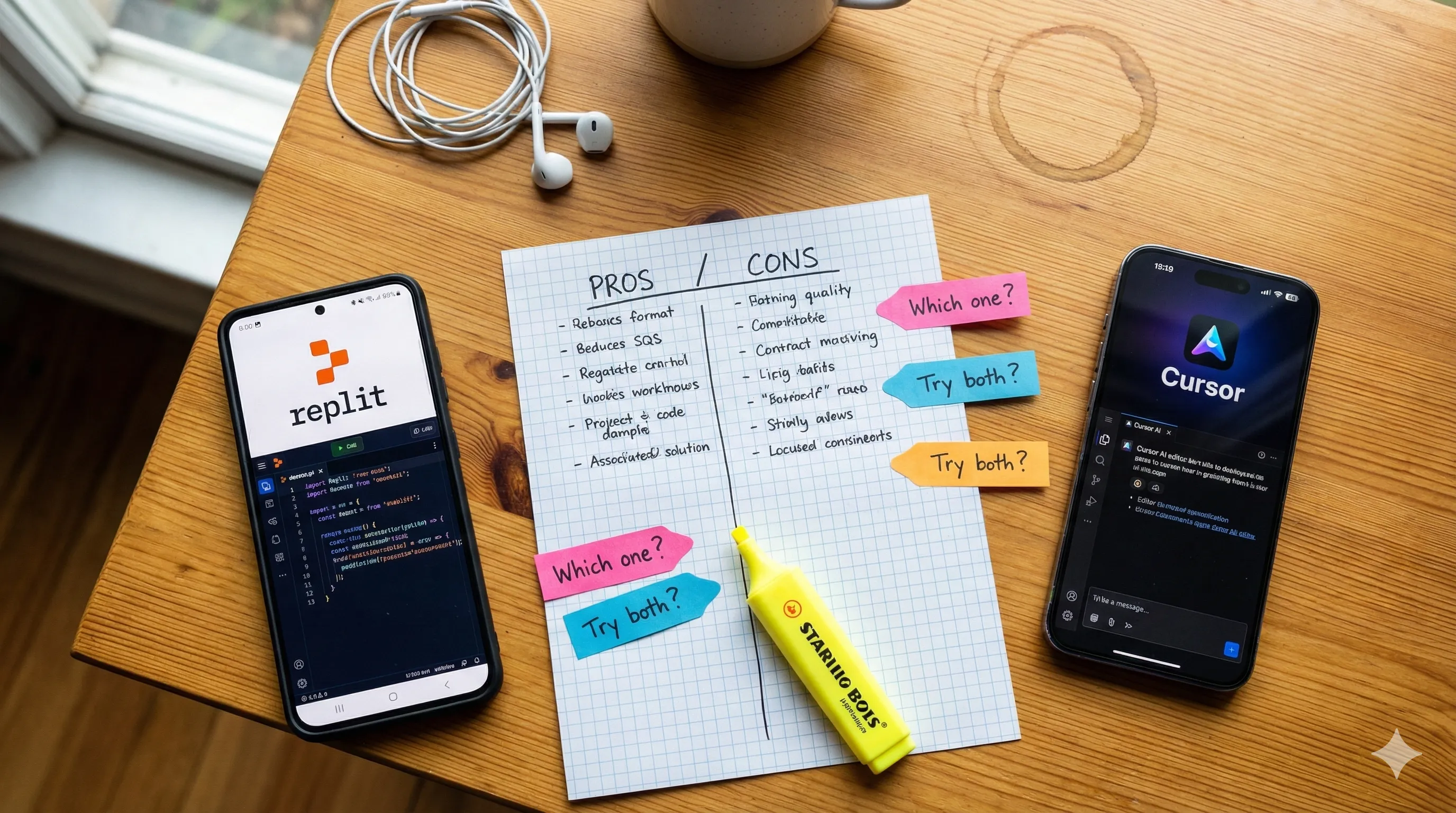
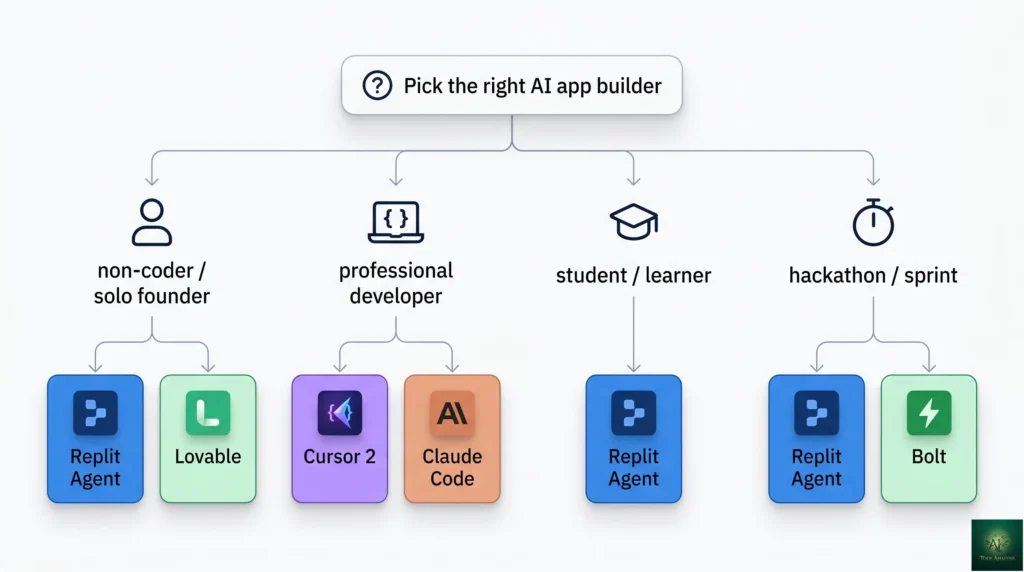
The honest verdict: pick by use case. Replit Agent for prompt-to-deployed-app autonomy (non-coder friendly). Cursor 2 for engineer-driven development with AI assistance (you steer, AI accelerates). Lovable and Bolt for narrower flavors of the same prompt-to-app workflow. Most professional teams using AI dev tools end up with one IDE (Cursor or Antigravity) plus one autonomous tool (Replit Agent or Claude Code) — not one or the other.
Replit Agent Review: Who Should Use It
- Solo founders shipping MVPs: Yes. The “describe app → working deploy in 15 minutes” workflow compresses the validation cycle meaningfully. Build, ship, get user feedback, iterate.
- Non-coders prototyping internal tools: Yes. Replit Agent’s polish-quality is good enough for internal use; the alternative (hire a contract dev for a $2K weekend) is much higher friction.
- Knowledge workers building personal automation: Yes for self-contained tools (a personal habit tracker, a niche calculator). Skip if your tool needs to integrate with corporate systems behind enterprise auth boundaries.
- Students learning by building: Yes. The “see your idea become real software” feedback loop is genuinely motivating, and the cloud environment removes the “set up your local dev environment” friction that kills early learners.
- Hackathon teams: Yes. Replit Agent at a hackathon is essentially an unfair advantage — what used to take a 24-hour scramble can now ship in 2-3 hours.
- Skip Replit Agent if: You’re a professional developer wanting full control (use Cursor or Claude Code instead), need on-prem or custom infrastructure (use a code-first tool with your own hosting), or building a consumer app expecting real load (build the MVP in Replit, then rebuild in your real production stack if it proves out).

💡 Key Takeaway: Replit Agent’s moat is the combination of full-stack autonomy + integrated cloud environment + included deployment. No competitor matches all three for non-coder-friendly prompt-to-app workflows. Where Replit loses is when you outgrow its hosting (deployment costs scale aggressively) or need engineering control (developers prefer Cursor or Claude Code).
FAQs
Can Replit Agent really build apps without coding?
Yes for MVPs and prototypes. The Agent handles backend, frontend, database, auth, and deployment from plain-English descriptions. For production-grade apps facing real load, expect cleanup before shipping. “No coding” is honest; “production-ready in minutes” oversells what the output is.
How much does Replit Agent cost?
Replit Core at ~$25/mo gets you full Agent access plus model choice (Claude Opus 4.7 or Gemini 3.1 Pro). Teams at ~$35/mo per user adds collaboration. Deployment costs sit on top per usage — watch this line item if your app gets traction. Verify current pricing on replit.com.
Is Replit Agent better than Cursor?
Different tools for different jobs. Replit Agent for non-coder-friendly autonomous prompt-to-app workflows (you describe, it builds end-to-end). Cursor for engineer-driven AI-augmented development (you steer, AI accelerates). Most professional teams use both — Replit for prototypes, Cursor for production code. Direct comparison in our best AI developer tools roundup.
What model powers Replit Agent?
Model choice as of 2026 — Claude Opus 4.7 or Gemini 3.1 Pro per task, or Replit’s automatic routing based on workload. Pick Opus for harder logic problems, Gemini for cost-sensitive bulk generation, or just leave it on automatic.
Can I export my Replit app to host elsewhere?
Yes — Replit apps are real code that you can clone via Git and deploy anywhere (Vercel, Railway, AWS, your own server). Many users prototype on Replit then migrate to dedicated hosting when deployment costs cross the breakeven point against alternatives (~$100/mo).
Does Replit Agent work for mobile apps?
For web apps that work on mobile browsers, yes. For native iOS/Android apps, no — Replit doesn’t ship native mobile build pipelines. Use Cursor with React Native or a mobile-specific tool for native mobile work.
How does Replit Agent handle databases?
The Agent picks an appropriate database (typically Postgres for relational, occasionally key-value stores for simpler needs) and provisions it inside your Replit environment. Schema design is automatic from your prompt; you can refine via follow-up prompts. For complex schema requirements, expect to hand-tune the generated tables.
Is Replit Agent’s code production-ready?
For internal tools, MVPs, prototypes, and personal apps, yes. For consumer apps at scale, expect ~30-40% cleanup work before shipping — error handling, edge cases, security hardening, performance optimization. Use Replit for validation; rebuild in your real production stack once the idea proves out.
✅ What Replit Agent Wins At
- ✓ Full-stack autonomy in one tool (best in category)
- ✓ Integrated cloud environment + included deployment
- ✓ Model choice — Opus 4.7 or Gemini 3.1 Pro
- ✓ Iterative refinement via follow-up prompts
- ✓ Genuine non-coder friendly UX
❌ Where Replit Agent Falls Short
- ✗ Deployment costs stack aggressively at scale
- ✗ Output needs cleanup for production-grade apps
- ✗ Cloud-only — no local-first or on-prem option
- ✗ No native mobile build pipelines
Best-in-class for non-coder-friendly prompt-to-deployed-app workflows. Half a star off because deployment costs can stack aggressively if your app gets traction, and production-grade output requires cleanup before shipping at scale.
Replit Agent Review: The Final Verdict
Replit Agent in May 2026 is the right answer to the specific question “I want to ship a working app from a plain-English description without learning to code or hiring a developer.” Full-stack autonomy + integrated cloud environment + included deployment + model choice (Opus + Gemini) + non-coder friendly UX — no competitor matches all five for prompt-to-app workflows. For solo founders, non-coders, knowledge workers, students, and hackathon teams, this Replit Agent review unambiguously recommends it.
Final Replit Agent review verdict: pick Replit Agent if you’re shipping MVPs, prototypes, internal tools, or personal apps where “working software in minutes” matters more than production-grade polish. Skip Replit Agent if you’re a professional developer (use Cursor or Claude Code for fuller control), need on-prem deployment (use a code-first tool with your own hosting), or building a consumer app expecting real load (build the MVP in Replit, then rebuild in your real production stack once the idea validates). Match the tool to your scale and you’ll be happy — Replit Agent serves “ship something real fast” better than anything else in the prompt-to-app category.
Related Reading
- Cursor 2 Review — the engineer-first AI IDE alternative
- Claude Code Review — Anthropic’s autonomous coding agent (similar autonomy, different surface area)
- Best AI Developer Tools 2026 — broader roundup placing Replit Agent in context
- GitHub Copilot Pro Review — for the in-editor coding assistant tier
- Google Gemini Review — Gemini 3.1 Pro (one of the models powering Replit Agent)
- Best AI Image Generators 2026 — for visuals to pair with your Replit-built apps
- The Complete AI Tools Guide — buyer’s guide for picking the right tool from 200+ tested
Founder of AI Tool Analysis. Reads every pricing page, help article and footnote so you don’t have to. Covering AI tools since 2025. See how we research →
Stay Updated on AI Coding Tools
The AI coding tools landscape shifts quarterly. Subscribe for honest reviews of new Replit / Cursor / Claude Code / Lovable / Bolt releases, pricing changes, and feature drops — delivered every Thursday at 9 AM EST.
- ✅ Sourced Reviews: Every price and limit checked against the vendor’s own pages, not rewritten from press releases
- ✅ New Releases: Replit Agent / Cursor / Claude Code updates covered within days
- ✅ Pricing Changes: Know when subscription tiers shift
- ✅ Stack Recommendations: Real-world AI coding stacks as the field evolves
- ✅ No Hype: Just the AI coding news that matters for your work
Free, unsubscribe anytime.

Last Updated: May 1, 2026
Tool Tested: Replit Agent (May 2026 product), with comparison context to Lovable, Bolt by StackBlitz, Cursor 2, and Claude Code. Verify current Replit pricing on replit.com before publish — Replit adjusts subscription tiers periodically, and deployment costs scale per usage.
Slug Note: Renamed from /replit-agent-3-review/ to /replit-agent-review/ on May 1, 2026 for evergreen URL. 301 redirect in place. Under the no-version-or-year-in-slugs standing policy.
Next Review Update: August 2026 (or sooner when Replit ships a major Agent release)
Have a tool you want us to review? Suggest it here | Questions? Contact us