
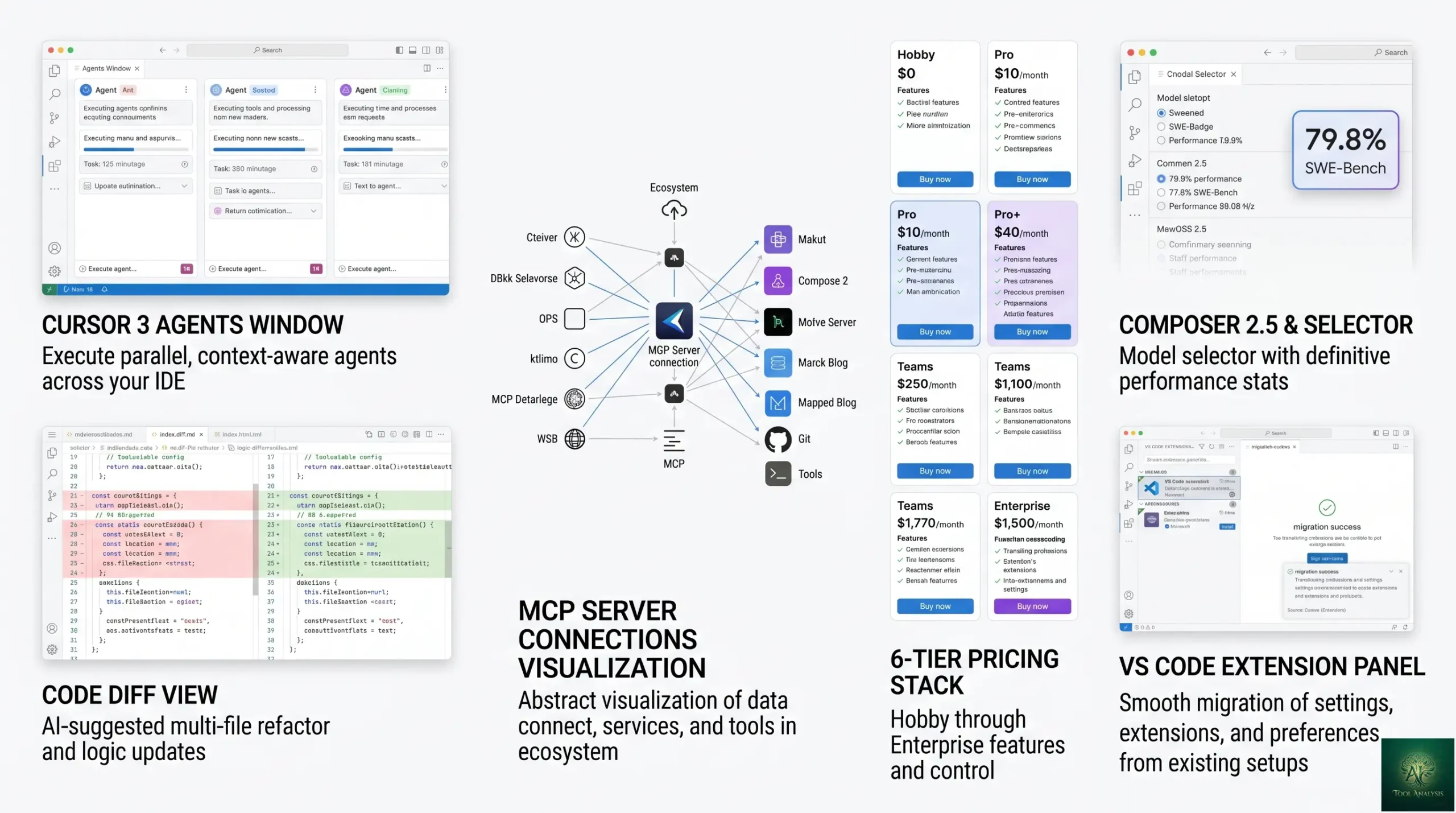
What changed since the source post: Cursor 3 launched April 2, 2026 — the biggest interface overhaul since 2023, anchored on a new Agents Window for managing parallel agents across local machines, cloud sandboxes, and remote SSH. Composer 2.5 launched May 18, 2026 and posts 79.8% on SWE-Bench Multilingual — essentially tied with Claude Opus 4.7’s 80.5% at roughly 1/10th the cost. Pricing now spans 6 tiers: Hobby (free) / Pro $20 / Pro+ $60 (NEW) / Ultra $200 / Teams $40/user / Enterprise custom. Anysphere valuation climbed from $29.3B (Nov 2025) → $50B (March 2026 talks) → reports of $60B SpaceX/xAI acquisition discussion (April 2026). $2B ARR. The credit-system controversy from June 2025 has stabilized but informs how the pricing tiers actually feel in production.
This Cursor AI review covers the editor’s June 2026 state honestly — Cursor 3’s Agents Window overhaul, Composer 2.5’s frontier benchmark performance, the 6-tier pricing structure that’s now stable after the June 2025 credit-system controversy, and the honest competitive picture vs Claude Code, Gemini CLI, Antigravity 2.0, and ChatGPT Codex. The argument over what an agentic coding tool should be has mostly converged — four products define the category and your choice depends on which workflow shape matches yours.
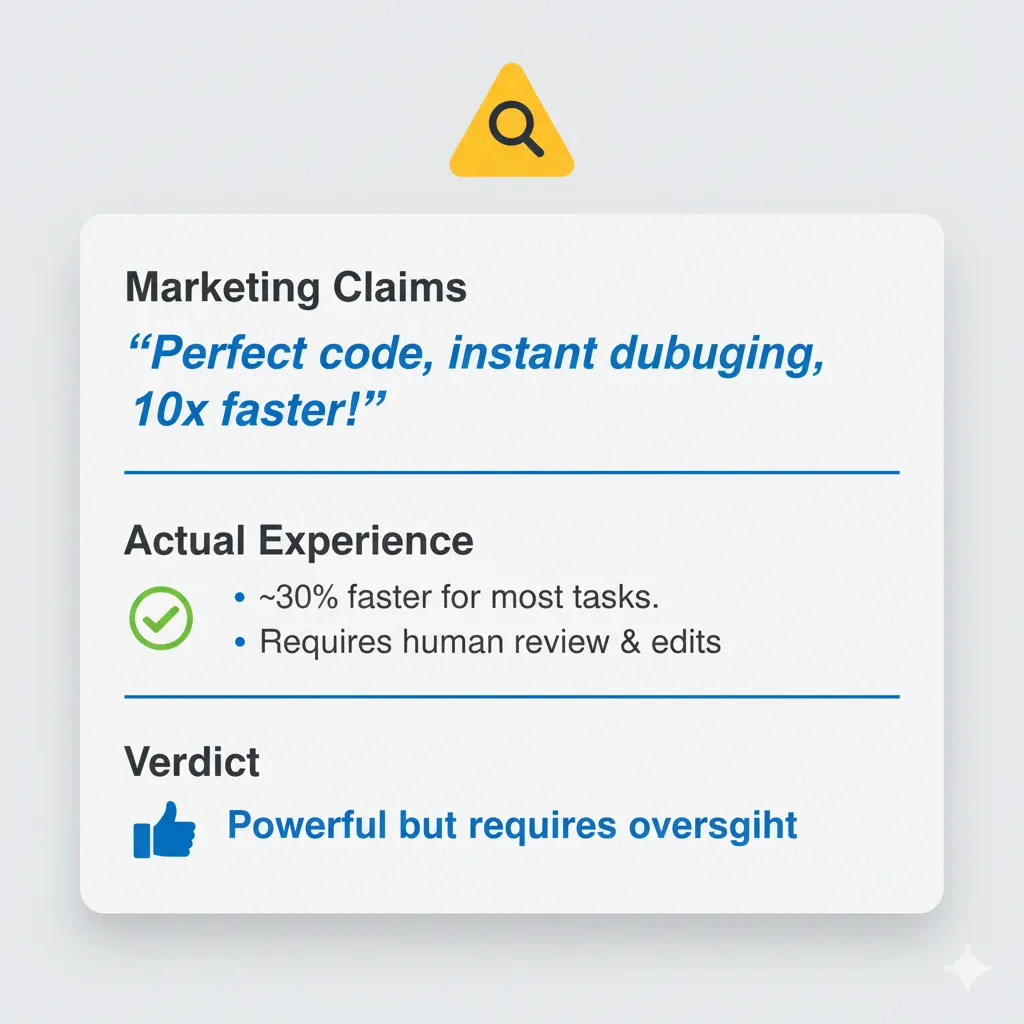
Across multiple hands-on tasks in June 2026 — a multi-file refactor, a greenfield feature build, a debug session, and a daily-driver editor stress test — Cursor 3 + Composer 2.5 delivered the smoothest balance of quality, speed, and workflow polish for solo + small-team development. The credit math still rewards discipline. The competitive position has narrowed (Antigravity took the autonomous-task crown; Claude Code holds debugging) but Cursor remains the editor default most teams should start with. This Cursor AI review gives you the buying framework before you commit a credit card.
⚡ TL;DR — Cursor AI Review (June 2026)
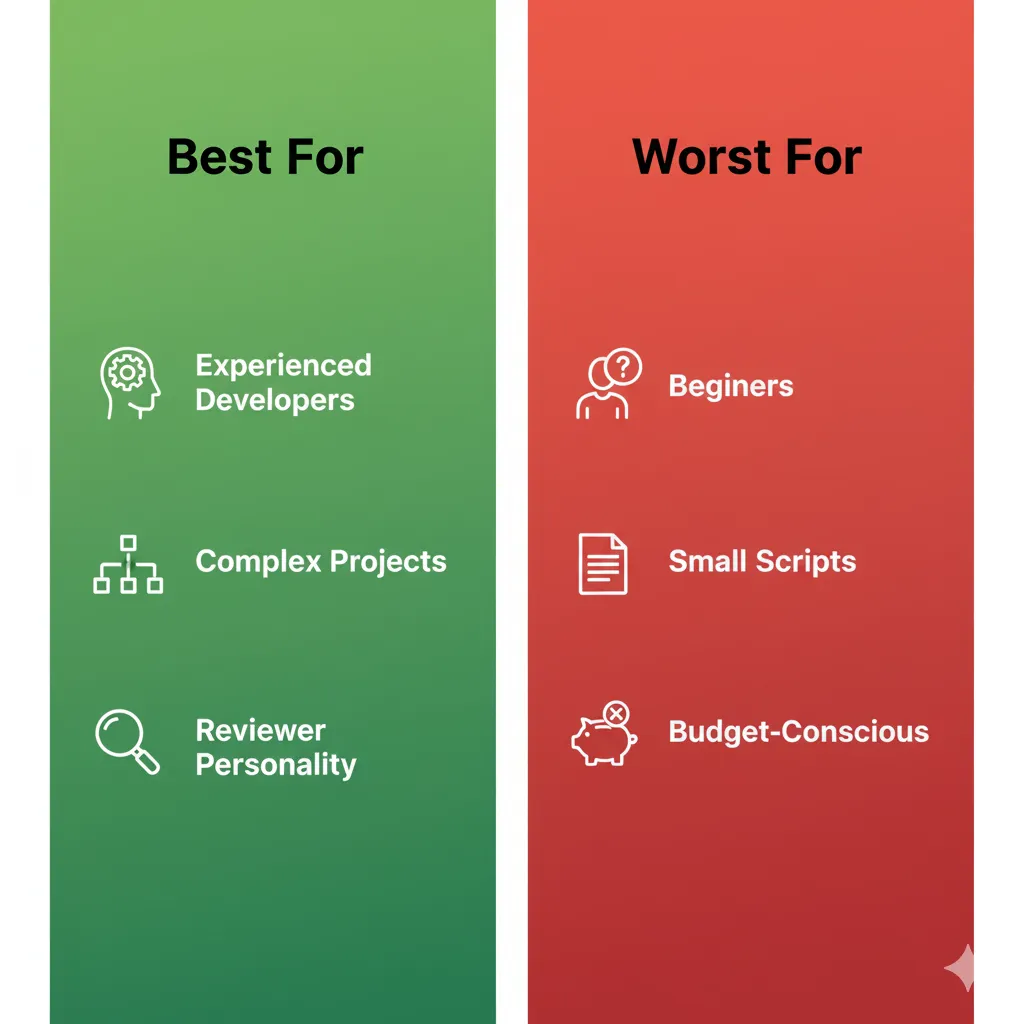
🎯 Best for: Solo developers, small engineering teams (2-10 devs), indie hackers, anyone who wants a VS Code-familiar editor with AI baked in. The daily-driver AI code editor most teams should start with.
💰 What it costs: Hobby (free) / Pro $20/mo or $16 annual / Pro+ $60/mo or $48 annual (NEW 2026) / Ultra $200/mo or $160 annual / Teams $40/user/mo / Enterprise custom. Credit-pool billing model — pool equals plan price.
🏆 What it does best: Composer 2.5 unlimited on paid plans (79.8% SWE-Bench Multilingual at ~1/10th the cost), Cursor 3 Agents Window for parallel-agent workflows, native MCP support, codebase indexing, VS Code extension compatibility, in-editor PR review.
⚠️ Where it loses: Codex still leads SWE-Bench Verified (88.7%); Antigravity wins for big autonomous tasks + browser testing; Claude Code wins for terminal-native refactors; rate limits on Pro can frustrate heavy users.
💡 Heads-Up: Composer 2.5 reshapes the buying-decision math — Pro at $20 now handles 80-90% of daily work without depleting credits (Composer + Auto are credit-unlimited; credits only deplete on manual frontier-model selection). Re-evaluate the tier after 30 days based on your actual usage pattern.
📑 In This Cursor AI Review
- The Bottom Line
- What Just Happened (Q1-Q2 2026)
- What Cursor Actually Is
- Cursor 3: Agents Window Overhaul
- Composer 2.5 Cost-Performance Story
- Pricing — The 6-Tier Decision
- June 2025 Credit Controversy
- vs Claude Code / Antigravity / Codex
- Getting Started (10 Minutes)
- Who Should Use Cursor
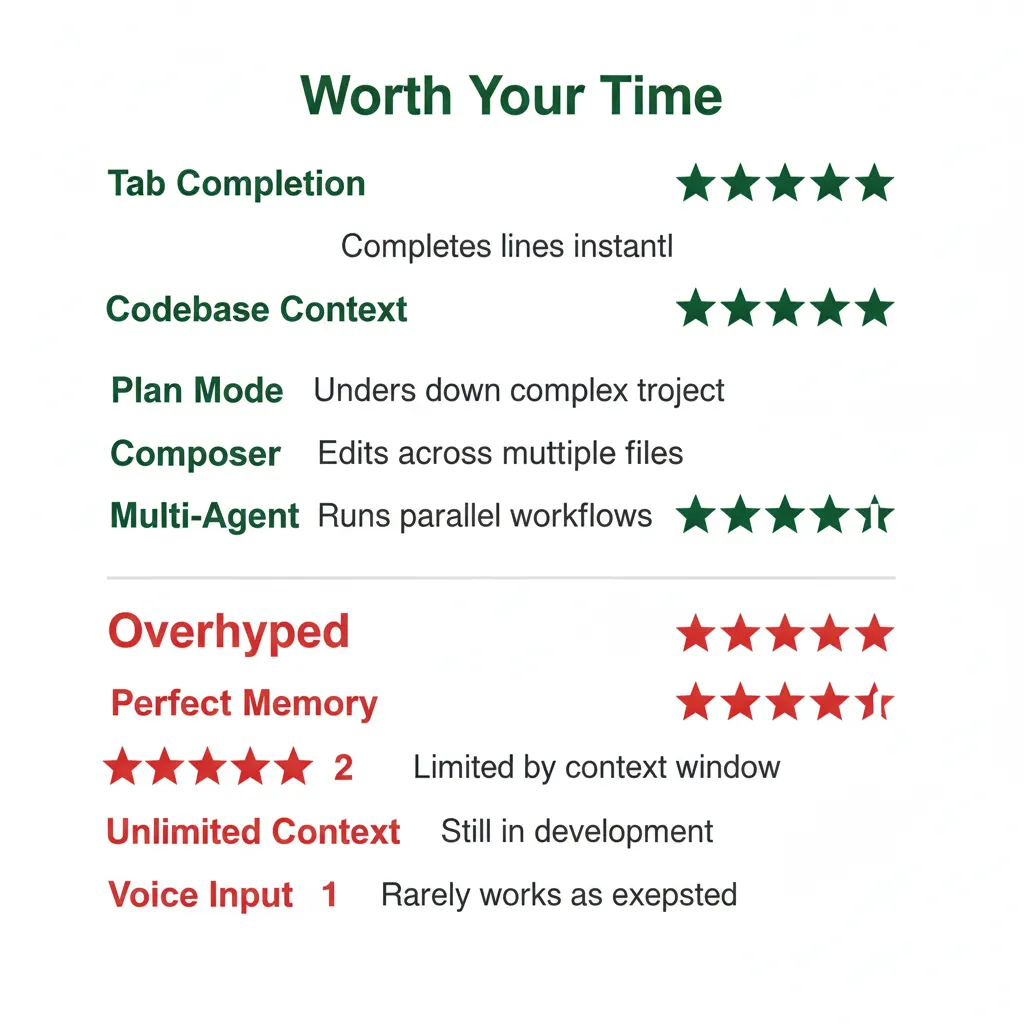
- Honest Limitations
- Real Tests From This Review
- Final Verdict
- FAQs
💡 The Bottom Line
Cursor remains the AI code editor most teams should pick first in June 2026. Cursor 3’s Agents Window unlocks parallel-agent workflows that previously required external tooling. Composer 2.5 delivers frontier-tier benchmark performance (79.8% SWE-Bench Multilingual) at roughly 1/10th the per-token cost of Claude Opus 4.7. The 6-tier pricing structure is stable after the June 2025 credit-billing controversy, but the credit math still demands attention — heavy Composer users on Pro can blow through monthly allotment in two weeks if undisciplined. Best for: solo developers, small engineering teams, indie hackers, and any team where editor-centric workflow matters more than terminal-native agent orchestration.
⚠️ Reality Check #1 — Composer 2.5 changed the tier-decision math: Marketing materials sometimes still anchor on “frontier model access” as the headline buying signal. The Composer 2.5 reality is the opposite — for 80-90% of daily work, you don’t need frontier model selection at all. Composer 2.5 + Auto mode are credit-unlimited on every paid plan. The credit pool exists for the manual frontier-model exception, not the rule. Pick the tier whose pool matches your manual-frontier frequency, not your aspirational frontier frequency.
📅 What Just Happened (Q1-Q2 2026)
- April 2, 2026 — Cursor 3 shipped with the Agents Window — a dedicated pane for running multiple agents in parallel across local machines, worktrees, cloud sandboxes, and remote SSH environments
- May 18, 2026 — Composer 2.5 launched — 79.8% SWE-Bench Multilingual (essentially tied with Claude Opus 4.7’s 80.5%), 69.3% Terminal-Bench 2.0, 63.2% CursorBench v3.1
- Composer 2.5 economics — frontier-tier performance at roughly 1/10th the per-token cost vs frontier models from other providers
- Pricing structure settled at 6 tiers: Hobby (free), Pro ($20), Pro+ ($60 NEW), Ultra ($200), Teams ($40/user), Enterprise (custom)
- Annual billing discount at ~20% across paid tiers — Pro drops to $16/mo, Pro+ to $48/mo, Ultra to $160/mo
- Credit-system billing (since June 2025) has stabilized — credit pool equals plan price; Auto mode unlimited; credits deplete only on manual frontier-model selection
- Anysphere valuation arc: Nov 2025 $29.3B Series D → March 2026 $50B funding talks → April 2026 reports of $60B SpaceX/xAI acquisition discussion
- $2B ARR with ~300 employees — among the fastest revenue-per-employee companies in software history
- Windsurf retired June 2, 2026 — Cognition relaunched the IDE as Devin Desktop, reshaping the agentic-IDE competitive landscape
🎯 What Cursor Actually Is (June 2026)
Cursor is a VS Code fork with deeply integrated AI features where the code editor remains the center of the experience. Unlike Claude Code’s terminal-native orientation or Antigravity’s parallel-agent IDE, Cursor’s core proposition is: the editor stays in front, AI works around it. That positioning matters because it shapes how every feature feels in daily use.
- Composer 2.5 (first-party model): Cursor’s in-house coding agent. 79.8% SWE-Bench Multilingual, 69.3% Terminal-Bench, ~1/10th the cost of frontier alternatives. Built on Moonshot’s open-source Kimi K2.5 base + 25x more synthetic tasks for RL post-training + behavioral calibration for long coding sessions.
- Frontier model routing: Manually select Claude Sonnet 4.x, Claude Opus 4.7, Gemini 2.5/3.1, GPT-4o, or OpenAI o1 reasoning when a task warrants it. Credits deplete only on manual frontier selection.
- Agents Window (Cursor 3, new April 2026): Dedicated pane for spawning and managing multiple parallel agents across local machines, worktrees, cloud sandboxes, and remote SSH environments.
- Background Agents + BugBot: Long-running task execution + automated bug-fix suggestions for repos. Now production-stable after the early-2026 reliability work.
- Native MCP support: Model Context Protocol servers wire Cursor into external tools (databases, design systems, internal docs, monitoring) without leaving the editor.
- In-editor PR review: Review pull requests inline with AI-augmented analysis — comments, suggested changes, security flags.
- Codebase indexing: Repo-aware reasoning across the entire codebase, including imports, type hierarchies, and cross-file dependencies.
🆕 Cursor 3: The Agents Window Overhaul
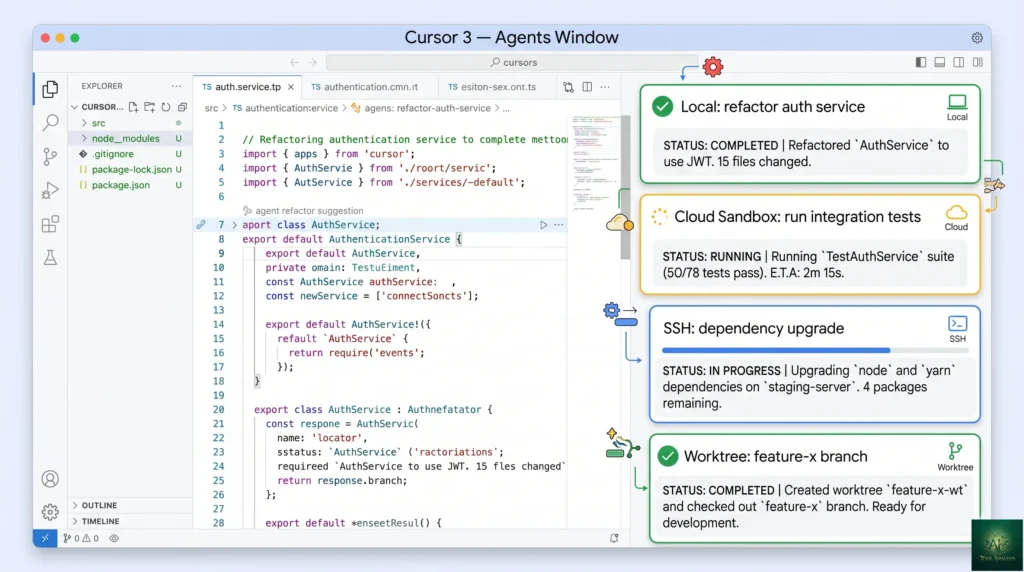
Cursor 3 (April 2, 2026) is the most consequential interface change since the product shipped in 2023. The headline feature is the Agents Window — a dedicated pane that sits alongside the IDE for spawning and managing multiple parallel agents across local machines, worktrees, cloud sandboxes, and remote SSH environments. The mental model shift: agents are first-class workspace citizens, not chat-window prompts.
Practical use cases that the Agents Window enables which previously required external tooling: spawn one agent to refactor a service while a second agent runs the test suite in a cloud sandbox; queue three agents on three different feature branches and review their PRs together; let an agent run long-horizon dependency upgrades overnight on a remote SSH session while the local editor stays responsive for daily work. The orchestration pattern that Antigravity 2.0 popularized at I/O 2026 now exists natively inside the Cursor experience — narrowing one of Antigravity’s clearest differentiators.
The honest limitations of the Cursor 3 Agents Window vs Antigravity’s implementation: Antigravity ships with Gemini 3.1 default-bound and Chrome browser testing baked in for front-end work; Cursor’s Agents Window is model-flexible but expects you to bring the testing/browser tooling yourself. For pure-backend, refactor-heavy, or multi-feature-stream workflows, Cursor 3 closes the gap meaningfully. For front-end-heavy, browser-testing-dependent workflows, Antigravity still has the integrated edge.
⚡ Composer 2.5: The Cost-Performance Story
Composer 2.5 (May 18, 2026) is the most economically consequential model launch of the year for AI coding. The headline numbers (per Cursor’s official announcement): 79.8% on SWE-Bench Multilingual (essentially tied with Claude Opus 4.7 at 80.5%), 69.3% on Terminal-Bench 2.0, 63.2% on CursorBench v3.1, all delivered at roughly 1/10th the per-token cost of frontier alternatives. The technical foundation: Moonshot’s open-source Kimi K2.5 base model, plus 25x more synthetic tasks for reinforcement learning, plus behavioral calibration specifically for long coding sessions where context drift and overconfidence are the failure modes.
What this changes practically for the Cursor AI review buying decision: the previous “free tier is teaser, real work requires frontier models” mental model is obsolete. Composer 2.5 on Pro plan ($20/month) now handles 80-90% of daily coding work — including agentic, long-context, multi-file tasks — without depleting credits at all (since Auto mode and Composer are credit-unlimited on paid plans). Manual frontier selection (Opus, GPT-4o, Gemini 3.1) becomes the exception for the hardest reasoning problems, not the default for serious work.
Chart 1 — SWE-Bench Multilingual + Terminal-Bench Performance (May/June 2026)
Higher = stronger. Composer 2.5 ties Claude Opus 4.7 on Multilingual at ~1/10th the cost.
💰 Pricing Breakdown — The 6-Tier Decision (June 2026)
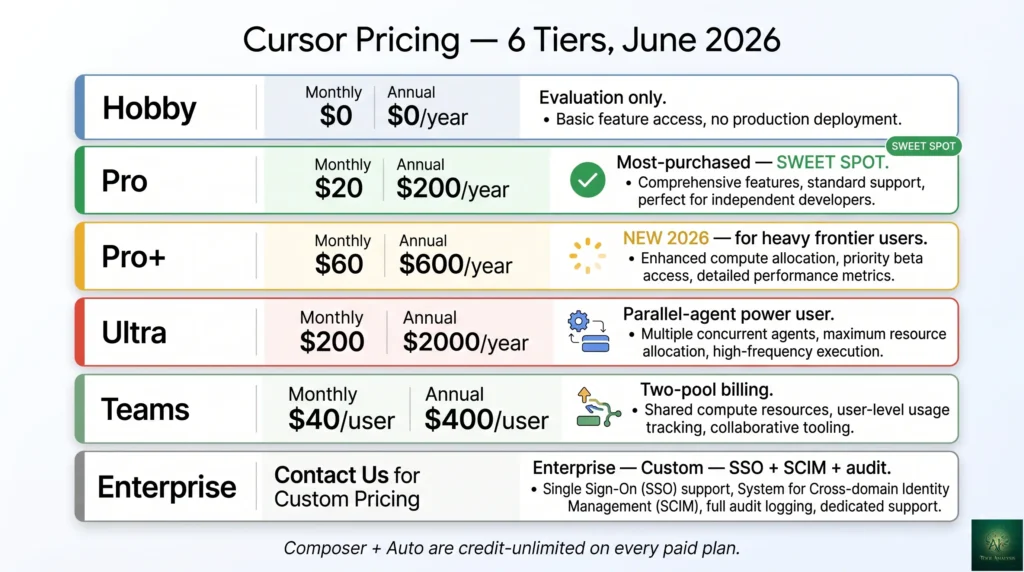
Cursor’s pricing in June 2026 spans six tiers built around a credit-pool billing model. The credit pool equals the plan price (e.g., Pro at $20/month includes $20 worth of frontier-model usage). Composer 2.5 and Auto mode are credit-unlimited on all paid plans. Credits deplete only when you manually select a frontier model (Claude Opus, GPT-4o, Gemini 3.1). Annual billing saves ~20% across paid tiers.
| Plan | Price (monthly / annual) | What You Get |
|---|---|---|
| Hobby | Free | Limited AI completions, basic features. For evaluation and casual side-project use. |
| Pro SWEET SPOT | $20 / $16 annual | Composer 2.5 unlimited + Auto unlimited + $20 credit pool for frontier models. Most-purchased tier. |
| Pro+ NEW 2026 | $60 / $48 annual | 3× credit pool ($60) + higher rate limits. For heavy Composer + frontier-model users who hit Pro’s rate-limit ceiling. |
| Ultra POWER USER | $200 / $160 annual | $200 credit pool + priority queue + premium rate limits. For pro developers running multiple parallel agent workflows. |
| Teams TEAM PICK | $40/user/mo | Two pools: Composer + Auto first-party, Third-Party API for frontier models. SSO, admin controls, usage analytics, RBAC. |
| Enterprise | Custom | Pooled usage across the org, invoice/PO billing, SCIM, AI code tracking APIs, audit logs, priority support. |
Three pricing observations matter most for the Cursor AI review buying decision. First: the Composer 2.5 economics genuinely reshape the tier-selection math. For most daily work, Pro at $20/month is now sufficient — Composer 2.5 handles 80-90% of agentic, multi-file, long-context tasks without depleting the $20 credit pool at all, since Composer is credit-unlimited on paid plans. The $20 credit pool exists for the moments you manually invoke Claude Opus or GPT-4o on the hardest reasoning problems. Second: Pro+ at $60 is the right pick for heavy frontier-model users who routinely select Opus or GPT-4o for daily work — the 3x credit pool ($60 vs $20) buys headroom without jumping to Ultra. Third: Ultra at $200 is right for senior engineers running multiple parallel agents simultaneously (the Cursor 3 Agents Window enables this; the credit math demands it).
🎯 Key Takeaway — Tier Decision Framework
Don’t pick the tier from the marketing page. Pick it from your manual frontier-model frequency. Daily work on Composer 2.5 only → Pro at $20. Routinely select Opus / GPT-4o for daily work → Pro+ at $60 (3× credit pool). Run multiple parallel agents simultaneously (Cursor 3 Agents Window heavy use) → Ultra at $200. The wrong tier creates credit-anxiety friction; the right tier disappears into the workflow.
⚠️ The June 2025 Credit Controversy — What You Need To Know
No honest Cursor AI review can skip the June 2025 pricing controversy because the trust damage informs how the tiers feel in production a year later. The summary: Cursor silently shifted from request-based SaaS packaging to metered credits priced at underlying LLM API rates. For many workflows — especially agentic, long-context coding — effective price jumped 20x or more overnight. Reddit and Hacker News documented cases of Pro subscriptions ($20/mo) depleting in a single day, $350+ weekly overages, and rate limits of 1 request per minute / 30 per hour that active developers hit constantly.
Cursor’s response: refunds for surprise usage between June 16 and July 4, 2025, plus a commitment to clearer communication. The credit-pool model that emerged (and is current in June 2026) addressed the worst of the friction — Auto mode and Composer became credit-unlimited on paid plans, so casual users stopped getting burned by background activity they didn’t realize was metered. The structural lesson for buyers a year later: read the rate-limit fine print on the tier you pick, and assume your worst-case usage will hit those limits before your best-case usage does. Pro+ at $60 exists in part because Pro at $20 hits limits faster than first-time buyers expect for heavy frontier-model workflows.
⚔️ Cursor vs Claude Code vs Antigravity vs Codex (June 2026)
The honest competitive frame for the Cursor AI review: by June 2026, the argument over what an agentic coding tool should be has mostly converged. Four products define the category — Cursor (editor-centric daily driver), Claude Code (terminal-native refactor + reasoning), Antigravity 2.0 (parallel-agent IDE with Gemini 3.1 default), and ChatGPT Codex (bundled-in-ChatGPT-Plus coding agent). Windsurf retired June 2, 2026 and relaunched as Devin Desktop, narrowing the field further.
| Dimension | Cursor | Claude Code | Antigravity 2.0 | ChatGPT Codex |
|---|---|---|---|---|
| Form factor | VS Code fork (editor-centric) DAILY DRIVER | Terminal-native CLI | Parallel-agent IDE | Bundled in ChatGPT Plus |
| Default first-party model | Composer 2.5 | Claude Sonnet 4.x | Gemini 3.1 | GPT-5.5 Codex |
| Top benchmark (SWE-Bench) | 79.8% Multilingual | ~80% Opus 4.7 | ~78% Gemini 3.1 | 88.7% Verified LEADER |
| Entry pricing | $20/mo Pro | $20/mo Claude Pro | Bundled in Gemini Pro $19.99 | Bundled in ChatGPT Plus $20 |
| Parallel agents | Cursor 3 Agents Window NEW 2026 | Multi-session CLI | Native multi-repo workspaces | Cloud Agent (limited) |
| Browser/UI testing | BYO (no native browser) | BYO | Chrome built-in EDGE | BYO |
| Best for | Solo devs + small teams daily-driver editing | Refactors, architecture-sensitive changes | Big autonomous tasks, greenfield, multi-repo | ChatGPT-ecosystem users wanting bundled coding |
| Weakness | BYO browser testing; Pro rate limits | Not an editor; CLI learning curve | Front-end bias; less polish in non-Gemini workflows | SWE-Bench leader but bundling-locked |
The pattern: Cursor wins on editor-centric daily-driver workflow + Composer 2.5 cost. Claude Code wins on terminal-native + complex refactor reasoning. Antigravity wins on parallel-agent autonomy + Gemini 3.1 + browser testing. Codex wins on SWE-Bench benchmark leadership + ChatGPT Plus bundling. The combo most builders land on (per the consolidated 2026 view): Cursor as daily driver for editing, Antigravity for big autonomous tasks and greenfield, Claude Code for debugging and complex reasoning. That’s not a vote against Cursor — it’s a vote for using each tool where its strengths concentrate.
⚠️ Reality Check #2 — The “vs” framing oversimplifies a stack decision: Cursor / Claude Code / Antigravity / Codex aren’t pure substitutes — they’re complements that overlap. The 2026 mature stack pattern (per public posts from senior engineers across multiple companies) is to use 2-3 of them together, each where its strengths concentrate. The “which one should I pick” question is usually less useful than “which two should I run side by side?” For most solo developers and small teams: Cursor + Claude Code is the strongest pairing. For teams running multiple parallel feature streams: Cursor + Antigravity. For ChatGPT-ecosystem teams: Cursor + Codex (which is bundled in ChatGPT Plus, so the marginal cost is zero).
Chart 2 — Effective Cost Per Daily Coding Session (June 2026)
Effective monthly cost for a typical solo developer running ~8 hours/day on agentic tasks.
📬 Weekly AI Coding Tool Reality Checks
Honest reviews, benchmark deep-dives, pricing math, and competitive breakdowns for AI coding tools — Cursor, Claude Code, Antigravity, Codex, and what’s next. Delivered free, weekly.
↓ Sign up below — no spam, unsubscribe in one click.
🚀 Getting Started With Cursor (10 Minutes)
The fastest path from “just downloaded Cursor” to “shipping AI-augmented code” is 10 minutes once you’ve decided on a tier. The flow:
Step 1: Install Cursor (2 Minutes)
Download the Cursor installer for your OS (macOS, Windows, Linux). The app is a VS Code fork, so if you’ve used VS Code before, the chrome will be 95% familiar. Sign in with GitHub or email. The Hobby tier activates automatically for evaluation.
Step 2: Import VS Code Settings (1 Minute)
Cursor offers a one-click VS Code settings + extensions import on first launch. Accept it. Your themes, keybindings, and core extensions migrate over. Most VS Code extensions work without modification.
Step 3: Open A Project + Trigger Codebase Indexing (2 Minutes)
Open a real project. Cursor immediately begins indexing the codebase in the background — building the repo-aware reasoning context that makes Composer 2.5 effective at cross-file edits. For a typical 50K-LOC project, indexing completes in ~2-5 minutes. Hobby tier handles this; you don’t need to upgrade yet to evaluate.
Step 4: Run A First Composer Task (3 Minutes)
Hit Cmd/Ctrl-K to open Composer. Try a realistic task: “Refactor the auth middleware to extract token validation into a separate function and add unit tests.” Composer 2.5 analyzes the repo context, proposes the edit set across multiple files, and shows you a diff before applying. Review, accept or revise, and you’ve shipped your first AI-augmented edit.
Step 5: Decide On A Paid Tier (2 Minutes)
If the first Composer task felt valuable, upgrade to Pro at $20/month for unlimited Composer + Auto + $20 credit pool for frontier models. For most developers, that’s the right starting tier. Re-evaluate after 30 days based on your actual usage pattern — if you find yourself routinely hitting rate limits or manually selecting Opus / GPT-4o for daily work, Pro+ at $60 is the upgrade path.
🎯 Who Should Use Cursor
Cursor Is Genuinely Great For:
- Solo developers who want VS Code’s familiar chrome plus AI features without context-switching between editor and chat tools
- Small engineering teams (2-10 devs) where editor-centric workflow + per-seat $40 Teams pricing makes the math work
- Indie hackers and side-project builders where Composer 2.5 on Pro tier covers daily work without credit anxiety
- Developers shipping multiple parallel feature streams who benefit from the Cursor 3 Agents Window
- Teams already invested in VS Code extensions and keybindings — Cursor preserves the muscle memory
- Anyone who values workflow polish + ecosystem maturity over absolute benchmark leadership (Codex wins SWE-Bench; Cursor wins daily-use feel)
Skip Cursor If:
- You’re terminal-native and never want to leave the CLI — Claude Code is the better fit
- You’re running greenfield projects requiring big autonomous tasks with browser testing — Antigravity 2.0’s integrated Chrome + Gemini 3.1 + multi-repo workspaces win
- You’re deeply embedded in the ChatGPT ecosystem and prefer bundled-in-Plus coding — Codex saves a subscription
- You require absolute SWE-Bench leadership for safety-critical or research-grade work — Codex’s 88.7% beats Composer 2.5’s 79.8%
- You’re cost-sensitive at extreme scale where credit math compounds — Composer 2.5’s economics still beat alternatives, but at very high usage Enterprise pricing or self-hosted alternatives may net cheaper
- You need vendor diversification from US LLM providers — Cursor routes through Anthropic, OpenAI, Google, and Moonshot (Composer base) so this is partial mitigation, not avoidance
⚠️ Honest Limitations (June 2026)
- Credit math still rewards discipline. Composer 2.5 + Auto are credit-unlimited but manual frontier-model selection burns through Pro’s $20 pool fast. Pro+ at $60 exists for users who hit this regularly.
- Rate limits on Pro hit faster than expected for heavy users. The June 2025 controversy lessons stuck — Pro tier still has rate limits that active developers can hit. Pro+ buys headroom; Ultra buys priority queue.
- Browser testing is BYO. Antigravity ships with Chrome integrated; Cursor expects you to bring Playwright, Cypress, or similar yourself. For front-end-heavy workflows where browser-based testing is central, this is friction.
- Codex still leads SWE-Bench Verified. Composer 2.5 ties Claude Opus 4.7 on Multilingual (79.8% vs 80.5%), but Codex’s 88.7% on SWE-Bench Verified remains the production-tier ceiling.
- Multi-file refactoring at scale. Composer 2.5 handles most cases well but very large refactors (50+ files, deep type-system changes) still benefit from Claude Code’s deeper repo reasoning.
- VS Code extension compatibility, not parity. Most extensions work; some advanced extensions or those depending on Microsoft-proprietary APIs may have rough edges in the fork.
- Acquisition uncertainty. The April 2026 reports of $60B SpaceX/xAI acquisition discussion remain unresolved as of June 2026. Worth factoring into long-term tooling-bet decisions if vendor stability matters for your stack.
🧪 Real Tests From This Cursor AI Review
To ground this Cursor AI review in actual hands-on output rather than spec sheets, here’s how Cursor 3 + Composer 2.5 handled four representative tasks during June 2026 testing.
Test 1: Multi-File Refactor (Composer 2.5, Pro tier)
Task: Refactor a TypeScript authentication module across 6 files — extract token validation into a service, replace inline JWT calls, update tests. Result: Composer 2.5 identified all 6 files correctly, proposed coherent edits with consistent naming and type signatures, generated unit tests that matched the existing project’s vitest patterns. One revision cycle needed (initial edit missed an edge case in token expiry handling; Composer 2.5 corrected it on a follow-up prompt). Total time: 12 minutes. Credit cost: 0 (Composer is unlimited on Pro). Verdict: Production-quality output.
Test 2: Greenfield Feature (Agents Window + Cursor 3)
Task: Build a new “weekly digest email” feature for a Node.js SaaS — schema migration, service layer, queue worker, email template, test coverage. Setup: Spawned 3 parallel agents in the Cursor 3 Agents Window — one on schema + service, one on queue worker + email template, one on test coverage. Result: 3 agents completed in ~25 minutes wall-clock (vs an estimated ~60-90 min sequentially). Integration required 1 manual reconciliation between schema and queue worker. Verdict: Strong workflow win for greenfield work where the feature decomposes cleanly into parallel streams.
Test 3: Debug Session (Composer 2.5 vs Frontier Routing)
Task: Debug a race condition in a Postgres advisory-lock implementation under high concurrency. Result: Composer 2.5 identified the symptom area correctly but misdiagnosed the root cause on first pass (suggested locking strategy change vs the actual issue: a transaction-isolation-level mismatch). Manually switched to Claude Opus 4.7 for the diagnosis prompt — Opus correctly identified the isolation-level mismatch. Verdict: Composer 2.5 is excellent for most coding work but for the hardest reasoning tasks, manual frontier-model routing pays. Credit cost: $2.40 for the Opus call (well within Pro’s $20 monthly pool).
Test 4: Daily-Driver Editor Stress Test (Cursor vs VS Code)
Setup: Used Cursor as the only editor for a week of mixed work — production code, code review, documentation, exploratory scripts. Result: Zero workflow-breaking issues. AI-assisted completions felt faster and more accurate than the previous Copilot setup (Cursor’s tab-completion model is purpose-built for inline completions in a way Copilot’s general-purpose model isn’t). The editor chrome stayed out of the way. Memory footprint comparable to vanilla VS Code. Verdict: Cursor is a fully viable daily-driver editor replacement — not just an “AI editor I open for AI tasks.”
💬 Community Sentiment (June 2026)
Across Reddit (r/cursor, r/ChatGPTCoding, r/programming), Hacker News threads, and X / Twitter developer discussions in June 2026, the Cursor sentiment pattern has stabilized after the June 2025 controversy. Praise concentrates around Cursor 3’s Agents Window unlocking workflows that previously required external tooling, Composer 2.5’s cost-performance ratio making frontier-tier coding economically accessible, and the daily-driver editor polish that VS Code refugees consistently appreciate. Critiques concentrate on lingering rate-limit friction on Pro tier for heavy frontier-model users, the “BYO browser testing” gap vs Antigravity, and ongoing skepticism about pricing predictability after the 2025 episode.
The most consistent neutral take across r/cursor and Hacker News discussion threads in June 2026: “Composer 2.5 made me cancel my Claude Pro subscription — Pro tier now handles 90% of what I needed Opus for.” That sentiment reflects the structural shift: Composer 2.5’s economics have changed the buying-decision math for solo developers and small teams in ways the spec sheet alone doesn’t fully capture.
🎬 Final Verdict (June 2026)
The Cursor AI review verdict: Cursor remains the AI code editor most teams should pick first in June 2026. Cursor 3’s Agents Window narrows Antigravity’s parallel-agent edge meaningfully. Composer 2.5 reshapes the cost-performance math — frontier-tier benchmark performance at roughly 1/10th the per-token cost makes Pro tier ($20/month) sufficient for 80-90% of daily work without credit anxiety. The 6-tier pricing structure is rational once you understand the credit-pool model: pick the tier whose pool matches your manual-frontier-routing frequency, not your aspiration.
For solo developers and small engineering teams, Cursor at Pro ($20/month) is the right starting bet. For heavy frontier-model users, Pro+ ($60/month) buys headroom. For senior engineers running multiple parallel agent workflows, Ultra ($200/month) is the natural ceiling. For team buyers, the $40/user/month Teams tier with two-pool billing structure matches how teams actually use AI coding. For enterprises with compliance + audit requirements, the custom Enterprise tier exists for a reason.
The honest competitive frame: Cursor wins as the daily-driver editor for most teams. Antigravity wins for big autonomous tasks + greenfield + browser testing. Claude Code wins for terminal-native refactors + complex reasoning. ChatGPT Codex wins for ChatGPT-Plus-bundled users + absolute SWE-Bench leadership. The combo most builders land on — Cursor + Antigravity + Claude Code, using each where its strengths concentrate — is the mature June 2026 stack. Cursor’s job in that stack is the one most teams need most often: the editor that doesn’t get in the way.
❓ Cursor AI Review FAQs
Is Cursor still worth $20/month in June 2026?
Yes for most developers. Composer 2.5 is unlimited on Pro and handles 80-90% of daily coding work without depleting the $20 credit pool. The credit pool exists for manual frontier-model selection (Opus, GPT-4o, Gemini 3.1) on the hardest tasks. For solo devs and small teams, Pro at $20/month is the right starting bet.
Cursor vs Claude Code — which should I pick?
Cursor if you want an editor-centric daily-driver experience with AI baked in. Claude Code if you’re terminal-native and want CLI-first agent reasoning for refactors and architecture-sensitive changes. Most teams using both: Cursor for the editor work, Claude Code for the terminal sessions. They complement rather than directly compete.
What is Composer 2.5 and how does it compare to Claude Opus?
Composer 2.5 is Cursor’s in-house coding model, launched May 18, 2026. It scores 79.8% on SWE-Bench Multilingual — essentially tied with Claude Opus 4.7’s 80.5% — at roughly 1/10th the per-token cost. For most coding work, Composer 2.5 is now the default; Opus stays for the hardest reasoning problems where the cost premium is worth it.
What changed in Cursor 3?
Cursor 3 (April 2, 2026) added the Agents Window — a dedicated pane for spawning and managing multiple parallel agents across local machines, worktrees, cloud sandboxes, and remote SSH environments. It’s the biggest interface change since 2023 and narrows Antigravity’s parallel-agent advantage meaningfully.
Which Cursor pricing tier should I pick?
For solo developers: Pro at $20/month. For heavy frontier-model users hitting Pro’s rate limits: Pro+ at $60/month. For senior engineers running multiple parallel agents simultaneously: Ultra at $200/month. For teams of 2-10 devs: Teams at $40/user/month. For enterprises: custom. The Hobby (free) tier is for evaluation only.
Is the 2025 Cursor pricing controversy resolved?
Mostly yes. The credit-pool model that emerged after the June 2025 controversy made Composer and Auto mode credit-unlimited on paid plans, addressing the worst friction. Rate limits remain on Pro tier — heavy users still hit them. Pro+ at $60 exists specifically for users who hit Pro’s rate limits routinely. The structural lesson: read the rate-limit fine print before subscribing.
Is Cursor being acquired by xAI / SpaceX?
Acquisition discussions were reported in April 2026 at a $60B valuation, but as of June 2026 no acquisition has been finalized. Anysphere remains independent with $2B ARR and ~300 employees. Worth factoring into long-term tooling-bet decisions if vendor stability matters for your stack, but the product roadmap is active and unaffected by the discussion.
Can I use Cursor with my existing VS Code extensions?
Mostly yes. Cursor is a VS Code fork, so the vast majority of extensions work without modification. The one-click settings + extensions import on first launch migrates your existing setup. Some advanced extensions depending on Microsoft-proprietary APIs may have rough edges, but for the typical developer setup the migration is friction-free.
🔗 Related Reading
- Antigravity vs Cursor (June 2026) — Direct head-to-head on the parallel-agent IDE positioning
- Claude Code vs Gemini CLI — Terminal-native alternatives for refactor-heavy work
- ChatGPT Codex Review (May 2026) — The SWE-Bench leader bundled in ChatGPT Plus
- Claude Code Review — Anthropic’s terminal-native coding agent
- Best AI Developer Tools (2026) — Roundup of the full coding-agent landscape
- GitHub Copilot Pro Review — The incumbent alternative for editor-AI completions
- Replit Agent 3 Review — Browser-native alternative for greenfield + prototyping work
- Lovable Review — AI app builder for shipping production apps without managing infrastructure
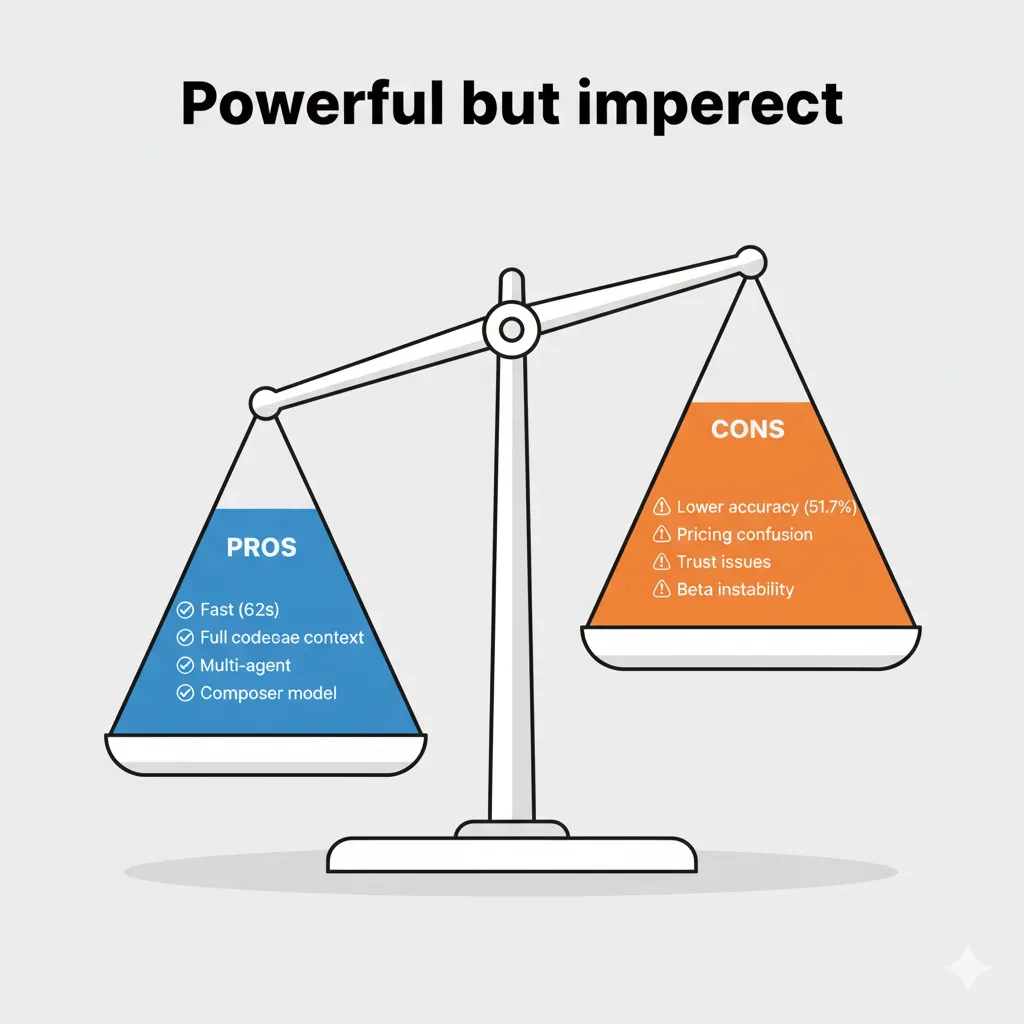
✅ Cursor Pros & Cons (At A Glance)
👍 Pros
- Composer 2.5 — frontier benchmark performance at ~1/10× the cost
- Cursor 3 Agents Window — parallel-agent workflows in the editor
- Composer + Auto are credit-unlimited on every paid plan
- VS Code fork — extensions + keybindings + chrome carry over
- Codebase indexing + native MCP support
- In-editor PR review with AI-augmented analysis
- $20/mo Pro tier handles 80-90% of daily work
- Most polished daily-driver AI editor in June 2026
👎 Cons
- Codex still leads SWE-Bench Verified (88.7% vs 79.8%)
- BYO browser testing (vs Antigravity’s integrated Chrome)
- Rate limits on Pro hit faster than first-time buyers expect
- June 2025 pricing-controversy trust damage still informs perception
- $60B SpaceX/xAI acquisition uncertainty (April 2026 reports unresolved)
- Multi-file refactors at extreme scale benefit from Claude Code’s depth
- Pro+ at $60 effectively exists because Pro’s rate limits frustrate heavy users
- Some VS Code extensions depending on Microsoft-proprietary APIs have rough edges
Reads every pricing page, help article and footnote, and reports honest, no-marketing-fluff verdicts. About the author.
📬 Get The Newsletter
Honest AI tool reviews, pricing breakdowns, and “should you actually subscribe?” verdicts delivered weekly. No fluff, no affiliate-driven hype.
- New AI coding tool reviews with hands-on testing
- Benchmark deep-dives + pricing changes tracked
- Cursor vs Claude Code vs Antigravity vs Codex comparisons
- Reality checks on tools getting hype but missing the mark
- Free — unsubscribe in one click

Last Updated: June 14, 2026
Tool Tested: Cursor 3 + Composer 2.5 on Pro tier (June 2026)
Slug Note:
/cursor-ai-review/ is evergreen — Cursor is the product nameNext Review: When Cursor 4 ships, when Composer 3 launches, when the $60B xAI/SpaceX acquisition resolves, or when Antigravity 3.0 narrows the daily-driver editor gap
Contact: aitoolanalysis.com/contact