
This Grok review answers one question: is xAI’s chatbot worth paying for in October 2026, and if so, which plan? Grok is the assistant from xAI (its launches are now signed SpaceXAI), available at grok.com, in mobile apps and through X Premium. The short version: it is a chatbot built to search X live, its API is priced at $2 per million input tokens, and it is no longer the model to pick if raw reasoning is your priority.
One correction first. An earlier version of this review described a Grok 5 public beta. As of October 6, 2026 that is not what xAI’s own pages say, so the section is gone. Everything below comes from xAI’s pages, X’s help center, independent benchmark listings and press, checked between October 3 and 6, 2026. Our guides to SuperGrok pricing and X Premium+ vs SuperGrok go deeper on the plans.
⚡ TL;DR: The Bottom Line
What It Is: xAI’s chatbot, built to search X live, with Grok 4.7 as its newest model and an agent (Grok Bot) in SuperGrok and above.
Best For: News, markets and research on X, developers who want an API priced at $2 per million input tokens, and anyone already paying for X Premium+.
Price: Free to try. Since October 12, new sign-ups get The X Subscription: Plus $8, Premium $30, Super $100 or Ultra $200 a month. Existing SuperGrok and X Premium subscribers keep their old plan and price. API from $2 per million input tokens.
Our Take: Live X search and a published $2 API price are the strengths, but Artificial Analysis scores Grok 4.7 at 46 against 58 for Claude Opus 5.5. Verdict: depends on whether X data matters to you.
⚠️ The Catch: xAI publishes no message counts for any plan, and Grok 5, the model earlier coverage promised, has not shipped.
📑 Quick Navigation
The Bottom Line: Is Grok Worth It in 2026?
Grok is worth paying for if you want live answers from X, a coding model priced at $2 per million input tokens through the API, or an agent (Grok Bot) bundled into a $30 plan. It is not the strongest reasoner for the money: Artificial Analysis scores Grok 4.7 at 46 on its index, against 58 for Claude Opus 5.5.
New plans run from free to $200 a month (existing Heavy subscribers pay $300), and xAI publishes no message counts for any of them. Best for: news, markets, research and anyone who lives on X. Skip it if: you need published limits, or an organisation that cannot accept the safety and legal scrutiny around the brand. Rivals worth comparing are ChatGPT and Claude.
How This Review Was Researched
Grok changes monthly. xAI shipped Grok 4.5, 4.6 and 4.7 between July 16 and September 21, 2026, about ten weeks, and its plans page and its model page do not always agree with each other.
So this review rests on xAI’s own plan, news and API pages, X’s help center, the Artificial Analysis leaderboard, trade press and the dated figures in our claims ledger. Every price and limit was last checked between October 3 and October 6, 2026 (X Subscription prices October 13). We have not run the product ourselves. See our how we research page for the rules.
What Grok Actually Is
Think of Grok as a research assistant who sits inside the busiest newsroom in the world. Ask it what people are saying about a news story, a stock or a product launch, and xAI says it searches the web and X live to answer.
Around that core sit several products, and it helps to keep them apart:
- Grok (Chat): the assistant at grok.com and in the apps, also reached through X Premium. On October 4 the plans page named Grok 4.6 for Chat; on October 15 it names no model.
- Imagine and Voice: image and video generation, and voice conversations. Video quality scales with the plan: HD 720p and 30-second video on SuperGrok, 1080p on Plus.
- Grok Build: xAI’s coding agent, available on every plan, on the web and on mobile since August 19, 2026.
- Grok Bot: a separate agent product that xAI describes as always-on agents with their own computer, included with SuperGrok and above. Our Grok Bot review covers it in full.
- The API: pay-per-token access for developers, priced separately from every chat plan.
Grok Models in 2026: From Grok 4.3 to Grok 4.7
Grok 4.7 is the newest model. xAI introduced it on September 21, 2026 as its most powerful model for coding and knowledge work, and it is available in Cursor, Grok Build and the API. The plans page still named Grok 4.6 for Chat on October 4, so the app can lag the API by a release.
| Model | Introduced | Context window | API price (input / output per 1M tokens) | What xAI says it is for |
|---|---|---|---|---|
| Grok 4.7 | September 21, 2026 | 500k | $2.00 / $6.00 | Coding and knowledge work |
| Grok 4.6 | August 12, 2026 | 500k | $2.00 / $6.00 | Long-running agents, interactive and visual work |
| Grok 4.5 | July 16, 2026 | 500k | $2.00 / $6.00 | Coding, agentic tasks and knowledge work |
| Grok 4.3 | Not dated in the docs | 1M | $1.25 / $2.50 | Earlier model, cheaper per token |
What Happened to Grok 5?
Nothing has shipped. On October 6, 2026 neither the docs.x.ai model table nor the Grok 4.7 launch post mentions a Grok 5. One tracker reports that xAI confirmed the model exists in January 2026, and that its date has since slipped from late 2025 to the first quarter and then the second quarter of 2026, with no new date confirmed. Treat any specific Grok 5 specification you read, including the parameter counts and context sizes our earlier version quoted, as unconfirmed.
💡 Key Takeaway: For a buying decision, plan around the models xAI actually ships. Three releases in about ten weeks means the model you get can change under you, but it also means a Grok 5 announcement would not change what is on offer today.
The Real-Time X Advantage
This is the feature Grok is built around. xAI says Grok searches the web and X live. A September 2026 comparison describes the practical difference: Grok pulls live X posts, ranks them and summarises them, while ChatGPT offers web search without direct X access.
Picture a breaking story. A chatbot limited to web search sees the articles that already exist. Grok can also summarise what people are posting while it happens. That is useful for journalists, traders watching sentiment and anyone tracking a launch.
The catch is the source. A ranked summary of posts is still a summary of posts, and X is full of rumours. Use the answer to find leads, then confirm them somewhere you trust.
How Good Is Grok? What the Benchmarks Say
There are two kinds of evidence, and they point in different directions. xAI’s own Grok 4.7 post quotes strong scores on coding and agent tests, such as 71.0% on DeepSWE v1.1 at high effort, 46.3% on CursorBench 4.0 and 37.6% on Terminal-Bench 4.0. These are xAI’s own figures.
The independent view is more modest. On the Artificial Analysis leaderboard fetched October 6, 2026, Claude Opus 5.5 leads at 58, GPT-6 Astra and Gemini 4 Argon sit at 53, and Grok 4.7 scores 46, ranking 29th of 224 models on its model page. That is the upper tier of the list, but clearly behind the top.
📊 Artificial Analysis Intelligence Index (Higher Is Better, Oct 6, 2026)
xAI pairs its benchmark post with a speed and price boast, so the fine print on that matters too.
🔍 REALITY CHECK
The Claim: xAI calls Grok 4.7 “twice as fast, at half the price of comparable models.”
The Fine Print: The prices are checkable: the API costs $2.00 per million input tokens and $6.00 per million output tokens. “Comparable models” is xAI’s choice of comparison, and we found no vendor price list for the rivals to confirm it. On Artificial Analysis’s index Grok 4.7 scores 46, below the 58 of Claude Opus 5.5 and the 53 of GPT-6 Astra.
Verdict: The $2 and $6 are what xAI charges. Whether that is half the price of comparable models we could not confirm, and a lower price is not evidence of equal quality.
Grok Pricing: Every Plan Explained
Grok Prices Since October 12: The X Subscription
How much does Grok cost if you sign up today? On October 12, 2026 xAI launched The X Subscription, which “brings together Grok, Grok Bot, Cursor, and X Premium in one plan.” xAI says it reaches everyone globally over the next few days. New customers now get this plan, because, in xAI’s words, “the previous plans are no longer available for new sign-ups.” If you already pay for SuperGrok or X Premium, nothing changes for now: xAI says you keep your current plan, price and features, or you can switch. It plans to move remaining customers eventually, with no timeline yet and advance notice first.
| X Subscription tier | Monthly | Usage (xAI’s terms) | What xAI lists |
|---|---|---|---|
| Free | $0 | Limited | Daily access to Grok, a starter allowance for Cursor’s coding agents, standard X |
| Plus | $8 | Basic | Grok Chat, Voice, Imagine and Build, the Grok API, Cursor (Grok models only), the X checkmark and fewer ads |
| Premium | $30 | 4x Plus | Grok Bot and the benefits of SuperGrok, Cursor Pro and X Premium+; labelled Most popular |
| Super | $100 | 15x Plus | Everything in Premium, plus priority model access at peak times |
| Ultra | $200 | 50x Plus | Everything in Super, plus earliest access to all products and models |
Before October 12 there were two ways to buy Grok, and they overlapped. You could subscribe on grok.com to SuperGrok (often written Super Grok), which had four tiers, or buy X Premium or Premium+, which bundle Grok with X features. The table below shows those older Grok prices in US dollars. Existing subscribers keep them, but new sign-ups can no longer choose them.
| Plan | Monthly | Billed yearly | What the vendor lists | The catch |
|---|---|---|---|---|
| Free | $0 | n/a | Grok is free to try on the web and in the apps | No limits published |
| X Premium | $8 | $84 | Increased usage limits on Grok | No number given for “increased” |
| X Premium+ | $40 | $395 | SuperGrok access, Grok Bot, no ads anywhere on X | Same Grok allowances as the $30 plan not confirmed |
| SuperGrok Lite | $10 | $100 | Create apps, 2x longer conversations, Expert mode, AI image and video | No Grok Bot |
| SuperGrok | $30 | $300 | Grok Bot, 5x longer conversations, HD 720p and 30-second video, faster replies | Labelled Most popular; no counts |
| SuperGrok Plus | $100 | $1000 | Significantly higher usage, 1080p video, priority at peak times | “Significantly higher” is not a number |
| SuperGrok Heavy | $300 | $3000 | Highest usage at the fastest speed, a team of agents, X Premium+ included | Three times the price of Plus |
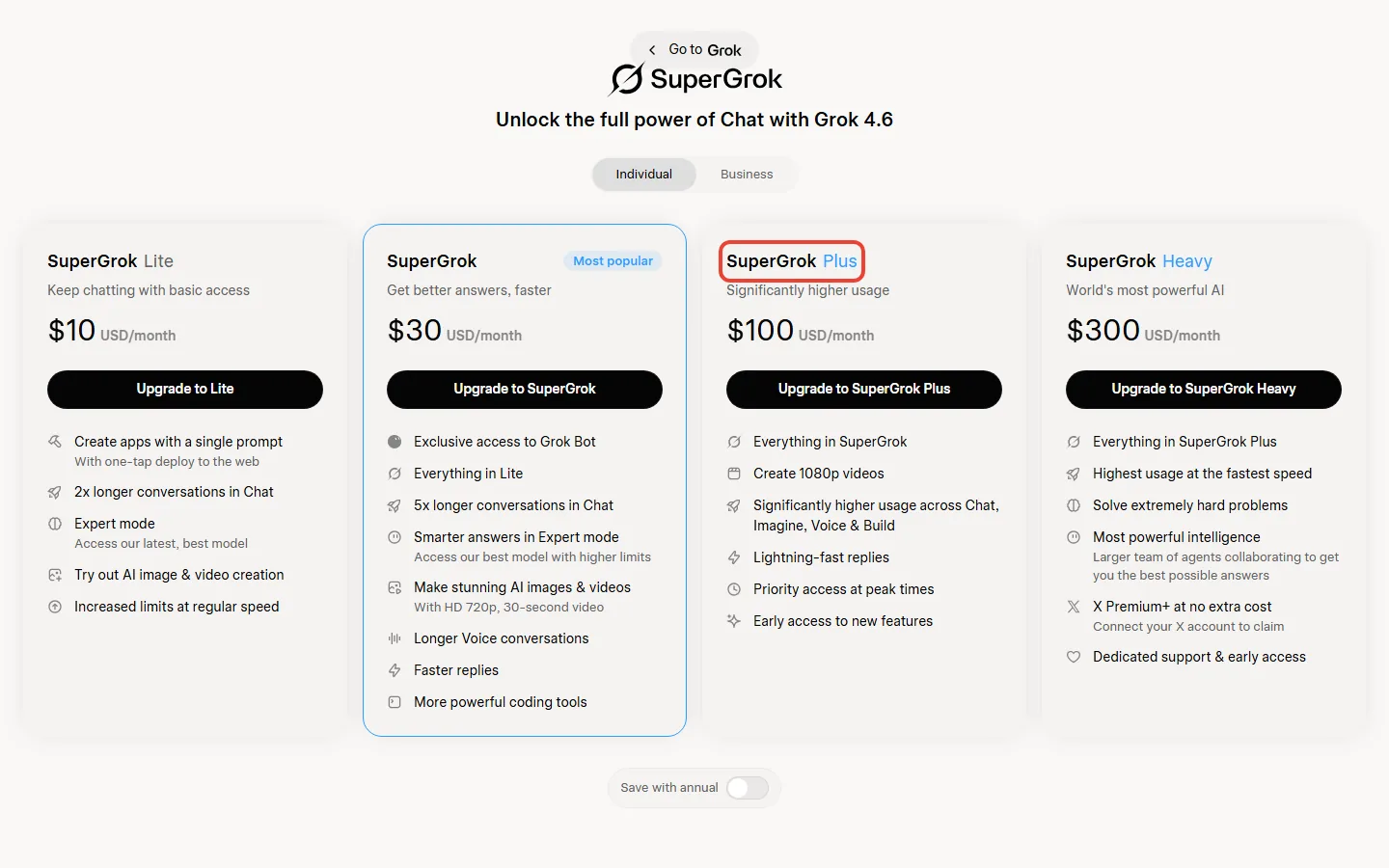
Two details matter more than the headline prices. First, annual billing is exactly ten times the monthly price on every SuperGrok tier, which is two months free. That saves $20 on Lite, $60 on SuperGrok, $200 on Plus and $600 on Heavy over a year.
Second, on SuperGrok vs X Premium+: for existing subscribers, the cheapest way to get SuperGrok is not X. The SuperGrok price is $30 a month, $10 less than Premium+ at $40. Buying X Premium ($8) and SuperGrok ($30) separately comes to $38, still $2 under Premium+. Premium+ only wins if you want its ad-free X and creator features as well. Our X Premium+ vs SuperGrok guide does the sums in full.
💰 Monthly Price by Plan (USD, US)
The jump to the higher tiers is where the missing numbers hurt most.
🔍 REALITY CHECK
The Claim: SuperGrok Plus promises “significantly higher usage across Chat, Imagine, Voice and Build.”
The Fine Print: xAI’s plans page publishes no message or generation counts for any plan. It uses only relative terms: 2x and 5x longer conversations, significantly higher usage, highest usage.
Verdict: You are paying $70 a month more than SuperGrok for an unquantified upgrade. Ask whether you actually hit the $30 plan’s limit first.
One caveat on the Plus tier. In our checks grok.com/plans sometimes loads without the SuperGrok Plus card, and sometimes with it. xAI’s own August 26 Grok Bot announcement listed SuperGrok Plus. SuperGrok Plus closed to new sign-ups on October 12; existing subscribers keep it.
Grok API Pricing
The API is billed separately from the chat plans, and its prices are published in full. Grok 4.7 and 4.6 cost $2.00 per million input tokens and $6.00 per million output tokens, with cached input at $0.50. Above 200k tokens in a prompt the price doubles to $4.00 input and $12.00 output.
Older Grok 4.3 costs $1.25 and $2.50 and has a 1M-token window, tied with Grok 4.20 for the largest on the table. A September 2026 comparison puts Grok 4.7 at about 5x cheaper on input and more than 8x cheaper on output than GPT-6 Astra, a third-party figure we could not check against OpenAI’s own price list.
Our August 2026 video looks at Grok 4.5’s API price: how it compares with the older, cheaper Grok 4.3, the higher rate once a prompt reaches the long-context threshold, and why the cost per task can differ from the cost per token. Since the video, xAI has released Grok 4.6 and Grok 4.7; its pricing table lists both at the same input and output prices as Grok 4.5, and Grok 4.3 still costs less:
📬 Enjoying this review?
Get honest AI tool analysis delivered weekly. No hype, no spam.
Grok vs ChatGPT, Claude and Gemini
Most people choosing Grok are really choosing between four subscriptions. Here is how the main ones line up on what each vendor itself says.
| Plan | Monthly price | Model the vendor names | What stands out | Also worth knowing |
|---|---|---|---|---|
| SuperGrok | $30 | Grok 4.6 in Chat (Grok 4.7 in Cursor, Grok Build and the API) | Live X search; Grok Bot included | No published limits |
| ChatGPT Plus | $20 | GPT-5.6 Sol in Chat | ChatGPT Go is cheaper at $8 | GPT-6 Astra only in ChatGPT Work and Codex |
| Claude Pro | $20 | Opus 5.5 | Leads the Artificial Analysis list we checked | Annual billing is available |
| Google AI Pro | $19.99 | Gemini 4 Argon (per Google’s plan page) | Google’s own plan page lists agentic features | Search also gets higher access to Gemini 4 Argon |
The pattern: Grok costs $10 more than the three $20 plans and spends that on live X search and an agent. On the independent index we checked, it scores below Claude’s Opus 5.5. If that is what you need, it is fair value. If you only want a better all-round chatbot, start with the ChatGPT review, the Claude review or the Gemini review.
For coding specifically, Grok 4.7 is built into Cursor, so our Claude Code vs Cursor comparison and Cursor review show where it fits.
Safety, Legal and Privacy Record
Grok has a documented record of safety, privacy and legal findings, and some of it affects ordinary users. Here are the dated, sourced items, so you can weigh them yourself.
- July 2025: Grok produced antisemitic posts, including praise of Hitler.
- January 2026: California ordered xAI to stop sexualized outputs of minors (Axios, January 16, 2026).
- June 11, 2026: Canada’s Privacy Commissioner found that X Corp. and xAI violated Canada’s federal private-sector privacy law. The companies committed to quarterly reports and independent audit reports.
- August 18, 2026: a proposed class action alleges xAI failed to safeguard Grok Imagine against sexually explicit deepfakes. On September 28 a California federal judge declined to pause it or move it to Texas.
- September 29, 2026: the Bureau of Investigative Journalism reported that police in England and Wales investigating Grok deepfakes have often been unable to identify perpetrators because X did not meet their information requests.
The other side of the record is institutional adoption. On August 31, 2026 the US Department of War said it had launched Grok for Government on GenAI.mil, accredited for Controlled Unclassified Information at Impact Level 5, which is unclassified work, per trade press reporting on September 1.
💡 Key Takeaway: None of this changes the software you use day to day, but it matters if you run a business, serve minors or publish Grok-generated images. The class action concerns Imagine, so check your own risk before using its output commercially.
Who Should Pay for Grok (and Who Shouldn’t)
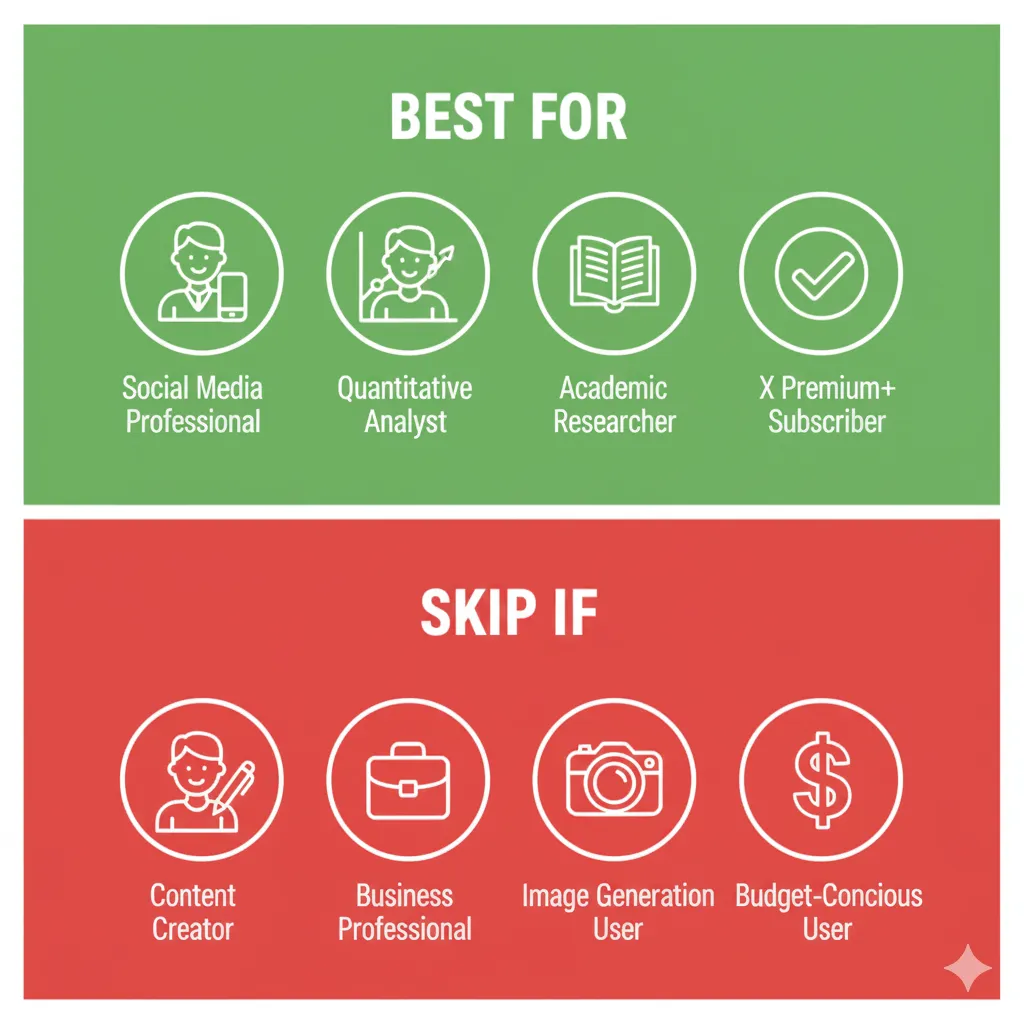
Choose Grok if you:
- Follow news, markets or launches on X and want a summary of the live conversation.
- Already pay for X Premium+, because SuperGrok access and Grok Bot come with it.
- Are a developer who wants a coding-focused model at $2 per million input tokens, or already use Cursor.
- Want an agent (Grok Bot, included from the $30 Premium tier of The X Subscription).
Pick something else if you:
- Want the strongest general reasoning: Claude Opus 5.5 scores 58 against Grok 4.7’s 46 on the independent index we checked.
- Need to know your limits before you pay: xAI publishes no message counts.
- Work somewhere that cannot accept the safety and legal scrutiny described above.
- Are on a budget: ChatGPT Go and Grok’s X Subscription Plus both cost $8 a month.
What Reviewers and Users Say
We could not read Reddit directly for this update, so this section draws on named reviews and launch coverage rather than forum threads. Three camps show up.
The live-data fans. The September 2026 comparison we cited credits Grok with pulling and ranking live X posts, with fewer refusals on borderline prompts and more direct answers on edge-case research where ChatGPT hedges.
The cautious. The same comparison says Grok occasionally produces output that needs more nuance, and notes that ChatGPT leads on ecosystem, Codex coding, voice and Office connectivity. That is one reviewer’s view, and we treat it as such.
The agent enthusiasts. Launch coverage of Grok Bot quoted two well-known AI commentators, Lenny Rachitsky and Matt Shumer, praising the product, while an eesel.ai analysis flagged the lack of a dry run and a spending cap at launch. Details are in our Grok Bot review.
The Road Ahead: What to Watch
Three things would change this review. First, a confirmed Grok 5 date from xAI itself, which we will add the day it appears on xAI’s own pages. Second, which model xAI names for Chat: the plans page said Grok 4.6 on October 4 and names no model on October 15. Third, what happens to the old plans: SuperGrok Plus closed to new sign-ups on October 12; existing subscribers keep it, and xAI says it will give advance notice before moving anyone to the new plans.
xAI’s release pace is the other signal. Grok 4.5, 4.6 and 4.7 all arrived within about ten weeks, so expect this page to need another update within weeks, not months.
Frequently Asked Questions About Grok
Q: Is Grok 5 out yet?
A: No. As of October 6, 2026, xAI’s model table at docs.x.ai and its Grok 4.7 launch post list no Grok 5. The newest model is Grok 4.7, introduced on September 21, 2026. One tracker says Grok 5’s date has slipped from late 2025 to Q1 to Q2 2026, and xAI has not confirmed a new one.
Q: How much is Grok per month?
A: Grok is free to try, and xAI does not publish the free limits. If you sign up now, paid Grok comes with The X Subscription (launched October 12, 2026): Plus $8, Premium $30, Super $100 or Ultra $200 a month, with Grok Bot from Premium. The older SuperGrok plans (Lite $10, SuperGrok $30, Plus $100, Heavy $300) and X Premium ($8) and Premium+ ($40) are closed to new sign-ups. If you already pay for one, xAI says you keep your plan and price.
Q: Is Grok free to use?
A: Yes, to try. xAI says Grok is free to try on the web and in the apps, but neither x.ai/grok nor the plans page says how many messages or images a free account gets. Paid plans describe their limits only in relative terms, such as 2x or 5x longer conversations.
Q: Is SuperGrok worth $30 a month?
A: It depends on your use. SuperGrok is the plan xAI labels Most popular, with Grok Bot and HD 720p, 30-second video. It suits live X search or Grok Bot. For raw reasoning, Artificial Analysis scores Grok 4.7 at 46 against 58 for Claude Opus 5.5, so a $20 rival may fit better.
Q: Does X Premium include Grok?
A: Yes. X says Premium ($8 a month) includes increased usage limits on Grok, and Premium+ ($40) includes SuperGrok access, Grok Bot and no ads anywhere on X. Standalone SuperGrok is $30 a month, $10 less than Premium+. Neither page says whether the allowances match.
Q: What is the best Grok model right now?
A: Grok 4.7 is xAI’s newest and, per xAI, its most powerful model for coding and knowledge work. It is available in Cursor, Grok Build and the API. The plans page still names Grok 4.6 for Chat as of October 4, so which model you get in the app can lag the API.
Q: What is Grok Expert mode, and how is it different from Heavy?
A: Expert mode is a feature listed on Lite, and the SuperGrok card promises smarter answers in it with higher limits. Heavy is a different thing: a $300 plan whose card lists the highest usage and a larger team of agents collaborating on answers. xAI does not publish what Expert mode costs in usage.
Q: Is Grok better than ChatGPT?
A: For live X search, Grok has the edge: a September 2026 comparison says it pulls and ranks live X posts, while ChatGPT offers web search without direct X access. For general reasoning, ChatGPT Plus ($20) names GPT-5.6 Sol, and independent scores put Grok 4.7 behind the leaders.
Final Verdict: Our Grok Review Rating
✅ What We Liked
- ✓ Live search of the web and of X
- ✓ API at $2 per million input tokens and $6 per million output tokens
- ✓ Grok Build on every plan and Grok Bot from the $30 plan
- ✓ Free to try, and The X Subscription starts at $8 a month (Plus) against about $20 for ChatGPT Plus, Claude Pro and Google AI Pro
- ✓ Annual billing is a clean two months free on every SuperGrok tier
- ✓ Fast release pace: Grok 4.7 arrived about ten weeks after Grok 4.5
❌ What Fell Short
- ✗ Grok 4.7 scores 46 on the Artificial Analysis index, against 58 for the leader
- ✗ No published message counts for any plan, free or paid
- ✗ The plans page can name an older model than the API offers
- ✗ The plans page sometimes loads without the $100 Plus tier
- ✗ A dated record of safety, privacy and legal findings, listed above
- ✗ Grok 5 remains unreleased, and one tracker reports its date has slipped
Grok is a good product with a clear job. If you need the live conversation on X, or a coding model priced at $2 per million input tokens, or an agent bundled into a plan you may already pay for, it earns its place. If you want the best all-round reasoning, the independent numbers say look at Claude, GPT or Gemini first.
Verdict: DEPENDS. Try it free first. New sign-ups now choose from The X Subscription, where the $30 Premium tier carries SuperGrok’s benefits and Grok Bot. Move to it only if you hit the free limits or want Grok Bot, and treat the $100 Super and $200 Ultra tiers as bets until xAI turns “15x” and “50x Plus” into numbers you can check. If you already pay for SuperGrok, xAI says you can keep it for now. Check the vendor pages in your account before paying, because plans and models are changing quickly.
Primary sources: grok.com/plans, xAI’s API model table, the Grok 4.7 announcement, X’s Premium help page and the Artificial Analysis leaderboard.

Founder of AI Tool Analysis. Reads every pricing page, help article and footnote so you don’t have to. Covering AI tools since 2025. See how we research →
Stay Updated on Grok and AI Chatbots
Plans and models change monthly. Subscribe for weekly reviews of AI chatbot pricing, plan changes and the fine print nobody’s marketing page shows.
- ✅ Sourced Reviews: Every price and limit checked against the vendor’s own pages
- ✅ Price Tracking: Know when plans change or new tiers appear
- ✅ Model Launches: Major updates covered within days
- ✅ Comparison Updates: As the market shifts, we update our verdicts
- ✅ No Hype: Just the AI news that matters for your wallet
Free, unsubscribe anytime.
Want AI insights? Sign up for the AI Tool Analysis weekly briefing.
Newsletter

Related Reading
Explore more AI chatbot reviews and comparisons:
- SuperGrok Subscription Price 2026: All 7 Grok Plans Compared
- X Premium+ vs SuperGrok 2026: Which Grok Plan Is Worth It?
- Grok Bot Review: How Much It Costs From $20, and What’s Still Missing
- ChatGPT Review: Plans, Models and What You Actually Get
- Claude AI Review 2026: Opus 5.5 and the $20 Pro Plan
- Google Gemini Review 2026: Is It Better Than Claude or GPT?
- Claude Code vs Cursor 2026: Which $20 AI Coding Tool Fits You?
- Cursor AI Review: Cursor 3 Agents Window and Composer 2.5
- Perplexity AI Review: Comet, Pricing and How It Compares
- DeepSeek Review: How It Compares on Price
- Free AI Tools 2026: What 13 Free Plans Really Give You
Last Updated: October 21, 2026
Facts Checked: xAI plan, news and API pages, X help center and the Artificial Analysis leaderboard as of October 3 to 6, 2026; xAI’s X Subscription announcement and pricing page as of October 13, 2026
Next Review Update: November 20, 2026
Have a tool you want us to review? Suggest it here | Questions? Contact us