
📅 Post Updated: February 14, 2026
Major update: Anara AI restructured from 3 to 5 pricing tiers, added Deep Search agent, GPT-5/Claude Opus 4.5 models, Zotero integration, and Chrome web clipper. Updated competitor comparison with NotebookLM, Elicit, and Consensus. Original review published October 2025.
What Changed Since October 2025
Key Updates (October 2025 – February 2026)
- Pricing Restructure — Expanded from 3 plans (Free, Pro, Teams) to 5 tiers (Free, Plus, Pro, Max, Teams) plus Enterprise. Teams pricing dropped from $50 to $30/seat. New Max tier at $167/month unlocks Deep Search and cutting-edge models.
- Deep Search Agent (Max plan) — A new agentic search capability that handles complex, multi-file research questions with detailed, citation-backed responses. Think Perplexity Pro meets academic rigor.
- New AI Models — Pro tier now includes GPT-4.1, GPT o3, o4-mini, Claude 3.5, DeepSeek, and Gemini 2.5 Flash. Max tier adds GPT-5, Claude Opus 4.5, and Gemini 3 Pro.
- Zotero Integration — Reference manager integration for importing and syncing your Zotero library. Still maturing but functional.
- Chrome Web Clipper — One-click article summaries directly from your browser. Saves articles to your Anara library with auto-generated notes.
- Library-Wide Chat — Chat across your entire library without importing specific files into a session. A significant workflow improvement.
- New Features — EPUB support, PDF annotations, editable tables, file notes, 90+ language support, expanded audio file handling.
- Institutional Expansion — Added MIT, Yale, UC Berkeley, Goldman Sachs, PwC, Intel, GSK, and Biogen to the client roster alongside Stanford, Johns Hopkins, and Roche.
- Revenue Growth — Revenue approaching $10M/year (up from $220K at the time of our original review). Team still lean at 5 employees, hiring 4 more.
The Bottom Line
Anara AI has changed substantially since our October 2025 review. Back then, it was a promising Y Combinator-backed research tool with three pricing tiers and a growing user base. Four months later, it’s a more ambitious platform with five pricing tiers, an agentic Deep Search feature, access to GPT-5 and Claude Opus 4.5, and a client list that reads like a Fortune 500 directory.
The core value proposition hasn’t shifted: upload your PDFs, papers, or documents, and Anara’s AI will help you analyze, summarize, and extract insights with traceable citations. What has changed is the competitive landscape. NotebookLM now offers paid tiers (up to $249.99/month) with Deep Research capability. Elicit raised a $22M Series A and achieved SOC 2 Type II certification. Consensus has 200M+ papers indexed. Anara isn’t the scrappy underdog anymore — it’s fighting for position in a rapidly maturing market.
The $20/month Pro plan remains the sweet spot for most researchers. It gives you unlimited AI queries, premium models, and unlimited uploads — things that competitors like Elicit charge $49/month for. But the new $167/month Max tier feels like a stretch unless you specifically need Deep Search or bleeding-edge models like GPT-5.
Rating: 7.8/10 — A meaningful upgrade from 7.5 in October. Better model selection, smarter pricing tiers, and genuine new capabilities. Loses points for SOC 2 still being “in progress,” the maturing Zotero integration, and still no mobile app. The $20 Pro plan remains one of the best values in AI research tools.

Table of Contents
- The Bottom Line
- What Anara AI Actually Does
- Getting Started: Your First 15 Minutes
- Features That Actually Matter
- Head-to-Head Comparison
- Pricing Breakdown
- Who Should Use This
- What Researchers Are Actually Saying
- Honest Limitations
- Alternatives Worth Considering
- Final Verdict
- FAQs
Estimated read time: 22 minutes
What Anara AI Actually Does
Strip away the marketing language and Anara AI does one thing well: it lets you upload documents — PDFs, Word files, PowerPoints, EPUBs, audio recordings, web pages — and then have an AI conversation with that content. Every answer includes traceable citations that link back to specific passages in your source material. No hallucinated references. No made-up page numbers.
That sounds simple, but execution matters. With 3M+ users across institutions like Stanford, MIT, Yale, UC Berkeley, Johns Hopkins, Roche, Goldman Sachs, PwC, Intel, GSK, and Biogen, Anara has quietly become infrastructure for serious research. The platform handles everything from analyzing a single 300-page PDF to managing an entire library of hundreds of documents with cross-referencing capabilities.
Since our October review, Anara has added several capabilities that shift it from “document Q&A tool” toward “research workspace.” Library-wide chat lets you query across your entire document collection without manually selecting files. The Deep Search agent (Max plan) tackles complex, multi-step research questions. PDF annotations let you mark up documents directly in the platform. File notes attach AI-powered annotations to individual files and folders. And the Chrome web clipper turns any webpage into a summarized, importable document with a single click.
The Y Combinator pedigree (W23 batch) and angel investment from GitHub and Reddit founders gave Anara early credibility. But what keeps researchers using it is the citation traceability. In a world where ChatGPT confidently makes up references, Anara’s strict source-grounding is genuinely differentiated.
Getting Started: Your First 15 Minutes
Sign up is straightforward — email or Google account, no credit card required for the free tier. You land in a clean dashboard with a library panel on the left and a chat interface in the center. The design is noticeably less cluttered than SciSpace or Elicit.
Here’s what to expect on the free tier as of February 2026: you get 1,000 AI words per day, 5 uploads per day, 1 recording, a maximum of 120 pages per file, and a 20MB upload limit. The AI model is GPT-OSS (a 120B parameter open-source model). This is a change from the original structure — previously, free users got 15 AI questions per month. The daily word limit is actually more generous for light users, but it runs out fast if you’re doing serious analysis. Most researchers will hit the wall within their first session.
Upload a PDF, and Anara processes it in 10-30 seconds depending on length. You can immediately start asking questions. The responses come with inline citations — click one, and the source passage highlights in the document viewer on the right. It’s the kind of interaction loop that makes you wonder why every PDF reader doesn’t work this way.
The new library-wide chat option means you don’t have to manually select which documents to query. Upload your 20 papers on a topic, and ask questions across all of them simultaneously. This is a genuine workflow improvement over the October version, where you had to create specific sessions with selected documents.
First 15 minutes verdict: intuitive, fast, and you’ll understand the value immediately. The question is whether the free tier gives you enough runway to make a purchasing decision — and with 1,000 words per day, it does, barely.
Features That Actually Matter
Anara has expanded its feature set considerably since October. Here’s what’s worth your attention, organized by what actually impacts your research workflow.
Document Analysis
This remains Anara’s core strength. Upload a document, ask questions, get cited answers. The citation system links every claim to specific passages, and you can click through to see the exact source text highlighted in context. For literature reviews, this is transformative — you can process a 200-page paper in minutes instead of hours.
The new addition here is library-wide chat. Previously, you had to create a session and manually select which documents to include. Now you can chat across your entire library — every document you’ve ever uploaded becomes searchable in a single conversation. For researchers managing dozens or hundreds of papers, this eliminates the tedious file-selection step and enables cross-document synthesis that would take hours to do manually.
PDF annotations are also new — you can highlight, comment, and annotate directly within the platform. Not as full-featured as a dedicated PDF tool like Zotero’s reader, but convenient for keeping your annotations alongside your AI analysis.
Graph View
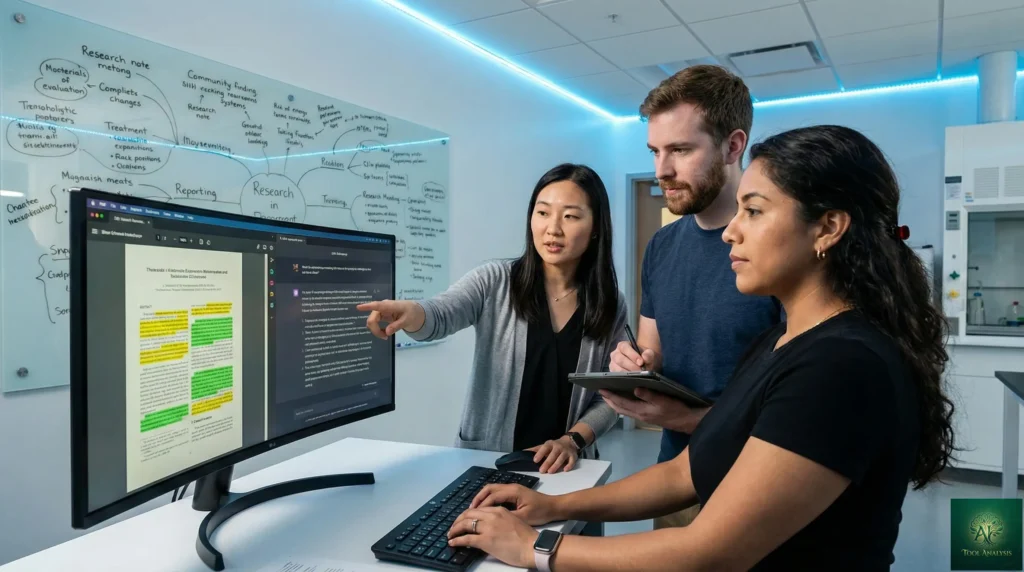
Anara’s knowledge graph visualizes relationships between concepts, papers, and ideas across your uploaded documents. Nodes represent key concepts, and edges show how they connect. It’s particularly useful for literature reviews where you need to understand how different papers relate to each other.
Honestly, this feature hasn’t changed much since October. It’s still more useful as an exploration tool than a rigorous analytical one. The visualization helps you spot unexpected connections between papers, but it’s not going to replace a proper systematic review methodology. Think of it as a brainstorming aid that occasionally surfaces genuinely interesting cross-references.
Writing Assistance
Anara can help draft sections of papers, generate summaries, and create outlines based on your uploaded documents. The writing quality is decent — better than raw ChatGPT for academic content because it grounds everything in your actual sources — but it’s not going to produce publication-ready prose without significant editing.
New since October: file notes. These are AI-powered annotations that you can attach to individual files or folders. Think of them as smart sticky notes — you can ask the AI to generate a summary note for a paper, tag key findings, or create reading notes that persist across sessions. For researchers managing large literature collections, this adds a layer of organization that was previously missing.
The community consensus hasn’t changed much: writing assistance is “decent, not amazing.” Use it for first drafts and outlines. Don’t expect it to replace your own analytical writing.
Collaboration
Real-time collaboration was already available in October. What’s new is the restructured Teams plan (now $30/seat, down from $50) and the Enterprise tier with granular permissions. Enterprise adds SSO via SAML 2.0 and OAuth2, SharePoint live sync, and admin controls for managing team access.
For academic research groups, the Teams plan at $30/seat is now competitive with institutional site licenses for tools like Zotero Teams. For corporations, the Enterprise tier with SSO and compliance certifications (SOC 2 in progress, ISO 27001 in progress) addresses the security concerns that previously blocked adoption. Goldman Sachs and PwC being on the client list suggests the Enterprise sales motion is working, even without completed certifications.
Multi-Format Support
Anara already supported PDFs, Word documents, PowerPoints, and audio files. Since October, they’ve added EPUB support (useful for book-length content), expanded audio file handling, and introduced the Chrome web clipper for importing web articles directly into your library.
The web clipper is a small but meaningful addition. Instead of saving a webpage as a PDF and uploading it, you click the extension, get an AI-generated summary, and the article is saved to your Anara library. For researchers who pull from both academic papers and web sources (blog posts, news articles, reports), this streamlines the collection process significantly.
Editable tables are another new addition — when Anara extracts tabular data from your documents, you can now edit it directly in the platform. Useful for data extraction workflows where you need to clean up or annotate extracted information.
AI Models
This is the biggest change since October. Anara has dramatically expanded its model lineup and stratified access across pricing tiers:
- Free tier: GPT-OSS 120B — an open-source model. Capable for basic queries but noticeably weaker than commercial models for nuanced analysis.
- Pro tier ($20/month): GPT-4.1, GPT-4o, GPT o3, o4-mini, Claude 3.5, DeepSeek, Gemini 2.5 Flash — a strong selection of current-generation models.
- Max tier ($167/month): Everything in Pro, plus Claude Opus 4.5, Gemini 3 Pro, GPT-5 — the absolute cutting edge.
The practical impact: Pro users get access to models that are genuinely excellent for research tasks (Claude 3.5 and GPT-4.1 both handle complex academic content well). Max users get early access to frontier models, which matters if you’re working on cutting-edge problems where model capability is the bottleneck. For most researchers, the Pro tier models are more than sufficient.
The ability to switch between models mid-conversation is a nice touch. If Claude 3.5 gives you a weak answer on a technical question, you can switch to GPT-4.1 and try again without losing context. This kind of model flexibility is something you don’t get with single-model tools like NotebookLM (Gemini only) or Elicit (proprietary models).
Head-to-Head Comparison
The competitive landscape has shifted significantly since October. NotebookLM went from free-only to offering paid tiers. Elicit raised $22M and earned SOC 2 certification. Consensus crossed 200M papers. Here’s how they all stack up:
| Feature | Anara AI | NotebookLM | Elicit | SciSpace |
|---|---|---|---|---|
| Free Tier | 1,000 words/day | Free (limited) | Free (limited) | Free (limited) |
| Paid Plans | $10 / $20 / $167/mo | $19.99 – $249.99/mo | $10 / $49/mo | $12 – $20/mo |
| AI Models | GPT-5, Claude Opus 4.5, Gemini 3 Pro, DeepSeek + more | Gemini (proprietary) | Proprietary models | GPT-4, proprietary |
| Citation Quality | ★★★★★ | ★★★★ | ★★★★★ | ★★★★ |
| Paper Database | Upload-based | Upload-based | 138M+ papers | 200M+ papers |
| Deep Research | Deep Search (Max) | Deep Research | Systematic review | Deep Review + Agent |
| Collaboration | Real-time + Teams | Shared notebooks | Limited | Teams available |
| SOC 2 Certified | In progress | Google Cloud | ✓ Type II | Not disclosed |
| Context Window | 10,000 pages (Pro) | 1M tokens | Not disclosed | Not disclosed |
| Mobile App | ✗ | ✓ | ✗ | ✗ |
| Best For | Multi-model document analysis | Google ecosystem users | Systematic lit reviews | Quick paper summaries |
The standout comparison is Anara vs. NotebookLM. In October, NotebookLM was free-only and felt like a Google experiment. Now it has paid tiers reaching $249.99/month, Deep Research capability, and a 1M token context window. For users in the Google ecosystem, NotebookLM is an increasingly strong alternative. But Anara’s model flexibility (choose between GPT-5, Claude Opus 4.5, or Gemini) gives it an edge for researchers who want the best model for each task, not just whatever Google ships.
Elicit occupies a different niche — it’s built for systematic literature reviews with a database of 138M+ papers and clinical trials. If your workflow is “find all papers on topic X, extract data systematically, build an evidence table,” Elicit is purpose-built for that. Anara is better for “I have these specific documents, help me understand and synthesize them.”
Pricing Breakdown
Anara’s pricing was simple in October: Free, Pro ($20/month), and Teams ($50/seat). Now it’s a five-tier structure plus Enterprise, which is both more flexible and more confusing. Let’s break it down:
| Plan | Price | AI Words | Uploads | AI Models | Key Limits |
|---|---|---|---|---|---|
| Free | $0 | 1,000/day | 5/day | GPT-OSS 120B | 120 pages/file, 20MB, 1 recording |
| Plus NEW | $10/mo | 4,000/day | 10/day | GPT-OSS 120B | Expanded limits |
| Pro BEST VALUE | $20/mo | Unlimited | Unlimited | GPT-4.1, Claude 3.5, DeepSeek, Gemini 2.5 + more | 10,000 pages or 300MB/upload, priority support |
| Max NEW | $167/mo (annual only) | Unlimited | Unlimited | GPT-5, Claude Opus 4.5, Gemini 3 Pro + all Pro models | Deep Search agent, early access features |
| Teams | $30/seat/mo (was $50) | Unlimited | Unlimited | All Pro models | Shared workspaces, admin controls |
| Enterprise NEW | Custom | Unlimited | Unlimited | All models | SSO (SAML 2.0/OAuth2), SharePoint sync, SOC 2 & ISO 27001 in progress |
The ROI calculation: A PhD researcher spends roughly 15-20 hours per week reading and synthesizing papers. Anara’s Pro plan at $20/month can realistically cut that by 30-40% — say, saving 5-8 hours per week. At even a modest $25/hour opportunity cost, that’s $500-800/month in time saved for a $20 investment. The math still works overwhelmingly in Anara’s favor, just as it did in October.
What about the Plus tier? At $10/month, Plus feels like a half-measure. You get 4x the daily word limit (4,000 vs. 1,000) and double the uploads, but you’re still stuck on the GPT-OSS model. For most researchers, the jump from Plus to Pro ($10 more) is the smarter investment — unlimited queries, premium models, and no daily caps. Plus exists mainly for casual users who need slightly more than free but don’t want to commit to Pro.
Max at $167/month: This is annual billing only ($2,004/year), which is a significant commitment. You get Deep Search, GPT-5, Claude Opus 4.5, and early access to new features. Unless you’re a power user who specifically needs the agentic Deep Search capability or the absolute frontier models, Pro at $20 gives you 90% of the value at 12% of the price.
Hidden Costs to Watch
Max is annual-only: There’s no monthly billing option for the $167/month Max plan. You’re committing to $2,004/year upfront. If you cancel mid-year, you don’t get a prorated refund (based on current terms). Teams pricing adds up: A lab of 5 researchers at $30/seat = $150/month, which is approaching the cost of institutional site licenses for established tools. Free tier exhaustion: 1,000 AI words per day sounds generous until you realize a single detailed analysis response can consume 300-500 words. You might get 2-3 substantive questions before hitting the daily cap.
Who Should Use This
The expanded pricing tiers make the “who should use this” question more nuanced than before. Here’s the breakdown by tier:
- Free / Plus ($0-$10): Students writing term papers, casual researchers who need to analyze a few documents per week, anyone who wants to test the platform before committing. The daily caps will frustrate power users, but for occasional use, it’s functional.
- Pro ($20/month): The sweet spot. Graduate students, postdocs, independent researchers, journalists, analysts, and anyone who regularly works with academic or technical documents. Unlimited queries, premium models, and no daily caps. This is where Anara becomes genuinely useful as a daily research tool.
- Max ($167/month): Power users who need Deep Search for complex multi-document questions, researchers working at the frontier who want GPT-5 or Claude Opus 4.5, and early adopters who want access to new features first. The price-to-value ratio only makes sense if you’re spending 20+ hours per week on research.
- Teams ($30/seat): Academic research groups, lab teams, consulting firms, and small organizations that need shared workspaces and collaborative document analysis. At $30/seat (down from $50), this is now competitive for groups of 3-10 people.
- Enterprise (Custom): Universities, pharmaceutical companies, financial institutions, and large organizations that need SSO, compliance documentation, and IT admin controls. The Goldman Sachs and PwC references suggest this tier is gaining traction.

What Researchers Are Actually Saying
Community sentiment since October has been generally positive but not uniformly glowing. Here’s what real users are reporting:
Reddit (r/GradSchool, r/ArtificialIntelligence): Consistent praise for citation accuracy and multi-format support. Researchers highlight the time savings for literature reviews — “turned a 3-day process into 4 hours” is a common refrain. The library-wide chat feature has been particularly well-received. Criticism centers on theoretical text handling and writing quality.
Trustpilot: Reviews are mixed. Positive reviews emphasize the speed of document analysis and the quality of citations. Negative reviews mention free tier limitations being exhausted too quickly and occasional UI bugs. Some users report frustration with the Zotero integration not syncing reliably. Overall, the pattern is similar to most SaaS tools — satisfied power users, frustrated free-tier users.
Common praise: Citation traceability remains the number one differentiator users mention. Multi-format support (especially the new EPUB and web clipper) gets positive attention. Time savings are consistently cited as the primary benefit. The model flexibility (choosing between Claude, GPT, and Gemini) is something power users specifically call out as an advantage over single-model competitors.
Common criticism: Theoretical and philosophical texts still trip up the AI — questions about abstract concepts get weaker answers than empirical or data-driven queries. Writing assistance is “decent but not amazing” (this phrase appears almost verbatim across multiple reviews). The free tier’s daily word limit exhausts quickly for any substantive research session. And the Zotero integration, while welcome, is described as “still maturing” — it works, but not as seamlessly as native Zotero tools.
Honest Limitations
Every tool has edges where it breaks down. Here are Anara’s, updated for February 2026:
- No mobile app. Still. This was a limitation in October and it remains one. You can access Anara through a mobile browser, but there’s no native iOS or Android app. For researchers who read papers on tablets or phones, this is a genuine gap — especially when NotebookLM now has a mobile app.
- Theoretical text struggles persist. Ask Anara to analyze a Heidegger paper or a dense philosophical argument, and the responses are noticeably weaker than for empirical or data-driven content. The AI is excellent at extracting facts, data, and structured arguments. It’s less reliable for interpretive or conceptual analysis.
- Free tier limitations are aggressive. 1,000 AI words per day is enough for about 2-3 substantive questions. If you’re evaluating Anara for a serious research workflow, you’ll need to either upgrade quickly or spread your testing across multiple days. The shift from monthly question limits to daily word limits is actually worse for binge-style research sessions.
- SOC 2 and ISO 27001 still “in progress.” For a tool handling sensitive research data, the lack of completed compliance certifications is a concern. Elicit has SOC 2 Type II. NotebookLM inherits Google Cloud’s certifications. Anara is GDPR compliant with AES-256 encryption and zero data retention with AI providers, which is good — but enterprise procurement teams want to see completed certifications, not “in progress” language.
- Zotero integration is functional but immature. Syncing works, but users report occasional reliability issues. If Zotero is central to your workflow, expect some friction. The integration will likely improve, but it’s not at the level of tools that have had years to develop Zotero plugins.
- Plus tier is underwhelming. At $10/month, you get 4x the word limit but stay on the same GPT-OSS model. The jump to Pro ($20) for premium models and unlimited usage is so much better that Plus feels like it exists to nudge you toward Pro rather than being a compelling tier on its own.
- Max pricing requires annual commitment. $167/month billed annually ($2,004/year) with no monthly option is a significant barrier. You’re betting that Deep Search and frontier models will be worth the premium for an entire year.
- Small team, ambitious roadmap. 5 employees supporting 3M+ users, enterprise clients like Goldman Sachs and PwC, and a multi-tier product. The revenue growth to ~$10M/year is impressive, but the team size creates legitimate questions about support responsiveness and development velocity.
Alternatives Worth Considering
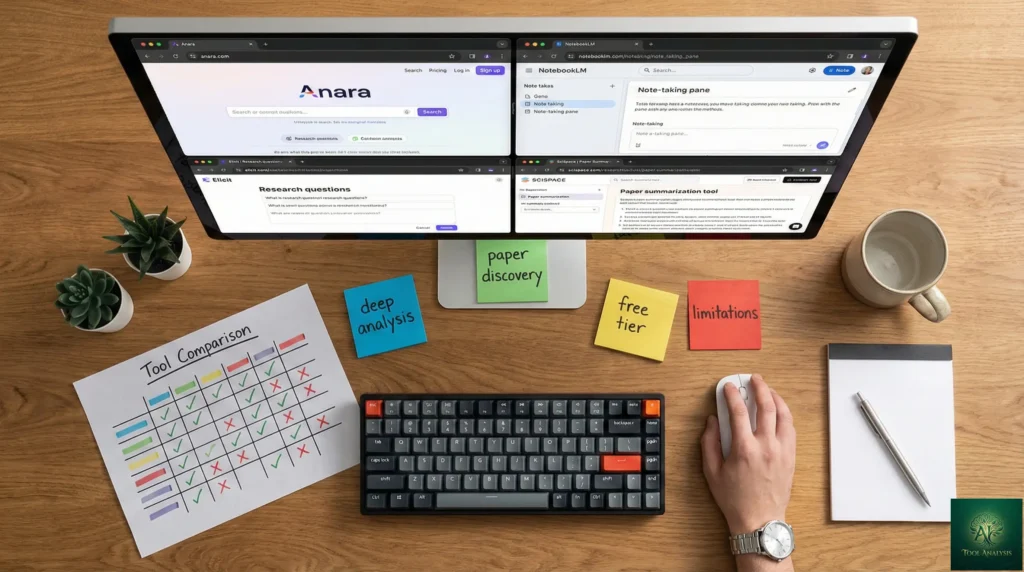
The AI research tool market has matured significantly since October 2025. Here are the alternatives worth evaluating alongside Anara:
| Tool | Free Tier | Paid Plans | Best For | Key Advantage | Key Weakness |
|---|---|---|---|---|---|
| Anara AI | 1,000 words/day | $10 – $167/mo | Multi-model document analysis | Model flexibility, citation quality | No mobile app, SOC 2 pending |
| NotebookLM | Yes (limited) | $19.99 – $249.99/mo | Google ecosystem researchers | 1M token context, Deep Research, mobile app | Gemini-only, expensive paid tiers |
| Elicit | Yes (limited) | $10 / $49/mo | Systematic literature reviews | 138M+ papers, SOC 2 Type II, $100M valuation | Upload-limited, less flexible models |
| Consensus | Yes | $8.99/mo | Quick academic search | 200M+ papers, affordable | Search-focused, limited analysis tools |
| SciSpace | Yes (limited) | $12 – $20/mo | Quick paper understanding | Deep Review, agent capabilities, 200M+ papers | Less model flexibility |
| Paperguide | Yes | Varies | Emerging researchers | New entrant with fresh UX | Less established, smaller user base |
NotebookLM is the most significant competitive shift since October. Google’s tool went from “interesting free experiment” to a serious paid product with Deep Research capability and a 1M token context window. If you’re already in the Google ecosystem and don’t need multi-model flexibility, NotebookLM at $19.99/month is worth serious consideration. The tradeoff: you’re locked into Gemini, while Anara lets you pick from GPT-5, Claude, DeepSeek, and more.
Elicit continues to differentiate with its systematic review capabilities and a database of 138M+ papers plus clinical trials. The $22M Series A at $100M valuation signals serious institutional backing, and the SOC 2 Type II certification matters for enterprise procurement. If your primary workflow is finding and systematically analyzing published literature (rather than analyzing your own uploaded documents), Elicit is purpose-built for that.
Consensus at $8.99/month remains the budget option for academic search. With 200M+ papers indexed, it’s excellent for quick evidence lookups and literature discovery. It’s not trying to be a full document analysis platform — it’s a search engine for academic papers that happens to use AI for synthesis.
SciSpace has added Deep Review and agent capabilities since October. Annual plans make it cheaper than Anara for budget-conscious researchers. The 200M+ paper database gives it discovery capabilities that Anara (upload-based) doesn’t match.
Paperguide and Koke AI are newer entrants worth watching. Neither has the user base or feature depth of Anara yet, but the market is clearly attracting new competitors — which is good for researchers in the long run.
Final Verdict

Four months ago, Anara AI was a promising Y Combinator research tool with good citation accuracy and a simple pricing model. Today, it’s a more mature platform with a broader feature set, a more complex pricing structure, and a client list that includes some of the world’s most demanding institutions.
The good: Deep Search is a genuinely useful agentic capability. The model lineup (GPT-5, Claude Opus 4.5, Gemini 3 Pro at the top end; GPT-4.1, Claude 3.5, DeepSeek at the Pro level) is the widest in the market. Library-wide chat, PDF annotations, and the Chrome web clipper turn Anara from a document Q&A tool into something approaching a research workspace. And the $20 Pro plan remains one of the best values in AI research tools.
The bad: SOC 2 and ISO 27001 are still “in progress” — a gap that matters more as the client list grows more enterprise. The Zotero integration needs more polish. No mobile app is increasingly embarrassing when NotebookLM has one. And the $167/month Max tier, available only with annual billing, is a hard sell for all but the most dedicated power users.
The competitive landscape is also more challenging. NotebookLM’s paid tiers and Deep Research capability make it a legitimate alternative for the first time. Elicit’s SOC 2 certification and systematic review focus give it an enterprise advantage. The market is maturing, and Anara can’t coast on “Y Combinator-backed” cachet anymore — it needs to compete on product quality and reliability.
Final rating: 7.8/10. The $20/month Pro plan is what I’d recommend to most researchers. It delivers excellent citation quality, genuine multi-model flexibility, and unlimited usage. The platform is better than it was in October, the pricing is more flexible, and the institutional adoption validates the product. Just don’t expect perfection on theoretical texts, mobile access, or enterprise compliance — those are still works in progress.
If you’re choosing between Anara and the alternatives: pick Anara for multi-model document analysis with citation traceability. Pick NotebookLM if you’re in the Google ecosystem and want Deep Research. Pick Elicit for systematic literature reviews with a built-in paper database. Pick Consensus if you just need a quick, cheap academic search engine. There’s no single “best” tool anymore — the right choice depends on your specific workflow.
FAQs
Is Anara AI free?
Yes, Anara AI offers a free tier with 1,000 AI words per day, 5 uploads per day, 1 recording, and a maximum of 120 pages per file (20MB limit). The free tier uses GPT-OSS 120B, an open-source model. For most serious research, you’ll want the Pro plan ($20/month) for unlimited usage and premium models like GPT-4.1 and Claude 3.5.
What is Anara AI used for?
Anara AI is a document analysis and research tool. You upload PDFs, Word documents, PowerPoints, EPUBs, audio files, or web pages, and the AI helps you analyze, summarize, and extract insights with traceable citations. It’s used by researchers, students, analysts, and professionals at institutions including Stanford, MIT, Yale, Goldman Sachs, and PwC for literature reviews, document synthesis, and research workflows.
How much does Anara AI cost?
As of February 2026, Anara AI has five tiers: Free ($0), Plus ($10/month), Pro ($20/month), Max ($167/month billed annually), and Teams ($30/seat/month). There’s also an Enterprise tier with custom pricing. The Pro plan at $20/month is the best value for most researchers, offering unlimited AI queries, premium models, and unlimited uploads.
Is Anara AI better than ChatGPT for research?
For document-grounded research, yes. Anara’s key advantage over ChatGPT is citation traceability — every answer links to specific passages in your uploaded documents. ChatGPT is better for general knowledge queries and creative tasks, but it can hallucinate references. If your workflow involves analyzing specific documents (papers, reports, legal documents), Anara is purpose-built for that. If you need broad knowledge synthesis without specific sources, ChatGPT is more flexible.
Does Anara AI support collaboration?
Yes. The Teams plan ($30/seat/month, down from $50 in 2025) includes shared workspaces, real-time collaboration, and admin controls. The Enterprise tier adds SSO (SAML 2.0/OAuth2), SharePoint live sync, and granular permissions. Individual Pro and Max users can share specific documents and conversations, but the full collaboration suite requires the Teams or Enterprise tier.
What file formats does Anara AI support?
Anara AI supports PDFs, Word documents (.docx), PowerPoint presentations (.pptx), EPUBs (new since October 2025), audio files, and web pages (via the Chrome web clipper). The Pro plan allows uploads up to 10,000 pages or 300MB per file. The free tier is limited to 120 pages and 20MB per file.
Is Anara AI safe and private?
Anara AI is GDPR compliant, uses AES-256 encryption, and maintains zero data retention with AI providers (meaning your documents aren’t used to train AI models). However, SOC 2 and ISO 27001 certifications are still in progress as of February 2026. For comparison, Elicit has already achieved SOC 2 Type II certification. If your organization requires completed compliance certifications for procurement, this is a factor to consider.
How does Anara AI compare to NotebookLM?
Both are excellent document analysis tools, but they differ in key ways. Anara offers multi-model flexibility (GPT-5, Claude, Gemini, DeepSeek) while NotebookLM is Gemini-only. Anara’s Pro plan costs $20/month; NotebookLM’s paid tiers range from $19.99 to $249.99/month. NotebookLM has a 1M token context window and a mobile app — Anara has neither. Anara’s citation traceability is slightly better. For Google ecosystem users, NotebookLM integrates more naturally. For researchers who want model choice and cross-platform flexibility, Anara has the edge.
Can Anara AI replace Zotero?
No. Anara AI and Zotero serve different functions. Zotero is a reference manager — it organizes your paper library, generates bibliographies, and manages citations in your writing. Anara is a document analysis tool — it helps you understand and extract insights from documents. They now integrate with each other (Zotero integration added since October 2025), though the integration is still maturing. Most researchers will benefit from using both: Zotero for reference management, Anara for document analysis.
What AI models does Anara AI use?
Anara AI’s model access varies by tier. Free users get GPT-OSS 120B (open-source). Pro users ($20/month) get GPT-4.1, GPT-4o, GPT o3, o4-mini, Claude 3.5, DeepSeek, and Gemini 2.5 Flash. Max users ($167/month) get everything in Pro plus GPT-5, Claude Opus 4.5, and Gemini 3 Pro. You can switch between models mid-conversation, which is unique among research tools.
What changed in Anara AI’s pricing since 2025?
Anara AI restructured from 3 tiers (Free, Pro at $20/month, Teams at $50/seat) to 5 tiers plus Enterprise. New additions: Plus ($10/month) for casual users, Max ($167/month billed annually) for power users with Deep Search and frontier models, and Enterprise (custom pricing) with SSO and compliance features. The Teams plan dropped from $50 to $30 per seat. The Pro plan stayed at $20/month but gained significantly more model options. The free tier shifted from 15 questions/month to 1,000 AI words per day.
What is Anara AI’s Deep Search agent?
Deep Search is an agentic research feature available exclusively on Anara’s Max plan ($167/month). It handles complex, multi-step research questions that require synthesizing information across multiple documents. Unlike standard chat queries, Deep Search performs iterative analysis — breaking down your question, searching across your document library, cross-referencing findings, and producing detailed, citation-backed responses. Think of it as having a research assistant that reads all your papers before answering. It’s most valuable for complex literature synthesis and multi-document analysis tasks.
How does Anara AI compare to NotebookLM for research?
For everyday research, both are excellent. Anara’s advantages: multi-model choice (10+ models including GPT-5 and Claude Opus 4.5), stronger citation traceability, lower entry pricing ($20/month Pro vs. $19.99+ for NotebookLM paid), and the Deep Search agent. NotebookLM’s advantages: 1M token context window (massive for long documents), Deep Research built into paid tiers, native mobile app, and Google ecosystem integration. If you work primarily with your own uploaded documents and want model flexibility, Anara wins. If you want the largest context window and don’t mind being locked to Gemini, NotebookLM is the better choice.
AI Tool Analysis Newsletter
Weekly breakdowns of AI tools — what works, what doesn’t, and what’s worth paying for. No hype, just analysis.
Join 5,000+ readers. Unsubscribe anytime.