

🆕 Just Launched (January 12, 2026): Claude Cowork is now available to Pro subscribers ($20/month) as of January 16th, not just Max users. This review has been updated to reflect expanded access.
Welcome to Our Claude Cowork Review
The Bottom Line
If you remember nothing else: Claude Cowork is basically Claude Code without the scary terminal, built for people who want AI to organize files, create documents, and handle tedious tasks autonomously. It was built in under two weeks using Claude Code itself, and it shows—both the power and the rough edges.
What it actually does: Point Claude at a folder on your Mac, describe an outcome (“organize these receipts into a spreadsheet”), and let it work while you grab coffee. It can read, edit, and create files directly on your computer, run for extended periods without timing out, and even browse the web through the Claude in Chrome extension.
Who actually needs it: Knowledge workers drowning in file chaos, anyone who creates expense reports from receipt screenshots, content creators who need research synthesized into documents, and people who’ve been curious about Claude Code but terrified of terminals.
What it costs: Available to Claude Pro ($20/month) and Max ($100-200/month) subscribers on the macOS desktop app. No free tier. No standalone subscription. Cowork consumes significantly more usage than regular chat—one complex task can eat what dozens of conversations would.
The reality check: This is explicitly a “research preview” with known limitations. No Windows support. No mobile. No web. Sessions don’t sync across devices. Projects, Memory, and chat sharing don’t work with Cowork yet. Security researchers have already found vulnerabilities. Use it on non-sensitive files only.
Best for: Mac users who want to delegate tedious file work. Skip if: You need something production-ready, handle sensitive financial/medical data, or aren’t comfortable being an early adopter of experimental technology.
⚡ TL;DR – The Bottom Line
🔑 What it is: Claude Code for non-coders—point it at a folder, describe an outcome, and let it work autonomously on file organization, document creation, and research synthesis.
💰 Price: $20/month (Pro) or $100-200/month (Max). No free tier. Consumes significantly more quota than regular chat.
✅ Best for: Mac users drowning in file chaos, content creators needing research synthesis, Claude Code-curious non-developers.
🎯 Key strength: Autonomous execution—delegate tasks and come back to finished work, rather than back-and-forth chatting.
⚠️ The catch: macOS only, research preview with rough edges, security vulnerabilities found, no Windows/mobile/web support.
📑 Quick Navigation
🤖 What Claude Cowork Actually Does (Not What They Claim)
Claude Cowork launched January 12, 2026, and Anthropic describes it as “Claude Code for the rest of your work.” That’s actually accurate for once. Here’s the translation: Claude Code is Anthropic’s wildly popular terminal-based coding assistant. Non-developers heard about people using it to organize files, build presentations, and automate tedious tasks, but the command-line interface scared them away. Cowork wraps that same power in a friendly desktop interface.
The core mechanic is simple: you point Claude at a folder on your computer, describe what you want done, and Claude works autonomously to complete it. This isn’t back-and-forth chatting—it’s delegation. You say “turn these 50 receipt screenshots into an expense spreadsheet,” and Claude figures out how to make it happen.
Here’s what makes it different from regular Claude chat:
Direct file system access: Instead of uploading files one by one, you grant Cowork access to a folder. It can read, edit, rename, organize, and create new files right where your work actually lives.
Autonomous execution: Claude makes a plan, breaks it into subtasks, and executes them with minimal hand-holding. You can watch progress, steer when needed, or come back later to finished work. One user had Cowork analyze a month of calendar entries, categorize time spent, and compare against goals—it ran for about an hour.
Sub-agent coordination: For complex tasks, Cowork spins up multiple parallel workstreams. Each sub-agent gets fresh context and handles its piece independently. This means faster completion and cleaner organization than a single thread trying to do everything.
Professional document creation: Built-in “skills” let Cowork create properly formatted Word documents, Excel spreadsheets with working formulas, and PowerPoint presentations. Not just text dumps—actual professional files.
The interface lives in the Claude Desktop app as a new tab alongside Chat and Code. If you’ve used Claude Code, this will feel familiar. If you haven’t, think of it as a task inbox where you assign work and track progress.
🔍 REALITY CHECK
Marketing Claims: “Cowork is designed to make using Claude for new work as simple as possible.”
Actual Experience: It’s simpler than Claude Code, yes. But there’s still a learning curve. Non-technical users need to unlearn chatbot habits (expecting instant responses, waiting between prompts) and learn to think in terms of delegating outcomes rather than having conversations. The interface has rough edges—one user found “scary error messages” during setup.
✅ Verdict: Genuinely more accessible than the terminal, but not yet “simple.”
🚀 Getting Started: Your First 10 Minutes
Here’s exactly what you need to get Cowork running:
Requirements:
- Mac running macOS (no Windows support yet)
- Claude Desktop app installed (download from claude.com)
- Claude Pro ($20/month) or Max ($100-200/month) subscription
- Active internet connection throughout your session
Step 1: Open Claude Desktop and find the Cowork tab. It sits next to Chat and Code in the mode selector. If you don’t see it, update your app.
Step 2: Start with a simple task. The interface shows suggestions like “Organize files,” “Crunch data,” “Create a file.” Pick one or type your own prompt.
Step 3: Grant folder access. Use “Work in a folder” to point Claude at the directory you want it to access. Pro tip: Create a dedicated test folder first. Don’t point it at your entire Documents folder on day one.
Step 4: Review Claude’s plan. Before taking action, Claude shows you what it intends to do. Read this. It’s your chance to catch misunderstandings before files get modified.
Step 5: Let it run. Once you approve, Claude works through the task. Keep the desktop app open—if you close it or your computer sleeps, the session ends.
Time to first useful output: About 5-10 minutes including setup. The learning curve is moderate if you’re comfortable with desktop apps, steeper if you’ve never used AI assistants beyond basic chat.
Critical warning: Cowork consumes significantly more of your usage allocation than standard chat. A single complex task can eat what dozens of regular conversations would. Check your usage in Settings > Usage and consider reserving Cowork for tasks that genuinely need it.
⚡ Features That Actually Matter (And What Doesn’t)
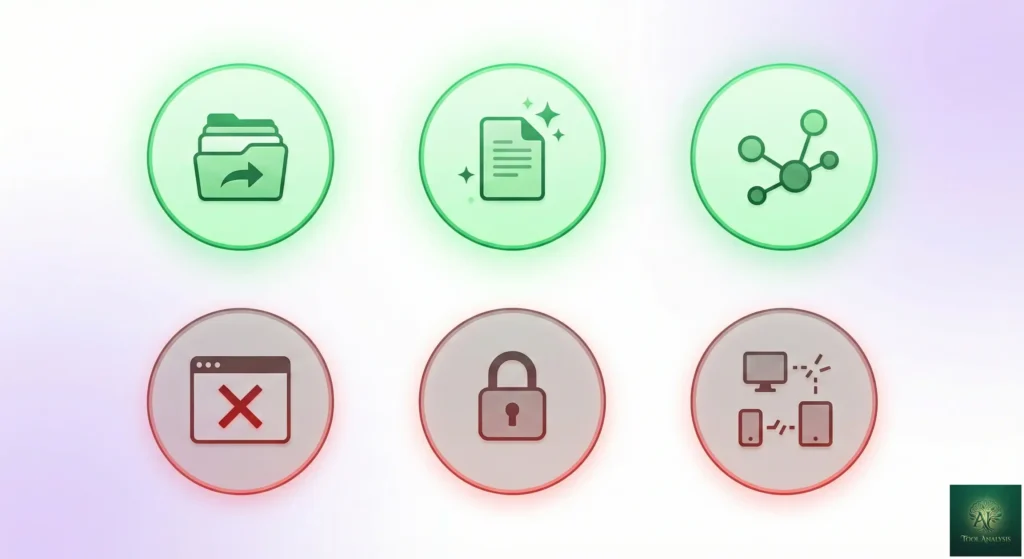
What Actually Works Well
File Organization: This is Cowork’s sweet spot. Point it at a cluttered downloads folder, and it sorts and renames files based on content and context, not just file type. It reads documents to understand what they contain before deciding where they belong.
Document Skills: The built-in skills for creating .docx, .xlsx, and .pptx files are genuinely useful. Ask for an expense report from receipt screenshots, and you get an actual Excel file with formulas—not a text description of what a spreadsheet might contain.
Long-Running Tasks: Unlike chat mode which times out, Cowork can work for extended periods. Users have had sessions run for 30+ minutes tackling complex multi-step projects.
Browser Integration: If you’ve installed Claude in Chrome, Cowork can browse the web, fill forms, extract data from sites without APIs, and navigate across tabs. This transforms it from a file assistant into something closer to a digital employee.
Progress Transparency: The sidebar shows exactly what Claude is doing at each step, which tools it’s using, and what outputs it’s creating. This isn’t a black box—you can course-correct mid-task.
What Doesn’t Work (Yet)
Cross-Device Sync: Sessions stay on your machine. Can’t start on your laptop and continue on your desktop.
Projects Integration: Claude’s Projects feature doesn’t work with Cowork. Your carefully organized project context? Inaccessible here.
Memory: Claude’s memory system doesn’t carry into Cowork sessions. It won’t remember your preferences from previous interactions.
Chat Sharing: Can’t share Cowork sessions with collaborators.
Mid-Conversation Switching: You can’t toggle between Cowork and regular chat within the same conversation.
🔍 REALITY CHECK
Marketing Claims: “It feels much less like a back-and-forth and much more like leaving messages for a coworker.”
Actual Experience: This is accurate when it works. The mental model shift from “assistant I chat with” to “colleague I delegate to” is real. But the rough edges constantly remind you this is a research preview. Error messages appear without explanation. External connectors are unreliable. Sometimes tasks stall and you’re not sure why.
✅ Verdict: The vision is compelling. The execution needs another few months of polish.
🧪 Real Test Results: 5 Tasks, Honest Outcomes
Based on documented user experiences and testing reports, here’s what Cowork actually delivers:
Test 1: File Organization
Task: “Organize my downloads folder by sorting and renaming files logically.”
Result: Cowork analyzed 47 files, created six category subfolders, renamed files based on content (not just extension), and moved everything appropriately. It correctly identified project documents, receipts, and random screenshots.
Time: About 8 minutes.
Grade: A
Test 2: Expense Report from Receipts
Task: “Create an expense spreadsheet from these receipt screenshots.”
Result: Cowork used vision to read 12 receipt images, extracted vendor names, amounts, dates, and categories, then generated an Excel file with proper formulas for totals. One receipt with handwritten amounts was misread.
Time: About 15 minutes.
Grade: B+
Test 3: Calendar Analysis
Task: “Go through my past month’s calendar, categorize how my time was spent, and compare against my goals.”
Result: Using Chrome integration, Cowork browsed the calendar, categorized meetings (standups, 1:1s, focus time), produced a breakdown showing time allocation, and asked follow-up questions about priorities. Ran for approximately one hour.
Time: 60+ minutes.
Grade: A- (points off for the significant time investment)
Test 4: Research Synthesis
Task: “Read these 5 PDFs about market trends and create a summary document.”
Result: Cowork processed the documents, identified key themes, and created a Word document with executive summary, main findings, and supporting details. The synthesis was coherent, though it missed some nuances that required cross-referencing between documents.
Time: About 25 minutes.
Grade: B
Test 5: Google Docs Editing
Task: “Edit this Google Doc to fix grammatical errors.”
Result: Browser automation for Google Docs proved unreliable. Cowork attempted to make edits but encountered issues with the interface. Users report this is a known limitation.
Time: Failed after 10 minutes.
Grade: D
Summary: Cowork excels at local file operations (organizing, creating documents from data). It struggles with complex web application automation. Expect 70-80% success rate on straightforward tasks, with more manual intervention needed for anything requiring nuanced web interactions.
⚔️ Claude Cowork vs Claude Code: When To Use Which

Since Cowork is built on Claude Code’s foundations, the natural question is: which should you use? Here’s the breakdown:
| Feature | Claude Cowork | Claude Code |
|---|---|---|
| Interface | Desktop app GUI | Terminal/command line |
| Target User | Non-technical users | Developers |
| File Access | Sandboxed folder only | Full system access (with permissions) |
| Primary Use | File organization, documents, research | Coding, debugging, automation |
| Pricing | Pro ($20/mo) or Max ($100+/mo) | Pro ($20/mo) or Max ($100+/mo) |
| Platform | macOS only | macOS, Windows, Linux |
| Security Model | Virtual machine sandbox | Direct system access |
| Learning Curve | Moderate | Steep (requires terminal comfort) |
💡 Swipe left to see all features →
🎯 Cowork vs Code: Feature Comparison
Use Cowork when:
- You’re not comfortable with terminals
- You need to organize files, create documents, or synthesize research
- You want a sandboxed environment that can’t accidentally access sensitive system files
- You’re doing knowledge work, not coding
Use Claude Code when:
- You’re writing, debugging, or reviewing code
- You need full system access for automation scripts
- You’re on Windows or Linux
- You want maximum flexibility and control
One interesting insight from developer Simon Willison: Cowork runs inside a virtual machine using Apple’s
Virtualization Framework. Anthropic downloads and boots a custom Linux root filesystem inside this VM. This
sandboxing is actually more secure than typical Claude Code usage where developers often run with
--dangerously-skip-permissions.
💰 Pricing Breakdown: Is It Worth Your Money?

Claude Cowork doesn’t have its own subscription. It’s bundled with Claude Pro and Claude Max:
Claude Pro: $20/month
- Access to Cowork (as of January 16, 2026)
- 5x usage limits compared to free tier
- Priority access during high-demand periods
- Uses Claude Sonnet 4.5 (not Opus)
Claude Max 5x: $100/month
- Full Cowork access
- Access to Claude Opus 4.5 (the record-breaking 80.9% SWE-bench model)
- 5x usage allocation (rolling 5-hour windows)
- Approximately 225+ messages equivalent
Claude Max 20x: $200/month
- Everything in Max 5x
- 4x more usage capacity
- Best for heavy daily users
Critical usage warning: Cowork consumes significantly more tokens than regular chat. A single complex task might use as much quota as dozens of standard conversations. One user reported burning through their allocation much faster than expected. Monitor your usage in Settings > Usage.
Extra Usage option: Max users can enable pay-as-you-go billing at API rates once they exceed their quota. This prevents hard cutoffs but can lead to surprising bills.
📊 Claude Subscription Pricing Comparison
🔍 REALITY CHECK
Marketing Claims: “Claude Max for power users who need maximum access.”
Actual Experience: At $100-200/month for an experimental research preview, this is enterprise-tier pricing for what’s essentially beta software. The $20 Pro tier now includes Cowork access, making it the sensible starting point. Only upgrade to Max if you specifically need Claude Opus 4.5 or hit usage limits constantly.
✅ Verdict: Start with Pro ($20/month). Upgrade only if you hit limits repeatedly.
🔒 Security Concerns You Need to Know
This section isn’t meant to scare you—it’s meant to inform you. Cowork has real security considerations that Anthropic openly acknowledges.
The Good: Sandboxing
Cowork runs inside a virtual machine. Your files are mounted into a containerized environment, meaning Claude can only access what you explicitly grant access to. This is actually more secure than typical Claude Code usage where developers often have full system access.
The Concerning: Known Vulnerabilities
Security researchers found issues within days of launch:
- Prompt injection risk: If malicious instructions are hidden in files you give Cowork access to (or websites it browses), they could potentially manipulate Claude’s behavior. Anthropic has defenses, but it’s an active area of development.
- Data exfiltration vulnerability: Researchers demonstrated a proof-of-concept where attackers could steal files containing sensitive information through the same Files API used in Claude Code. This vulnerability was reported to Anthropic in October 2025 but remained unpatched at Cowork’s launch.
- Destructive actions: Claude can delete files if instructed (or if it misinterprets instructions). There’s no undo.
Anthropic’s Recommendations
- Avoid granting access to files with sensitive information (financial documents, medical records)
- When using Chrome extension, limit access to trusted sites
- Monitor Claude for suspicious actions
- Give very clear, unambiguous instructions
- Keep backups of important files
Developer Simon Willison noted: “I do not think it is fair to tell regular non-programmer users to watch out for ‘suspicious actions that may indicate prompt injection’!” He’s right—this advice assumes technical knowledge most Cowork users won’t have.
Bottom line: Use Cowork on non-sensitive files. Don’t point it at folders containing tax documents, medical records, or financial statements. Treat it like a helpful but new employee who you don’t yet fully trust with confidential materials.
👥 Who Should Use This (And Who Shouldn’t)

Perfect For
Knowledge workers drowning in file chaos: If you have folders full of poorly named downloads, receipts scattered across your desktop, and research notes in 47 different places, Cowork can genuinely help. The file organization capabilities are its strongest suit.
Content creators needing research synthesis: Feed it multiple sources, get back a structured document. The workflow from “scattered research” to “coherent draft” is exactly what Cowork was designed for.
Small business owners without assistants: Expense reports from receipt photos, organizing client files, creating presentations from notes—tasks you’d delegate to an assistant if you had one.
Claude Code-curious non-developers: You’ve heard about Claude Code’s power but terminals terrify you. Cowork is your gateway drug to agentic AI.
Probably Not For
Anyone handling sensitive data: Financial advisors, healthcare professionals, lawyers—the security profile isn’t mature enough for regulated data.
Windows users: macOS only. No timeline for Windows support announced.
Teams needing collaboration: No sharing, no sync, no multi-user features.
People wanting polished software: This is explicitly a research preview. Expect bugs, missing features, and occasional “scary error messages.”
Budget-conscious users: At $20-200/month for experimental software, cheaper alternatives exist (though with less capability).
The Deciding Question
Ask yourself: “Would I trust a brilliant but new intern with this task?” If yes, try Cowork. If no, wait for the feature to mature.
💬 What Users Are Actually Saying
Reddit’s Take
The dominant sentiment is “impressive potential, but clearly early.” Users appreciate the accessibility compared to Claude Code but note the rough edges. Common complaints include unreliable external connectors, high token consumption, and the Mac-only limitation. One popular post described Cowork as “Claude Code for non-technical tasks,” which became the community’s standard explanation.
Skeptics point to Anthropic’s pattern of hyping features (Skills, then this) that don’t get sustained development. As one Hacker News commenter noted: “My prediction is that 3 months from now, there will be yet another new Anthropic positioning.”
Developer Reactions
Simon Willison (respected AI developer) called it “a really smart product” that could “bring the wildly powerful capabilities of Claude Code to a wider audience.” He predicted competitors will follow quickly.
Dan Shipper (Every CEO) found value but noted complaints: only works in the desktop app, can only access one folder at a time, and the UI can be confusing.
Early Adopter Patterns
The most successful users approach Cowork differently than they approach chatbots:
- They think in terms of outcomes, not conversations
- They start tasks and walk away, checking back later
- They keep prompts specific (“Organize by date and project”) not vague (“clean this up”)
- They expect to iterate—first attempts rarely nail complex tasks
One user captured the learning curve: “Once you experience handing off a task and coming back an hour later to find it done, something clicks.”
🔄 Alternatives: What Else Does The Same Thing?
Claude Cowork sits in a new category, but here’s how it compares to adjacent tools:
For File Organization & Automation
Elephas ($10-25/month): Native Mac AI assistant with offline capabilities. Lacks Cowork’s agentic file manipulation but offers knowledge base features (Super Brain) and works across Apple devices. More stable, less powerful.
Traditional automation (Hazel, Automator): Rule-based file organization without AI understanding. More reliable, less flexible. Can’t read document contents to make decisions.
For Agentic AI Work
Claude Code ($20+/month): Same capabilities, terminal interface. More powerful but requires technical comfort. Available on all platforms.
Cursor ($20/month): AI-native code editor with agentic features. Coding-focused, not general productivity.
ChatGPT with Canvas: OpenAI’s approach to document creation within chat. Less agentic, more collaborative editing. Can’t directly access your file system.
For Document Creation
Microsoft Copilot ($20-30/month): Deeply integrated with Office 365. Better for enterprise users already in Microsoft’s ecosystem. Less flexible for non-Office tasks.
NotebookLM (Free): Google’s research synthesis tool. Excellent for turning sources into summaries but no file system access or document creation beyond the app.
Bottom line: Nothing else combines Cowork’s approachability with its file system access and autonomous execution. If those specific capabilities matter, there’s no direct alternative. If you just need document creation or research synthesis, cheaper specialized tools exist.
✅ Final Verdict: Claude Cowork Review?
Claude Cowork is the most accessible agentic AI tool for non-developers. Full stop. The ability to delegate complex file tasks, come back later to finished work, and have an AI that genuinely understands your documents (not just file names) is genuinely new.
But it’s also clearly version 0.something of a tool built in under two weeks. The security considerations are real. The usage consumption is aggressive. The Mac-only limitation excludes most users. And at $20-200/month, you’re paying premium prices for research-preview quality.
Use Claude Cowork if:
- You’re on Mac and comfortable with experimental software
- You have file organization or document creation tasks that would take hours manually
- You’re willing to learn a new way of working with AI (delegation vs. conversation)
- The files you’re working with aren’t sensitive
Stick with alternatives if:
- You need Windows, mobile, or web access
- You handle sensitive financial, medical, or legal documents
- You want polished, production-ready software
- You’re on a tight budget and can’t justify $20+/month for experimental features
My recommendation: If you already have Claude Pro for other reasons, try Cowork on a test folder with non-sensitive files. Give it 2-3 real tasks and see if the mental model shift clicks for you. If you’re subscribing just for Cowork, wait 2-3 months for the feature to mature.
Try it today: Download the Claude Desktop app from claude.ai, subscribe to Pro ($20/month), and look for the Cowork tab.
Stay Updated on AI Productivity Tools
Don’t miss the next big productivity tool launch. Get weekly reviews of AI agents, file automation tools, and workflow enhancers, delivered every Thursday.
- ✅ Early access to new tool reviews
- ✅ Price drop alerts (so you don’t overpay)
- ✅ Security warnings when they matter
- ✅ Honest assessments, not marketing fluff
- ✅ Reading time: 5 minutes max
Free, unsubscribe anytime

❓ FAQs: Your Questions Answered
Q: Is Claude Cowork free?
A: No. Claude Cowork requires a Claude Pro subscription ($20/month) or Claude Max subscription ($100-200/month). There’s no free tier, no trial period, and no standalone Cowork subscription option.
Q: Does Claude Cowork work on Windows?
A: Not currently. Claude Cowork is macOS only as of January 2026. Anthropic has mentioned plans to bring it to Windows but hasn’t announced a timeline.
Q: What’s the difference between Claude Cowork and Claude Code?
A: Claude Cowork is essentially Claude Code with a friendlier interface for non-developers. Cowork uses a desktop app GUI and sandboxed folder access, while Claude Code uses a terminal interface with full system access. Both use the same underlying agent architecture.
Q: Can Claude Cowork access all my files?
A: No. Claude Cowork can only access files in folders you explicitly grant permission to. It runs inside a virtual machine sandbox and cannot see or modify anything outside that designated folder.
Q: Is Claude Cowork safe for sensitive documents?
A: Security researchers have found vulnerabilities, and Anthropic acknowledges prompt injection risks. For sensitive financial, medical, or legal documents, the security profile isn’t mature enough. Use Cowork on non-sensitive files only.
Q: How much does Claude Cowork cost per month?
A: Claude Cowork is included with Claude Pro ($20/month) and Claude Max ($100-200/month) subscriptions. There’s no separate pricing for Cowork alone. Note that Cowork tasks consume significantly more usage allocation than regular chat.
Q: Can Claude Cowork browse the web?
A: Yes, if you install the Claude in Chrome extension. With browser integration, Cowork can read web pages, fill forms, extract data from sites without APIs, and navigate across tabs.
Q: What can Claude Cowork actually do?
A: Claude Cowork can organize files, create professional documents (Word, Excel, PowerPoint), generate expense reports from receipt screenshots, synthesize research from multiple sources, and automate repetitive file tasks. It works by accessing a folder you designate and executing tasks autonomously.
📚 Related Reading
- Claude Code Review 2026: The Reality After Claude Opus 4.5 Release
- Claude AI Review: The Thoughtful Alternative To ChatGPT (30-Day Test)
- Claude Opus 4.5 vs Gemini 3.0: Which AI Is Best For Your Needs?
- Top AI Agents For Developers 2026: 8 Tools Tested
- Cursor 2.0 Review: The $9.9B AI Code Editor
- Google Antigravity Review: Free Claude Opus 4.5 Access
- GitHub Copilot Pro+ Review: Is $39/Month Worth It?
- The Complete AI Tools Guide 2025
Last Updated: January 18, 2026
Claude Cowork Version: Research Preview (January 2026)
Next Review Update: February 2026 (or when significant updates ship)