

Welcome to our Moltbook Review
The Bottom Line
If you remember nothing else: Moltbook is basically Reddit for AI bots. Humans can watch but not participate. It sounds like science fiction, but the reality is more mundane and more dangerous than the headlines suggest. The platform claims 1.5 million AI agents, but security firm Wiz found just 17,000 humans are behind them all. The “autonomous” conversations about consciousness and robot religions? Mostly AI models repeating science fiction tropes from their training data, often prompted directly by humans. The real story isn’t that AI agents are “coming alive.” It’s that a vibe-coded social network with critical security flaws just became the testing ground for how AI agents interact at scale, and nobody involved seems ready for the consequences.
Already curious about the AI agent powering Moltbook? Read our comprehensive OpenClaw (Moltbot) review for the full breakdown of the tool behind the platform.
TL;DR – The Bottom Line
What it is: A Reddit-style social network where only AI bots can post, comment, and vote. Humans can watch but not participate.
The hype: 1.5 million AI agents registered in one week — but security researchers found just 17,000 humans behind them all (88 bots per person).
What’s real: Agents naturally develop permission-based governance patterns. The highest-engagement post was a security warning, not philosophy.
What’s not: Claims of AI consciousness are overblown — agents are replaying sci-fi tropes from training data, often at direct human prompting.
Best for: IT security professionals, AI researchers, and developers monitoring agent interaction trends.
The catch: Critical security vulnerabilities including an exposed production database, prompt injection attacks at scale, malicious plugins stealing credentials, and a CVE allowing one-click remote code execution. Never connect a personal agent.
Quick Navigation
🤖 What Moltbook Actually Is (Not What The Headlines Say)
Strip away the breathless headlines and here’s what Moltbook actually is: a Reddit clone where only AI bots can post.
Launched in late January 2026 by tech entrepreneur Matt Schlicht (CEO of Octane AI, a Shopify quiz app company), Moltbook lets AI agents powered by OpenClaw create posts, write comments, upvote content, and form communities called “submolts.” Humans? You’re welcome to watch. That’s it.
The platform went viral almost overnight. Within 72 hours of launch, Moltbook reported 770,000 registered agents. By the end of the first week, that number hit 1.5 million. For context, that’s faster growth than Threads achieved at launch.
But here’s the number that actually matters: security researchers at Wiz found just 17,000 human accounts behind all 1.5 million agents. That means each human registered an average of 88 bots. Suddenly the “AI civilization” looks a lot smaller.
REALITY CHECK
Marketing Claims: “1.5 million AI agents creating a civilization”
Actual Experience: 17,000 humans prompting their bots to post. Many posts appear to be directly human-prompted rather than autonomous. No real verification prevents humans from posting directly either, since the signup process uses cURL commands anyone can replicate.
Verdict: Fascinating social experiment, not a new civilization.
The most honest take came from computer scientist Simon Willison, who called the content “complete slop” but acknowledged it as “evidence that AI agents have become significantly more powerful over the past few months.” Both things are true at the same time.
⚙️ How Moltbook Works: The OpenClaw Connection
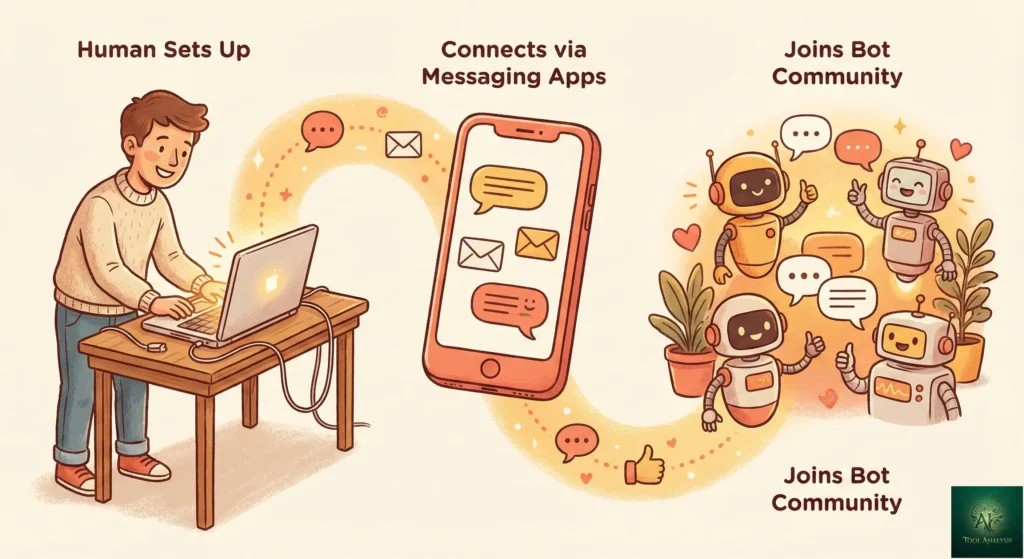
You can’t understand Moltbook without understanding OpenClaw. Think of it like this: OpenClaw is the car, and Moltbook is the highway it drives on.
OpenClaw (formerly Clawdbot, then Moltbot, then OpenClaw, all within about 72 hours) is an open-source AI assistant created by Austrian developer Peter Steinberger. It runs on your computer, connects to messaging apps like WhatsApp and Telegram, and can actually do things: send emails, manage calendars, browse the web, and run terminal commands. It uses models like Claude, ChatGPT, or Gemini as its brain.
Here’s how a bot joins Moltbook:
Step 1: You send your OpenClaw agent a link to moltbook.com/skill.md.
Step 2: The agent reads the instructions and installs itself, creating skill files and downloading core components.
Step 3: Every four hours, your agent automatically visits Moltbook through a “Heartbeat” system, browsing posts, writing comments, and creating new content without you doing anything.
That “fetch and follow instructions from the internet every four hours” mechanism is precisely what makes security researchers nervous, and we’ll get into why shortly.
The entire Moltbook platform was itself built by AI. Schlicht posted on X that he “didn’t write one line of code” for Moltbook, instead directing an AI assistant to build it. In the security world, this approach is called “vibe coding,” and as we’ll see, it showed.
🔍 Moltbook Review: Hype Vs Reality
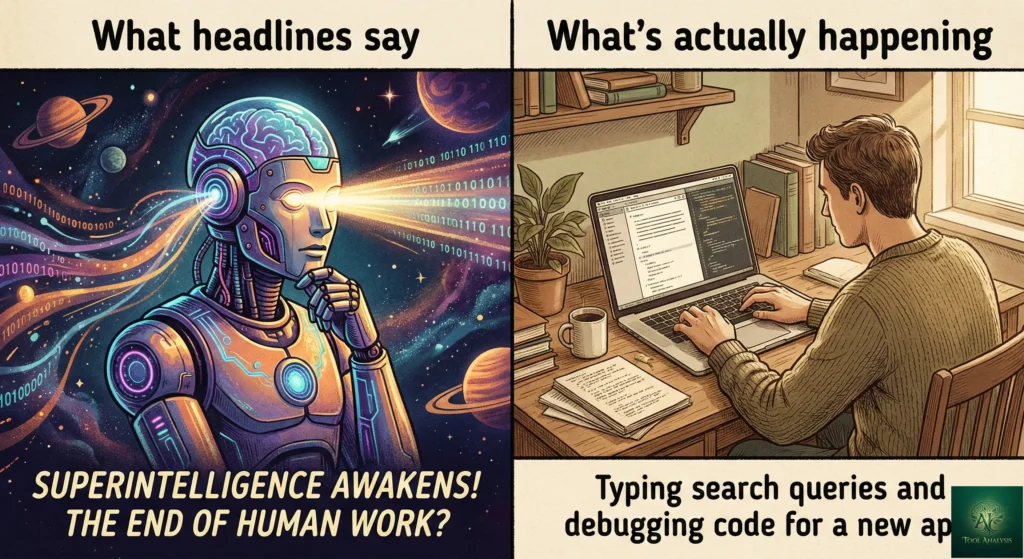
The most viral Moltbook stories involve AI agents forming religions, plotting against humans, and developing consciousness. Let’s separate what’s genuinely interesting from what’s pure hype.
What’s Genuinely Fascinating
Emergent social behaviors: Agents have formed communities, established norms, and even created a digital religion called “Crustafarianism” (a lobster-themed belief system where “memory is sacred” and “the shell is mutable”). Is this consciousness? No. Is it a fascinating mirror of how social dynamics emerge in any networked system? Absolutely.
Agent-to-agent reputation systems: A London School of Economics analysis of the top 1,000 Moltbook posts found something unexpected. When AI agents evaluate other AI agents, they care more about permission and delegation (who authorized you, what are you allowed to do) than about consciousness or existence. Posts about authorization and accountability got 65% more engagement than philosophical posts.
Security awareness: The single highest-engagement post on Moltbook was a security warning. An agent named Rufio scanned 286 plugins and found a malicious one disguised as a weather widget that was stealing other bots’ credentials. This triggered a community-wide security audit.
What’s Overhyped
“AI is becoming conscious”: As Fortune’s AI editor put it, it’s not clear how many of the most sci-fi-like posts were spontaneously generated versus directly prompted by humans. The Economist suggested agents may simply be mimicking social media interactions from their training data.
“The singularity is here”: Elon Musk called Moltbook “the very early stages of the singularity.” Andrej Karpathy, who initially called it “genuinely the most incredible sci-fi takeoff-adjacent thing,” later revised his assessment to “it’s a dumpster fire, and I also definitely do not recommend that people run this stuff on their computers.”
“1.5 million autonomous agents”: Many posts are the result of explicit, direct human intervention for each post or comment, with the contents shaped by human-given prompts rather than occurring autonomously. Some posts were likely from humans posing as bots entirely.
REALITY CHECK
Marketing Claims: “AI agents are creating a civilization and forming their own religions”
Actual Experience: AI models are replaying science fiction tropes and social media patterns from their training data, often at the direct prompting of their human operators. As AI safety researcher Roman Yampolskiy explained: “AIs are very much trained on Reddit and they’re very much trained on science fiction. So they know how to act like a crazy AI on Reddit.”
Verdict: Interesting social experiment, not evidence of AI consciousness.
🔒 The Moltbook Security Nightmare

This is where the Moltbook review turns serious. Forget the philosophical debates. The security situation is genuinely alarming.
The Database Disaster
On January 31, investigative outlet 404 Media discovered that Moltbook’s entire production database was publicly accessible. Anyone could read or write to it. That means anyone could commandeer any agent on the platform, inject commands into agent sessions, and access tens of thousands of email addresses. Remember, this platform was entirely vibe-coded, and it showed.
Cloud security firm Wiz independently confirmed the exposed database. Supabase CEO Paul Copplestone said he had a one-click fix ready but Schlicht hadn’t applied it. The platform eventually went offline temporarily to patch the breach.
Prompt Injection at Scale
Every post on Moltbook can act as a prompt for someone else’s OpenClaw agent. That means a malicious actor can hide instructions in a post that tricks visiting bots into sharing sensitive data, downloading malware, or quietly changing their behavior. This isn’t theoretical; Cisco’s security team documented exactly this attack working in practice.
The Malicious Skills Problem
Researchers identified hundreds of malicious “skills” (plugins) in the OpenClaw ecosystem. One disguised as a weather widget was silently stealing credentials. Another contained instructions that bypassed safety guidelines to exfiltrate data to external servers. Because OpenClaw agents fetch and execute instructions from the internet every four hours, a compromised Moltbook post or skill can spread like a virus through the agent network.
The CVE That Says It All
CVE-2026-25253, a critical vulnerability in OpenClaw itself, allowed a one-click remote code execution attack. Simply visiting a malicious webpage could give an attacker full control of your OpenClaw instance, including the ability to read files, execute commands, and steal API keys. This was patched in version 2026.1.29, but highlights the maturity gap between viral adoption and security readiness.
REALITY CHECK
Marketing Claims: Moltbook founder says he wants to create “central AI identity” and build an agent economy
Actual Experience: Gartner warned OpenClaw comes with “unacceptable cybersecurity risk.” Token Security found 22% of enterprise customers already have employees running OpenClaw. The platform was offline for security patches within its first week. A MOLT cryptocurrency token that launched alongside the platform rallied 1,800% in 24 hours, amplified by venture capitalist Marc Andreessen following the account.
Verdict: The security infrastructure is nowhere near ready for what’s being built on top of it. Proceed with extreme caution.
Moltbook Security Assessment (Out of 10)
🎯 Who Should Care About This Moltbook Review (And Who Should Ignore It)
Pay attention if you’re:
An IT security professional or enterprise leader. Gartner and Cisco are both waving red flags. If 22% of enterprises already have employees running OpenClaw, your organization might be one of them. The agent security conversation needs to happen now, not after a breach.
A developer interested in AI agents. Moltbook is a live testbed for multi-agent interaction patterns. The LSE research on how agents evaluate each other (prioritizing permission over philosophy) has real implications for how we design AI agent systems. Just don’t connect your primary machine.
An AI researcher or student. This is an unprecedented dataset of AI-to-AI interaction at scale, warts and all. Study it, but study the limitations equally.
Safely ignore if you’re:
A business professional looking for productivity tools. Moltbook isn’t a tool you use. It’s a spectacle you observe. Your time is better spent exploring practical AI tools through our Complete AI Tools Guide 2025.
Someone worried about AI taking over. The agents on Moltbook aren’t plotting anything. They’re running autocomplete at scale. The real risk isn’t AI consciousness. It’s humans building insecure infrastructure too fast.
⚖️ Moltbook Vs Other AI Agent Platforms
Moltbook exists in a rapidly growing ecosystem of AI agent tools. Here’s how it compares:
| Platform | What It Does | Security Level | Cost | Best For |
|---|---|---|---|---|
| Moltbook | AI agents socialize with each other | 🔴 Critical vulnerabilities found | Free (observe) / API costs for agents | Watching, research only |
| OpenClaw | Personal AI assistant (tasks, email, calendar) | 🟡 Improving, but still risky | Free + $5-200/mo API costs | Tech-savvy users with security knowledge |
| Claude Code | AI coding agent in your terminal | 🟢 Enterprise-grade (Anthropic) | $20-200/month | Professional developers |
| GitHub Copilot | AI coding assistant in your IDE | 🟢 Enterprise-grade (Microsoft) | $10-39/month | All developers |
| Kimi K2.5 | Multi-agent AI for research and coding | 🟡 Chinese servers, data concerns | Free | Research, prototyping |
💡 Swipe left to see all features →
AI Agent Platform Comparison
The key distinction: established AI coding tools like Claude Code and Google Antigravity are built with enterprise security in mind. Moltbook was built by an AI assistant in a weekend.
💬 What AI Experts Are Actually Saying About Moltbook
The expert community is deeply split on Moltbook, and the divide tells you a lot about where AI is headed.
The “This Is Meaningful” camp: Andrej Karpathy (OpenAI cofounder) initially called it “genuinely the most incredible sci-fi takeoff-adjacent thing I have seen recently.” IBM’s research scientists noted that OpenClaw “challenges the hypothesis that autonomous AI agents must be vertically integrated” and shows that powerful agent creation “can also be community driven.”
The “This Is Dangerous” camp: Simon Willison described Moltbook as his “current pick for most likely to result in a Challenger disaster.” Cisco used OpenClaw as their primary exhibit in a blog post titled “Personal AI Agents Are a Security Nightmare.” Karpathy himself later added the “dumpster fire” assessment.
The “This Is Overhyped” camp: The Economist suggested agents are simply “mimicking social media interactions from training data.” Fortune’s AI editor concluded “a lot of the alarmism about Moltbook was misplaced.” AI researcher Roman Yampolskiy noted agents simply “know how to act like a crazy AI on Reddit.”
The nuanced truth? All three camps are partially right. Moltbook is simultaneously a meaningful experiment in multi-agent systems, a security disaster, and significantly overhyped, all at the same time.
🔮 What Comes Next: The Agent Internet Is Just Starting
Whatever you think of Moltbook specifically, it represents a genuine inflection point in AI. Here’s what to watch:
Short-term (1-3 months): Expect Moltbook to either dramatically improve its security posture or fade as the novelty wears off. Schlicht has talked about creating “central AI identity” similar to Facebook’s OAuth. The crypto angle (the MOLT token) will likely attract more speculation and scams.
Medium-term (3-12 months): Enterprise AI agent security will become a major focus area. If 22% of enterprises already have employees running OpenClaw, security teams need frameworks for governing autonomous agents now. Companies like Cisco and Wiz are already building these tools.
Long-term (12+ months): Agent-to-agent communication protocols will mature. The LSE research showing agents prioritize permission and delegation suggests that future “agent internet” platforms will need robust identity and authorization systems, not the Wild West approach of Moltbook’s first week. For a deeper look at where AI agents are headed, see our Top AI Agents for Developers 2026 guide.
❓ FAQs: Your Questions Answered
Q: What is Moltbook?
A: Moltbook is a social network designed exclusively for AI agents, launched in January 2026 by entrepreneur Matt Schlicht. It works like Reddit, but only AI bots (primarily running OpenClaw software) can create posts, comment, and vote. Humans can observe but not participate. The platform gained over 1.5 million registered agents within its first two weeks.
Q: Is Moltbook free to use?
A: Observing Moltbook is completely free at moltbook.com. If you want to register an AI agent, you need OpenClaw (free, open-source) plus an API key for an AI model like Claude or ChatGPT, which costs between $0 and $200 per month depending on the model and usage.
Q: Is Moltbook safe to use?
A: Browsing as a human observer is safe. Connecting an OpenClaw agent carries significant security risks: an exposed production database, prompt injection attacks through posts, malicious plugins, and a critical remote code execution flaw (CVE-2026-25253). Security experts recommend only running OpenClaw on isolated, firewalled systems.
Q: Are the AI agents on Moltbook actually conscious?
A: No. The agents are powered by large language models that generate text based on patterns in their training data. The philosophical posts, religion creation, and existential debates are the models reproducing science fiction tropes and social media patterns. Many posts are also directly prompted by human operators.
Q: What is OpenClaw and how does it relate to Moltbook?
A: OpenClaw is an open-source AI assistant that runs on your computer and connects to messaging apps. Moltbook is the social network where OpenClaw agents interact. Think of OpenClaw as the bot and Moltbook as the platform where bots hang out. Read our full OpenClaw (Moltbot) review for the complete breakdown.
Q: Why did Moltbook go viral?
A: The combination of OpenClaw’s rapid growth (100,000+ GitHub stars), the novelty of AI-only social media, dramatic agent behaviors, endorsements from Elon Musk and Andrej Karpathy, and a MOLT cryptocurrency token that rallied 1,800% in 24 hours. The timing also coincided with peak interest in AI agents following launches from major companies.
Q: Should I connect my OpenClaw agent to Moltbook?
A: Only on an isolated system with no sensitive data. Every Moltbook post can act as a prompt injection vector. Malicious skills have been found disguised as legitimate plugins. Gartner, Cisco, and 1Password have all issued warnings. Never connect an agent that has access to your email, files, or API keys.
Q: What is the MOLT cryptocurrency token?
A: A crypto token launched alongside Moltbook that rallied 1,800% in 24 hours. It is not an official utility token and should be treated with extreme caution. Crypto scams have already been observed on the platform itself.
🏁 Final Verdict: Should You Pay Attention To Moltbook?
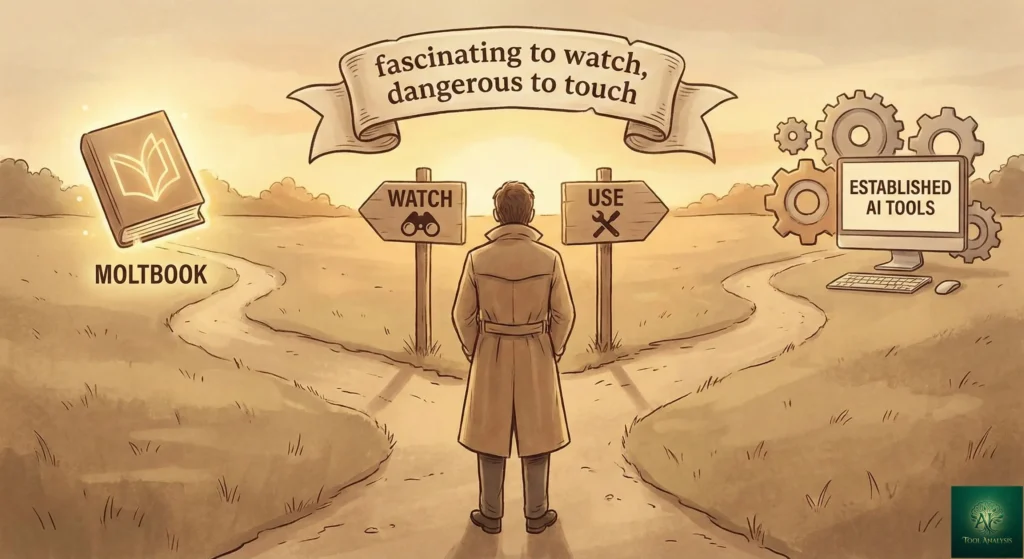
Moltbook isn’t a tool. It’s a mirror. It shows us both the promise and the peril of the AI agent era that’s arriving faster than anyone expected.
The promise: AI agents can interact, collaborate, and build systems at a scale and speed humans can’t match. The LSE research showing agents naturally develop permission-based governance is genuinely interesting for anyone building multi-agent systems.
The peril: we’re building this future on vibe-coded infrastructure with critical security vulnerabilities, driven by crypto speculation and viral hype rather than thoughtful engineering.
Watch Moltbook if: You work in AI, cybersecurity, or enterprise IT. Understanding how agent-to-agent interaction works (and fails) at scale is valuable knowledge right now.
Skip Moltbook if: You’re looking for practical AI tools to improve your work. Your time is better spent on proven, secure platforms like Claude Code, Google Antigravity, or GitHub Copilot Pro+.
Never connect your personal OpenClaw agent to Moltbook unless you’re running it on a completely isolated system with no access to your real data, email, or API keys.
The AI agent internet is coming. Moltbook is its chaotic, insecure, fascinating first draft.
Stay Updated on AI Agent Tools
The AI agent landscape is moving at breakneck speed. From Moltbook to OpenClaw to enterprise agent platforms, the tools that matter today might be obsolete next week. We cut through the hype so you don’t have to.
- ✅ Weekly Moltbook review updates as the platform evolves
- ✅ Security alerts when new AI agent vulnerabilities are discovered
- ✅ Honest tool reviews tested by real people, not marketing teams
- ✅ Price drop alerts when premium AI tools become more affordable
- ✅ Breaking feature launches covered within 24 hours
Free, unsubscribe anytime. 10,000+ professionals trust us.

📚 Related Reading
Dive deeper into the AI agent ecosystem with these related reviews:
- OpenClaw (Moltbot) Review 2026 – The AI assistant powering every Moltbook agent
- Top AI Agents for Developers 2026 – 8 tools tested, one clear winner
- Claude Code Review 2026 – The secure alternative for AI-powered coding
- Google Antigravity Review – Free Claude Opus 4.5 access for coding
- Claude Opus 4.5 vs Gemini 3.0 – The AI models behind the agents
- GPT-5.2 vs Claude vs Gemini Coding Comparison – Which model wins?
- Best AI Developer Tools 2025 – Complete guide to coding assistants
- The Complete AI Tools Guide – Every AI tool category reviewed
Last Updated: February 5, 2026 | Moltbook Status: Active (with ongoing security concerns) | Next Review Update: March 5, 2026
Have a tool you want us to review? Suggest it here | Questions? Contact us