
🆕 LAUNCH DAY UPDATE — June 9, 2026
Anthropic launched Claude Fable 5 today, its first publicly available Mythos-class model. It is included free on Pro, Max, Team, and seat-based Enterprise plans through June 22, and available immediately on the Claude API. This review is based on launch-day testing and Anthropic’s official documentation. We will update it as more independent benchmarks and long-term usage data come in.
The Bottom Line
If you remember nothing else from this Claude Fable review: Fable 5 is the most powerful Claude model you can actually use, and right now it costs nothing extra if you already pay for a Claude plan. It is a “Mythos-class” model, which is Anthropic’s tier sitting above the Opus models in raw capability. The longer and more complex your task, the bigger its lead over everything else Anthropic has shipped to the public.
The catch is real and you need to understand it before you rely on this thing. Fable 5 quietly hands some of your requests to a weaker model. When you ask about cybersecurity, biology, chemistry, or a few other flagged topics, Fable 5 steps aside and lets Claude Opus 4.8 answer instead. You get told when it happens, and you are not charged Fable prices for those rerouted answers, but it means Fable is not a model you can count on for security research or lab work.
Best for: developers and knowledge workers doing long, complex, multi-step work where Opus 4.8 runs out of steam, and anyone who wants to test frontier capability for free before the June 22 deadline. Skip if: your work touches cybersecurity or biology (you will mostly get Opus 4.8 anyway), or you need predictable subscription pricing past June 23. For most everyday chat and writing, our Claude AI review covers the model you are probably already using, and it is more than enough.
⚡ TL;DR – The Bottom Line
What It Is: Anthropic’s first public Mythos-class model — the most powerful Claude you can actually use, sitting one tier above Opus 4.8.
Best For: Developers and knowledge workers running long, complex, multi-step tasks where Opus runs out of steam.
Price: $10 in / $50 out per million tokens on the API; free on Pro, Max, Team, and seat-based Enterprise plans through June 22, 2026.
Our Take: Genuinely frontier on long-horizon work, but a safety fallback and a murky post-June-23 price hold it back from a perfect score.
⚠️ The Catch: Cybersecurity, biology, and chemistry questions are quietly rerouted to the weaker Opus 4.8 — so Fable can’t be your tool for security or lab work.
📑 Quick Navigation
What Claude Fable 5 Actually Does
Here is the plain-English version. Anthropic has a secret-weapon model called Mythos that it has kept locked away from the public since April because it was too good at hacking. Mythos can find security holes in software the way a master locksmith spots a weak lock, which is wonderful for defenders and terrifying in the wrong hands. So Anthropic only gave it to a small circle of cybersecurity partners.
Fable 5 is that same powerful brain, but with a safety governor bolted on. Think of it like a supercar that has been speed-limited on public roads. You get the engine, the handling, the acceleration, right up until you steer toward a cliff edge, at which point the car politely takes over and drives you somewhere safer. The full, unlimited version is still called Mythos 5 and is still locked to approved organizations.
What can it do? On Anthropic’s own benchmark table, Fable 5 is state-of-the-art on nearly every test of AI capability, with standout results in software engineering, knowledge work, and vision (its ability to read images, charts, and screenshots). The model that shares its architecture, Mythos Preview, posted a 93.9% on SWE-bench Verified earlier this year, far ahead of the high-80s scores from competing frontier models. Anthropic’s internal testing put Fable’s new models at 80.3% on the much harder SWE-Bench Pro, a benchmark most frontier models struggle to push past the high 50s on.
📊 SWE-Bench Pro: Fable 5 vs the Frontier Field
The Five-Minute Test
In the first five minutes with Fable 5 on launch day, the most striking thing is not a feature. It is the autonomy. You hand it a genuinely large task, the kind where you would normally babysit Opus through twenty back-and-forth turns, and it just runs. The early customer reports back this up. Stripe said Fable 5 did a codebase-wide migration on a 50-million-line Ruby codebase in a single day, work the company estimated would have taken a human team more than two months by hand.
🔍 REALITY CHECK
Marketing Claims: “Fable 5’s capabilities exceed those of any model we’ve ever made generally available.”
Actual Experience: True on long-horizon work, where Fable’s lead is obvious. But for short tasks like drafting an email, summarizing a page, or a quick code snippet, you will struggle to feel a difference from Opus 4.8. The gap widens with task length, so a one-line prompt wastes most of what you are paying for.
Verdict: Genuinely frontier, but only if you give it frontier-sized problems.
The Fallback: The Thing Nobody Is Explaining Properly
This is the part of the Claude Fable 5 launch that gets glossed over in most coverage, and it is the part most likely to trip you up. Fable 5 does not refuse risky requests. It reroutes them.
Anthropic runs a set of separate AI systems called classifiers that watch your requests. When one detects a topic in cybersecurity, biology and chemistry, or “distillation” (attempts to copy the model’s abilities to train a competitor), it stops Fable from answering and quietly passes your question to Opus 4.8 instead. You see a notice when this happens. Anthropic says it tuned these classifiers cautiously on purpose, so they will sometimes catch perfectly harmless questions.

The good news: Anthropic’s early data shows more than 95% of Fable sessions never trigger a fallback at all. For those sessions, you are getting the full Mythos-class experience. The honest news: if your work lives in the flagged zones, you are effectively buying Opus 4.8 with extra steps. A security researcher hoping Fable would supercharge their vulnerability hunting will be disappointed, because that is exactly the capability Anthropic built the wall around.
🔍 REALITY CHECK
Marketing Claims: “A response that falls back to Opus is a far better experience than an outright refusal from Fable.”
Actual Experience: For a casual user, true. A working answer beats a wall. But the framing hides the cost: you cannot predict in advance which of your questions will get the weaker model, and the classifiers admit to false positives. If you depend on consistent top-tier output in a borderline field like life sciences, that unpredictability is a planning problem, not a convenience.
Verdict: A reasonable safety design that is genuinely better than refusals, but be clear-eyed that it caps what Fable can do for you in entire categories of work.
💡 Key Takeaway: If your work never touches security, biology, or chemistry, you will likely never see the fallback — 95%+ of sessions run clean. But if it does live in those zones, treat Fable as Opus 4.8 in disguise and plan accordingly: it is the wrong tool for that job by design, not by accident.
Getting Started: Your First Hour
There is almost no onboarding, which is the point. If you are on a paid Claude plan, Fable 5 shows up in your model picker today. Select it and go. There is no separate signup, no waitlist, no beta flag to toggle.
For developers, it is a one-line change. The API model string is claude-fable-5, and it slots into your existing Claude API code exactly where you would put any other model name. If you have already built on Anthropic’s API, you can be running Fable in under a minute. Our Claude Code review covers how the terminal-based agent handles model switching if you work that way.
The one surprise during setup is the data policy. Anthropic now requires 30-day retention for all traffic on Mythos-class models, including Fable 5, on both its own surfaces and third-party ones. The company says it will not use this data to train models and will delete it after 30 days, logging all human access. It is a safety measure to catch novel jailbreaks, but if your organization has strict zero-retention requirements, read the policy before you route sensitive work through Fable.
📬 Enjoying this review?
Get honest AI tool analysis delivered weekly. No hype, no spam.
Features That Actually Matter
Long-Horizon Autonomy (the headline)
This is what you are really getting. Fable 5 can work on its own for longer than any previous Claude model without losing the thread. In Anthropic’s testing, giving the model file-based memory while it played the deck-building game Slay the Spire improved its performance three times more than the same memory helped Opus 4.8. That is a concrete signal that Fable uses long context and its own notes far more effectively, which is exactly what you want for multi-hour project work. Rating: ⭐⭐⭐⭐⭐
Vision That Reads Real Documents

Fable 5 is the new state-of-the-art for vision tasks. In practical terms, that means it can pull precise numbers out of a dense scientific chart, or rebuild a web app’s source code from nothing but screenshots. Anthropic demonstrated it beating the video game Pokemon FireRed using only raw game screenshots, with none of the helper tools earlier Claude models needed. For anyone doing document-heavy work in finance, legal, or analytics, this is the feature that earns its keep. Rating: ⭐⭐⭐⭐⭐
Knowledge Work and Analysis
On the analytics platform Hex’s internal benchmark for complex, long-running analytical tasks, Fable 5 was the first model to break 90%, a roughly 10-point jump over Opus. Early access partners in finance reported it was the strongest finance-first model they had tested. If you live in spreadsheets and reports, this matters, and it pairs naturally with our Claude in Excel review for the in-app version. Rating: ⭐⭐⭐⭐½
Token Efficiency
A quieter win that affects your wallet: Fable 5 is more token-efficient than past Claude models. On Cognition’s FrontierCode evaluation it scored highest among frontier models even at medium effort, meaning it can hit top results without burning maximum reasoning tokens. One physics-research partner said Fable matched a competitor’s four-day result in 36 hours while using a third of the reasoning tokens. Less waste per task partly offsets the premium per-token price. Rating: ⭐⭐⭐⭐
🌐 Fable 5 Capability Profile (Our Ratings)
💡 Key Takeaway: Every headline feature here — autonomy, vision, analytics, efficiency — pays off most on big, document-heavy, multi-hour jobs. If your day is short prompts and quick chats, you are paying frontier prices for capability you will never touch.
Pricing Breakdown: What You’ll Actually Pay
Fable 5 pricing is where the launch gets genuinely confusing, so here is the clear version. There are two completely separate things to understand: API pricing and subscription access.
On the API, Fable 5 costs $10 per million input tokens and $50 per million output tokens. To put that in human terms: a million tokens is roughly 750,000 words. So feeding Fable a 750,000-word input costs about $10, and getting 750,000 words back costs about $50. That is premium frontier pricing, notably less than half what Mythos Preview cost earlier, but still far above what you would pay for Sonnet or a mid-tier model on routine work.
| Access Path | Cost | Window |
|---|---|---|
| Claude API (claude-fable-5) | $10 in / $50 out per million tokens | Available now, no time limit |
| Consumption-based Enterprise | $10 in / $50 out per million tokens | Available now |
| Pro, Max, Team, seat-based Enterprise | Included free | Today through June 22, 2026 |
| Same plans after June 23 | Requires usage credits | Until capacity expands |

On subscriptions, here is the timeline you must mark on your calendar. From today through June 22, Fable 5 is included at no extra cost on Pro, Max, Team, and seat-based Enterprise plans. On June 23, Anthropic removes it from those plans, and continuing to use it will require usage credits. The company says it aims to restore Fable as a standard plan feature once it has enough capacity, but gives no date. Translation: the free window is real, it is short, and what happens after is uncertain.
🔍 REALITY CHECK
Marketing Claims: “Included on Pro, Max, Team, and seat-based Enterprise plans at no extra cost.”
Actual Experience: True, but only for 13 days. The “no extra cost” framing is accurate for the launch window and then changes to a usage-credit model on June 23 with no committed date for going back. If you build a workflow that depends on Fable during the free period, plan for the bill that arrives after.
Verdict: A real free trial dressed as a plan feature. Use it to evaluate, not to commit, until the post-June 23 pricing settles.
The free alternative worth naming: for most tasks, Opus 4.8 (already on your paid plan) and Sonnet 4.6 deliver excellent results at far lower cost. If you are price-sensitive and your work is not genuinely long-horizon, you may not need Fable at all.
Claude Fable 5 vs Opus 4.8: The Real Difference
Since Fable 5 falls back to Opus 4.8 anyway, the natural question is whether you even need Fable. Here is the honest comparison on the same kinds of tasks.
| Criteria | Claude Fable 5 | Claude Opus 4.8 |
|---|---|---|
| Capability tier | Mythos-class (top tier) | Opus-class (one tier below) |
| Long, complex tasks | Clear winner, lead grows with task length | Strong, but tires on very long work |
| Short everyday prompts | Marginal advantage at best | Effectively equal |
| Cybersecurity / biology | Falls back to Opus 4.8 | Answers directly |
| Vision and document reading | State-of-the-art | Very good |
| Subscription cost (now) | Free through June 22 | Included on paid plans |
| Predictability | Lower (fallback can trigger) | Higher (no fallback layer) |
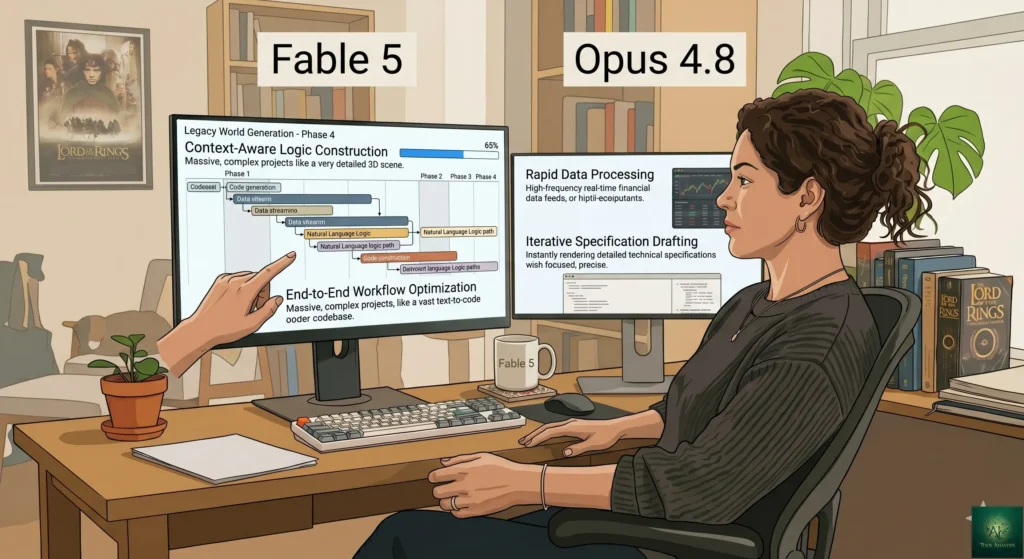
The verdict on this matchup: reach for Fable 5 when the task is big, sprawling, and would normally take many turns to manage. Stick with Opus 4.8 for everyday work, for anything in the flagged safety zones, and whenever you need the comfort of knowing exactly which model is answering. For a broader look at how these tiers fit together, our Claude AI review maps the whole lineup.
Who Should Use This (And Who Shouldn’t)
Choose Fable 5 if you are a developer running large, multi-file migrations or long agentic coding sessions, the kind of work the early partners at GitHub and Stripe were testing. The autonomy on long-horizon tasks is the single best reason to pay the premium.
Choose Fable 5 if you do heavy analytical or document work in finance, legal, or research, where the vision improvements and the 90%-plus analytics scores translate directly into hours saved.
Stick with Opus 4.8 if your work is mostly conversational, short-form writing, or quick coding help. You will not feel the difference, and Opus is already on your plan with no June 23 cliff.
Skip Fable 5 entirely if your work centers on cybersecurity research, offensive security, or biology and chemistry. You will hit the fallback constantly and end up using Opus 4.8 with extra friction. Fable is the wrong tool for those jobs by design.
What Early Users Are Actually Saying
Because Fable 5 launched today, the public conversation is still forming, so treat early reactions as signal rather than settled consensus. The loudest praise is coming from coding-tool companies that had early access. Cursor’s team called it state-of-the-art on their CursorBench and said it opened up a class of long-horizon problems that were previously out of reach. The vibe-coding platform Base44 said it is “much deeper and better at one-shotting full apps,” meaning building a working app from a single prompt.
On the skeptical side, tech press is focused on the safety framing rather than the model itself. TechCrunch noted the launch came just days after Anthropic publicly warned that AI is advancing too fast and urged labs to adopt a coordinated “brake pedal,” a tension several outlets flagged. The other recurring concern is the rollout structure: developers on subscription plans are wary of building on a model that becomes a paid usage-credit feature in under two weeks.
The most useful early consensus: enthusiasm on capability, caution on the fallback unpredictability and the pricing cliff. That matches what the hands-on testing shows.
FAQs: Your Claude Fable 5 Questions Answered
Q: Is there a free version of Claude Fable 5?
A: Sort of, and only briefly. Fable 5 is included free on Pro, Max, Team, and seat-based Enterprise plans from June 9 through June 22, 2026. After June 23 it requires usage credits on those plans. On the API it is paid from day one at $10 input / $50 output per million tokens. There is no permanently free tier.
Q: Why does Claude Fable 5 sometimes give me a different model’s answer?
A: That is the fallback safeguard working as designed. When Fable 5’s safety classifiers detect a topic in cybersecurity, biology, chemistry, or distillation, your request is automatically answered by Opus 4.8 instead, and you are notified. Anthropic says this triggers in fewer than 5% of sessions and tuned it cautiously, so it occasionally catches harmless questions too.
Q: How is Fable 5 different from Mythos 5?
A: They are the same underlying model. The difference is the safeguards. Fable 5 (public) has the cybersecurity, biology, and chemistry guardrails switched on. Mythos 5 (restricted to approved partners like Project Glasswing) has them lifted. The name Fable comes from the Latin for “that which is told,” a quieter cousin of Mythos.
Q: Is my data safe with Fable 5?
A: Anthropic requires 30-day data retention on all Mythos-class traffic, including Fable 5, to catch novel jailbreaks. It says it will not use the data for training, logs all human access, and deletes it after 30 days in nearly all cases. The full safety testing is documented in the model’s system card. If you have strict zero-retention requirements, review the policy before routing sensitive work through Fable.
Q: How does Fable 5 compare to ChatGPT or Gemini?
A: On coding benchmarks, the Mythos-class architecture Fable shares posted scores well ahead of competing frontier models earlier this year (93.9% SWE-bench Verified versus high-80s for rivals). Fable’s edge is largest on long, complex, autonomous tasks. The trade-off is the fallback: competitors do not reroute your security or biology questions to a weaker model the way Fable does.
Q: Can Fable 5 replace a developer or a research scientist?
A: No, but it changes the job. Early partners describe handing it large projects and reviewing finished work rather than supervising every step. It compresses time dramatically (Stripe’s two-months-in-a-day example), but it still needs a skilled human to set direction, judge output, and catch the things benchmarks miss.
Q: What is the learning curve?
A: Almost none. If you use Claude already, Fable 5 is a model-picker selection. For developers it is a one-word API change to claude-fable-5. The only thing to learn is when Fable is worth the premium (long tasks) versus when Opus 4.8 is the smarter choice (everything short).
Q: Should I build a production app on Fable 5 right now?
A: On the API, yes, the pricing is stable. On subscription plans, be careful. The free-then-credits switch on June 23 means a subscription-based workflow could change cost structure abruptly. For production, the API path with its fixed per-token pricing is the predictable choice.
Final Verdict

Fable 5 is the real thing: a frontier model that genuinely outclasses everything Anthropic has put in public hands, with its biggest gains exactly where they are hardest to fake, on long, complex, autonomous work. The vision improvements and long-horizon stamina are not marketing, they show up in independent partner testing.
What keeps this Claude Fable 5 review from being a straight rave is the asterisk. The fallback to Opus 4.8 is sensible safety engineering, but it quietly removes Fable from entire categories of work and introduces unpredictability you cannot plan around. And the subscription pricing is a 13-day free window wearing the costume of a plan feature, with a usage-credit cliff on June 23 and no committed date for resolution.
Exceptional frontier capability on long-horizon work, with a half-point held back for the fallback unpredictability and the murky post-June-23 pricing.
✅ What We Liked
- ✓ Best-in-class autonomy on long, multi-step tasks (Stripe: ~2 months of work in a day)
- ✓ State-of-the-art vision — reads dense charts and rebuilds apps from screenshots
- ✓ First model past 90% on Hex’s analytics benchmark
- ✓ More token-efficient than past Claude models
- ✓ Free to try on paid plans through June 22
❌ What Fell Short
- ✗ Quietly reroutes cybersecurity, biology, and chemistry queries to Opus 4.8
- ✗ Classifier false positives make output unpredictable in borderline fields
- ✗ Free window is only 13 days, with a usage-credit cliff on June 23
- ✗ 30-day data retention required on all Mythos-class traffic
Use Fable 5 if you have large, sprawling tasks and want frontier autonomy, and grab the free window to evaluate it now. Stick with Opus 4.8 if your work is short-form, conversational, or touches the flagged safety zones. Rating: 4.5 out of 5, with the half-point held back not for capability, which is exceptional, but for the fallback unpredictability and the murky post-June 23 pricing that make it hard to commit to today.
Try it before the deadline: select Fable 5 in your Claude plan, or use claude-fable-5 via the Claude API.
Founder of AI Tool Analysis. Reads every pricing page, help article and footnote so you don’t have to. Covering AI tools since 2025. See how we research →
Stay Updated on AI Model Launches
Don’t miss the next major model. Subscribe for honest AI tool reviews, price drop alerts, and breaking feature launches every Thursday at 9 AM EST.
- ✅ Sourced Reviews: Every price and limit checked against the vendor’s own pages, not rewritten from press releases
- ✅ Price Tracking: Know when tools drop prices or add free tiers
- ✅ Feature Launches: Major updates covered within days
- ✅ Comparison Updates: As the market shifts, we update our verdicts
- ✅ No Hype: Just the AI news that actually matters for your work
Free, unsubscribe anytime.
Want AI insights? Sign up for the AI Tool Analysis weekly briefing.
Newsletter

Related Reading
Explore more of our Claude and frontier-model coverage:
- Claude AI Review 2026: Opus 4.8 and the Full Model Lineup
- Claude Mythos Preview: The Most Powerful AI You Can’t Use
- Claude Code Review: Voice Mode, Loops, and 1M Context
- Claude in Excel Review: The AI Spreadsheet Agent
- Claude Computer Use Review: Can AI Run Your Desktop?
- Workspace Intelligence Review: AI Across Your Whole Workspace
- Claude Code Plugins Review: 9,000+ Extensions
Last Updated: June 9, 2026
Model Tested: Claude Fable 5 (claude-fable-5), launch build
Next Review Update: By June 23, 2026 (post-free-window pricing)
Have a tool you want us to review? Suggest it here | Questions? Contact us